


Justin Wolfers from Platypus Economics thinks the Pentagon’s estimate of the Iran war’s cost — $29 billion so far — barely scratches the surface. The cost of missiles, drones, and interceptors tell an incomplete story. In true professor fashion, he walks us through where the other billions are hiding: turbulent markets, oil shocks, supply chains, and the economic ripple effects already reaching your wallet. A crash course in long division, global panic, and the price of war.
Editor’s note:
This war is already hitting your wallet, whether you realize it or not. So we brought in one of the best economists in the business to break down exactly how much the Iran war is costing you.
Subscribe for notifications to join our next livestream!
The latest news at this hour:
By: Oleksandra Khelemendyk
U.S. AND IRAN EXCHANGE STRIKES AMID PEACE TALKS: On Thursday, Iran launched a missile at a U.S. base in Kuwait, following overnight strikes launched by both the U.S. and Iran.
This came after a series of strikes on Wednesday, when U.S. forces downed four Iranian attack drones near the Strait of Hormuz and then attacked an Iranian ground control station in the port city of Bandar Abbas, Reuters reported. Anonymous U.S. officials said that these actions were purely defensive and not intended to undermine the ceasefire.
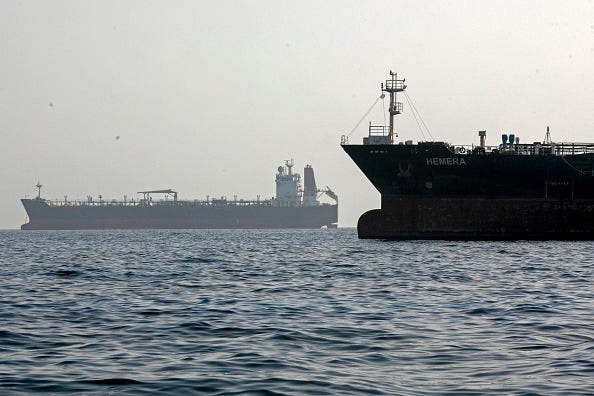
Two hours later, Iranian state media reported that the IRGC carried out a retaliatory strike on an American air base in Kuwait that allegedly was a source of the drone attack. Kuwait confirmed that it intercepted Iranian drones and missiles, with its foreign ministry calling the attack a “dangerous escalation” of tensions in the region. Iranian forces also attacked four vessels in the Hormuz Strait on their way to the Persian Gulf.
After the series of strikes between the U.S. and Iran, the Brent crude oil global benchmark rose by 3.75% to $97.83 a barrel, while U.S.-traded oil jumped by 4% to $92.22.
TRUMP THREATENS TO “BLOW UP” OMAN: Donald Trump made a threat to “blow up” Oman, a U.S. ally, if the country didn’t “behave just like everybody else”. This came after Oman and Iran discussed a plan for charging ships tolls for passing through the Strait of Hormuz. However, some are speculating that the president may have misspoken, but the White House has offered no clarification.
Oman had long-standing economic and military ties with the U.S., has played a part in mediation talks during the Iran war, and itself suffered attacks from Iran. Esmaeil Baqaei, spokesperson for Iran’s Ministry of Foreign Affairs, condemned the threats and expressed solidarity with Oman.
NEW HORMUZ STRAIT AUTHORITY UNDER U.S. SANCTIONS: The Persian Gulf Strait Authority, established by the IRGC on May 5 to issue permits and regulate maritime traffic through the Hormuz Strait, was added to a U.S. Treasury sanctions list. Last month, the institution introduced new rules for crossing the strait and issued a questionnaire with more than 40 points necessary to apply for a permit.
CNN cites the statement U.S. Treasury made on Wednesday, which said that through the Persian Gulf Strait Authority, the IRGC has aimed to “monetize its campaign of state-sponsored terror.”
U.S. DOLLAR INCHES UP: The U.S. dollar rose slightly on Thursday after reaching its strongest point since April.
As the war in the Middle East is driving oil prices up, demand for the U.S. currency is growing among oil importers. Currently, doubts over prospects of a deal to reopen the Strait of Hormuz may cause U.S. interest rate hikes.
FIRST ISRAELI STRIKES ON BEIRUT IN WEEKS: An Israeli source told CNN that Israel targeted a commander of Hezbollah’s missile unit on Thursday afternoon. This strike, coordinated with the U.S., was the first targeting of Beirut since early May, when the IDF claimed to have killed the commander of Hezbollah’s elite Radwan force, Ahmed Ali Balout.
A few hours earlier, The Guardian reported at least twelve casualties of Israeli attacks on Thursday in southern Lebanon. Local media wrote that a family of six people, including children, died in a drone strike on the Adloun Highway in the Nabi Sari area while trying to flee to safety. Others were killed in the cities of Tyre and Sidon, where the IDF claimed to have targeted sites used by Hezbollah. In total, over 135 targets were hit over the past 24 hours.
The attacks came ahead of security talks between Lebanese and Israeli military officials, planned for tomorrow in Washington. On 17 April, both sides attempted to establish a ceasefire, but the attacks have only intensified.
Every day of the Iran war feels like another surprise. Want succinct, reputable roundups to land in your inbox?
Have a friend who would appreciate an independent roundup of the latest in the Iran war? Send this post to them!
Stay safe out there!
Best,
Jacqueline and Oleksandra


