

At the bottom of this page: Latest news at this hour.
Iran seized two ships after the U.S. extended the ceasefire.… U.S. intercepts three Iranian tankers.…Senate rejects Iran war powers bill for fifth time..… Second Lebanon-Israel talks set in Washington.… Lebanese journalist Amal Khalil killed in Israeli airstrike.
Editor’s note:
At Iran War Dispatches, we are delivering something rare: firsthand accounts of civilian life inside wartime Iran. As the country remains under near-total internet blackout, even basic communication is restricted, making this reporting harder by the day.
Support our gritty, independent journalism! Subscribe today for free!
OUR LEAD STORY:
YEREVAN, Armenia— When the explosions began in Tehran on the last day of February, Maryam and the other women in her dormitory didn’t run to the nearest bomb shelter — there wasn’t one. Instead, they crowded into the bathroom, hoping it would protect them.
“Come to the bathroom, please, don’t stay there,” she remembered telling her friends. The reason was simple: the bathroom had no windows that might shatter.
All three of her friends who were nearby cramped into one small bathroom, where they stayed for more than an hour, counting the strikes in fear and panic.
Throughout the three weeks she spent in wartime Iran, Maryam, 35, sheltered under stairs, parking lots, and any other place she found a little safer.
“It is just a chance,” Maryam said. “You have to be lucky to be alive in Tehran during the strikes.”
Since the start of the war, 3,636 people have been killed in Iran, according to the U.S.-based rights group HRANA. Of those,1,701 are civilians.
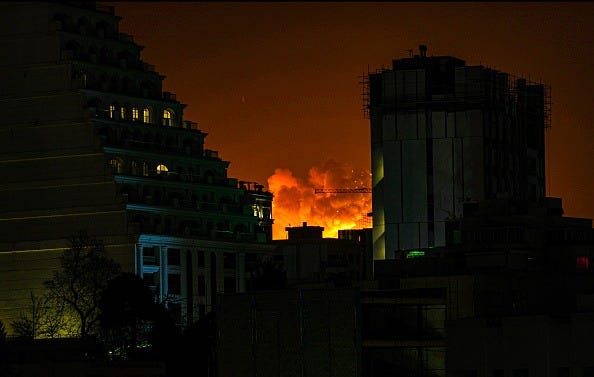
In many countries, living through war means spending large chunks of time in designated bomb shelters. But in Iran, those shelters hardly exist for civilians.
Since Donald Trump extended the ceasefire with Iran, and since the world awaits further peace negotiations, civilians across Iran are left in limbo — unsure if the fighting will resume or if the ceasefire will hold. It’s nearly impossible to make a safety plan, as they are tasked with the challenge of finding a shelter on their own.
Threats by Donald Trump to destroy infrastructure, coupled with the absence of infrastructure in Iran to protect and inform civilians on incoming attacks, are making people like Maryam doubt her own safety.
“Israel, at least, has bomb shelters for its citizens, so they are more ready in that sense,” Maryam said.
Israel has built an extensive system for civilian protection: since the early 1990s, all new residential buildings have been required to include safe rooms (mamad) which are designed to be reached within seconds of alert, alongside public bomb shelters.
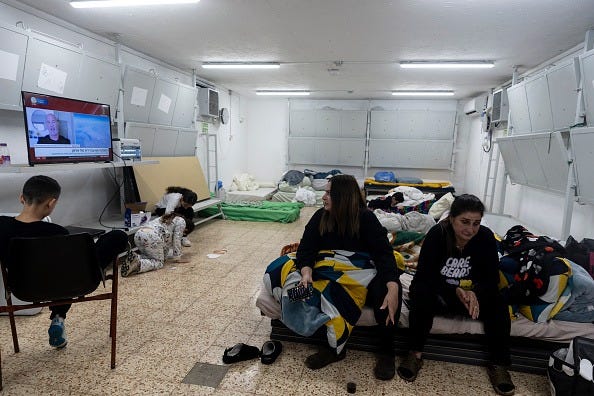
While decisions about war are made at the highest levels, it is ordinary people in Iran, who are left without the most basic protections and are forced to live through attacks with nowhere to seek shelter.
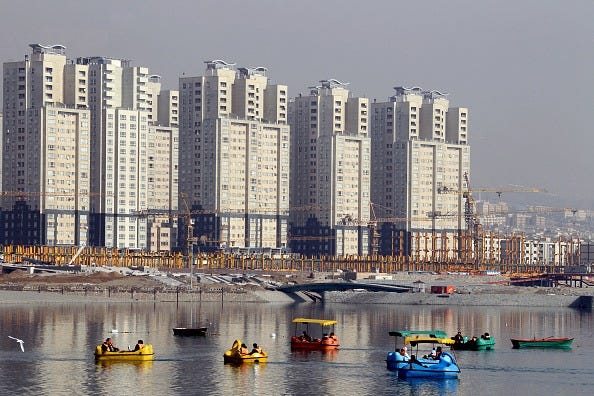
In Iran, Maryam had been living and working in Sa’adat Abad, a wealthy district in northern Tehran, where she was employed at a brokerage company. When the attacks began while she was at work, she had to run to the building’s underground parking with her colleagues, one of the few spaces that offered some protection.
“There is nothing designed to be a shelter,” she said. “If you are lucky, your building has a parking lot where you can hide. But not all of them have it.”
Unlike the Iran-Iraq war she heard about from her parents, Maryam said there were no warning sirens this time around.
Government channels, she said, provided little timely information about incoming strikes or targeted areas.
At the end of January, the head of the Tehran Crisis Management Organization stated that 82 metro stations and 300 other underground spaces across Tehran have been officially designated as potential shelters, capable of sheltering 2.5 million people, according to Anadolu news agency. But Maryam finds this advice impractical for Tehran, a city with a population around 10 million, particularly as these stations can be miles away from residential buildings.
“The government channels also never mention where and when the strikes are happening,” she said. “They are very bad with this.”
In the absence of reliable official information, many people turned to informal sources. According to Maryam, the most accurate information on strikes is on Vahid Online, a widely followed citizen-run news channel on the social media platform Telegram. Information there is often based on user submissions, which is not always verifiable, but sometimes the only available source of real-time updates. It also requires internet access, something that the average Iranian doesn’t have right now.
Maryam describes a disparity in access to shelter across different parts of Tehran.
According to her, areas associated with members of Iran’s Islamic Revolutionary Guard Corps (IRGC), including the Chitgar neighborhood in Tehran, are equipped with modern infrastructure and shelters. She learned about these facilities through her colleague’s brother, who moved to Chitgar after joining the IRGC. But those are closed complexes, inaccessible to civilians seeking safety.
“The safest buildings are there,” she said. “Those are the people the government cares about.”
Like during the coronavirus pandemic, she said, people were left to navigate the crisis only on their own.
If the Islamic Republic is in a conflict, one they know is inevitable, Maryam believes it is a moral obligation to also make sure their citizens have protection.
Now, she questions the state’s priorities, pointing to Iran’s involvement in regional conflicts and support for armed groups abroad.
“It sponsors military groups in Lebanon, Iraq, Yemen, and somehow there are no resources for its own people,” she said. “If you are arming everyone, you should at least think about shelters.”
Maryam felt she was lucky to survive the first few weeks of the war and left the country at the first chance she got to neighboring Armenia, arriving after a 24-hour journey on March 20.
Even in Yerevan the fear and trauma of the bombings hasn’t left her.
“Even when I hear the loud noise of a big truck passing by, I get scared. The planes flying always make me wonder if there is any attack, then I remember I’m not in Iran anymore,” Maryam said.
Leaving the country was not a simple decision for her. She was in the last semester of her master’s degree, studying art history at a university which she fought very hard to enter, when she had to pack her whole life into two suitcases.
War was not the only aspect of struggle for Maryam in Iran. As a divorcee, she had to fight in lengthy legal battles to get her right to her independence back.
After her divorce, Maryam spent three years trying to obtain permission to travel independently.
During her five-year marriage, she said, she was not allowed to work or study. And only recently did she regain the ability to leave the country on her own.
By the time the war escalated, she had both the legal permission and the determination to leave.
Maryam never supported the war.
“Some people wanted it,” she said. “They thought maybe it would weaken the government. I never did. I can’t be happy that my country is being bombed.”
Editor’s note:
At Iran War Dispatches, we are delivering something rare: firsthand accounts of civilian life inside wartime Iran. As the country remains under near-total internet blackout, even basic communication is restricted, making this reporting harder by the day.
Support our gritty, independent journalism! Subscribe today for free!
THE LATEST NEWS AT THIS HOUR:
By: Serafima Melnychuk and Kateryna Antonenko
IRAN SEIZED TWO SHIPS AFTER U.S. EXTENDED CEASEFIRE: Iran seized two ships in the Strait of Hormuz last night, just hours after Trump extended the ceasefire. Iranian state TV broadcasted a video of Iranian masked forces boarding a grey speedboat heading towards the MSC Francesca ship, then climbing a rope ladder into the hull of the ship. The video showed another vessel named Epaminondas. Iran claimed it had seized two ships earlier in the week, accusing them of attempting to cross the strait without prior approval.
U.S. INTERCEPTED THREE IRANIAN TANKERS: As reported by shipping and security experts on Wednesday, the U.S. military has intercepted three Iranian vessels in Asian waters and is forcing them away from regions near India, Malaysia, and Sri Lanka. The United States has diverted at least three more Iranian oil tankers bearing Iran’s flag in recent days, Reuters reported.
SECOND LEBANON-ISRAEL TALKS SET IN WASHINGTON: The discussions between Lebanese and Israeli diplomats will be held in Washington to address the border dispute between the two countries. The second round of negotiations is planned for Thursday as a means of extending the Israel-Lebanon ceasefire.
According to the U.S. Department of State, the ceasefire agreement could be extended through the negotiations between Lebanon and Israel.
SENATE REJECTED IRAN WAR POWERS BILL FOR FIFTH TIME: The U.S. Senate again failed to advance legislation requiring congressional approval for military action against Iran. The vote was 46 to 51, which is consistent with the last four failed votes.
…MEANWHILE U.S. NAVY SECRETARY FIRED AMID U.S. BLOCKADE: John Phelan who served as U.S. Navy Secretary was fired on Wednesday without explanation. Defense Secretary Pete Hegseth has been removing Pentagon leaders, defying the administration — tensions reportedly centered around the approach on the shipbuilding program, NBC reported. Trump and Phelan had historically disagreed over Trump’s naval initiative and ship deployment.
His exit comes as 21 US warships operate in the region, enforcing the blockade of Iranian ports.
LEBANESE JOURNALIST AMAL KHALIL KILLED IN ISRAELI AIRSTRIKE: Lebanese journalist Amal Khalil was killed Wednesday in an Israeli airstrike on the southern village of al-Tiri, according to her newspaper Al-Akhbar. Rescuers came under fire from Israeli forces while trying to reach her. Another journalist, Zainab Faraj, was taken to hospital by a Lebanese Red Cross team.
Stay safe out there!
Best,
Arpine
Thanks for this story. I appreciate Maryam's voice in this conflict. It is the people of Iran who have a double whammy from their own government and from Trump. I wish her the best of luck in Armenia, or wherever she may end up.
As usual he lied. He said he wanted to free the Iranian people but he’s killing them. Typical of him.