
By: Mohammad
At the bottom of this page: Latest news at this hour.
Day 1 of Khamenei’s week-long funeral takes place... Israel may have planned to kill Tehran’s key negotiators... France, UK and Oman agree to ensure security in Hormuz Strait... Over 640k Lebanese return home.
Editor’s note:
Today’s story comes from a reporter who is remaining anonymous for security reasons. This kind of reporting requires trust, access, and real personal risk. But we believe these stories need to be told.
If you want more deeply reported human-interest stories like this in your inbox, subscribe for free today!
And if you want to help keep our journalism alive, please consider upgrading to a paid subscription.
OUR LEAD STORY:
“They’re bombing Tehran. My mother is alone. I have to leave Hormuz,” Nader’s friend said to him on the phone, his voice laced with an unmistakable panic.
The phone call came out of nowhere. Nader’s fingers were frozen on his hang drum. The flames of the bonfire he was sitting by licked his body, yet the call had left him cold. He hadn’t even processed the news before he heard himself respond: “Wait, we’re coming with you.” He picked up his instruments, and started packing.
That was February 28th — the first day U.S. and Israeli forces bombed Iran. But now, four months later, the world is watching the Strait of Hormuz again become the indicator of rising tensions. Washington and Tehran signed a memorandum of understanding that called for a ceasefire on all fronts — including in Lebanon. Citing a breach of that agreement and continued Israeli attacks on Lebanon, Iran said it closed the Strait of Hormuz on June 20, warning that vessels using unauthorized routes faced security risks. Just over a week after the MoU was signed, an Iranian drone struck a Panama-flagged vessel in the strait. The next day, the U.S. struck targets in Iran. All eyes are on the Strait of Hormuz, which is responsible for about one fifth of the world’s oil and gas transports.
But for Nader and a small group of his fellow campers on Hormuz Island, this is nothing new. Months ago, when airstrikes first arrived in February, they were forced to pack up and leave as locals tried to get rid of potential spies. But instead of breaking, they hid in houses and turned their shared meals, music, and art into acts of defiance against the fear of war as explosions echoed — insisting that their community would not be demolished as easily as their campsites. For anyone who has ever faced fear, displacement, or crisis, this story is not just about surviving war in Iran — it’s about how everyday life can become resistance when the world feels like it’s ending.
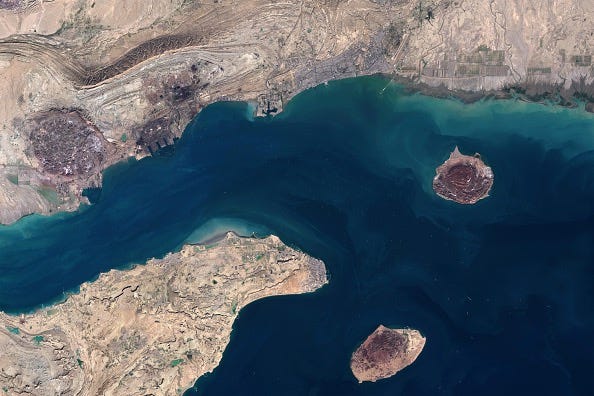
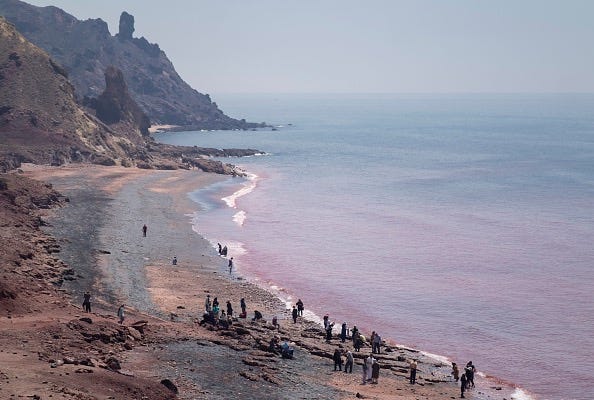
For years, the smear of red and purple earth in the Strait of Hormuz had been a refuge for backpackers, artists and vagabonds — one of the few places in Iran where you could camp on the beach, dance under the stars and almost feel free. Its psychedelic landscape of rainbow hills and caves against turquoise water, open sky, and fresh air have made it a place that keeps drawing artists and hipsters who come to breathe, paint, and escape the noise of the world. Tourism had also built a quiet economy: ferries, guesthouses, food stalls, and small shops lined along the harbor.
Nader, a middle-aged web designer and DJ from northern Iran, had already paid a price for his activism. During the September 2022 protests that erupted after the death of Mahsa Amini — a 22-year-old Kurdish woman who died in police custody after being arrested for not following dress code — he was jailed for marching against the government. After his release, he spent three years drifting — mixing tracks, building a music website, and camping across Iran and neighboring countries with artists and fellow wanderers who, like him, had decided the open road was safer than a fixed address.
On December 22, 2025, he pitched his tent on Hormuz Island. It was a pleasant season and the island was full with 700 to 800 travelers (he estimates). After unrest in January, when Iran’s government fatally crushed economic protests across the country, the internet was cut and the mood curdled. Protests flared in nearby towns, but the island stayed quiet, tense, and watchful. Nader rented a house with his girlfriend in the rather urban part of Hormuz on February 16 — 12 days before the war — and went back to the camp after a few days.
Nader didn’t like to check the news because the news is what led him to pay a price for protesting the government years ago. “I was jailed because of checking the news so I’m trying not to be affected by the news anymore,” he said. Nevertheless, on February 28, he saw the war upfront. “We got a call from a friend saying the war had begun and he had to go to his mother in Tehran, so we packed up and went back to the house.” They were shocked and wondering whether they should stay or leave the island.
The mood on Hormuz shifted overnight. Local patriots, feeling deeply loyal to their country, were mourning Ayatollah Ali Khamenei’s assassination. On the island, one question hardened into suspicion: “Who are all these outsiders camping on our shores? There are spies among them,” Nader recalls words from the high clergy of Hormuz as he discussed the situation. The police, plainclothes officers and locals began clearing the island of non-natives.
They went from campsite to campsite, door to door, jumping walls, dragging people out, and loading them onto boats, sometimes without their belongings, Nader explained. “’You can coordinate someone to pick them up later,’ that was the response locals gave to travelers who wanted more time to pack up their items,” Nader recalled.
Nader and his friends tried to disappear. Curtains drawn, voices low, skulking through the city’s quiet alleyways in ones and twos. On Chaharshanbeh Suri, the Persian Festival of Fire, which was celebrated on March 17 this year, an old man started asking them questions as they walked out of the house. “’Who are you? Why do you look like this?’ He was suddenly asking questions. Anyone would feel allowed to pick at us,” Nader recalled.
At first, fear was paralyzing: no money, no guarantee against bombs or forced evacuations, no rest from worrying someone would jump over the wall mid jam session. Yet, as the outside became harsher, something inside softened.
“From the very first days, we started to foster a community, getting together, playing music and having fun in the midst of the thudding explosions,” he said. “Someone would play an instrument, another would paint, and another would make handcrafts. Someone would surprise everyone with a pot of homemade food.”
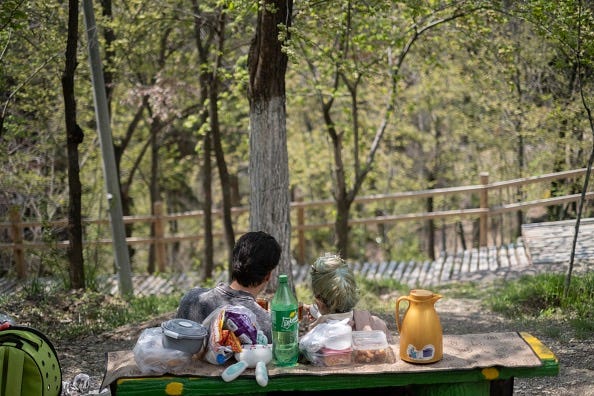
Each night, 15 to 20 people packed into a house, cooking delicious dishes for each other and dancing and playing music. Tourism evaporated overnight, prices climbed, ferries stopped coming and ingredients ran thin. Yet, they stretched everything further and cooked qorme sabzi, qeyme, sabzi polo and several other dishes Iranian and otherwise. In a place where food and hospitality already carry deep cultural weight, these dinners became their resistance: a way of saying that their community would not be demolished as easily as campsites.
One day IRGC officers knocked on the door, checked the foreigners’ visas, and left again, Nader recalled. He said they were more formal and respectful than the local police, there simply to document who remained since no system existed to track people on the island.
As Nader recalls, airstrikes hit nearby mountains. Tens of kilometers away, explosions rattled windows. According to ISNA, a semi-official Iranian news agency, a sea ambulance was struck on approach to Hormuz on March 11.
The pattern of U.S. and Israeli airstrikes, as the travelers saw it, was chilling: these were targets that fuelled the everyday civilians’ lives, not military targets.
On Qeshm Island, Nader recalled bombs ripping through fishing piers where families earned their living. “The same happened on Hengam Island,” he said. Similar accounts of attacks on Qeshm Island were reported by ISNA, a semi-official Iran-affiliated news agency.
According to Nader, a tanker ran aground in mid-March trying to slip through the strait; when the high clergy deemed its cargo spoils of war, locals looted it.
Emotions swung violently. At times everyone was laughing, cooking, and feeling ecstatic by the sound of daf, dotar and other Iranian instruments; minutes later, someone dissolved into tears. “The emotions were at extremes — peaks of sorrow and joy, serenity and anxiety,” Nader said. The day Nader learned two friends had been killed in airstrikes on Qeshm, about a week into the war, the cooking stopped for a while. Many began to question what the point of staying was when they couldn’t even go to the beach.
One night, a friend played a melody under a verse from a Rumi poem: “Don’t be disappointed when not called by the Beloved. Being pushed away today doesn’t mean you won’t be called tomorrow.” The line landed differently when no one knew if tomorrow would come.
Travelers left, one by one, kicked out or quietly gone. From an estimated 700 before the January unrest, Nader said it felt as though the number dwindled down to 20 by the Persian New Year. The community shrank, but for those who stayed the bond thickened.
Amid the chaos, small signs anchored them. In the yard stood a sea almond tree; over the course of a week, it suddenly filled out with a thick volume of leaves — a green explosion in the middle of a gray and scarlet war. On an opposing wall, someone had written a sentence: “Neither leave too early, nor cling too much.” The phrase became something like a private mantra for the remaining group.
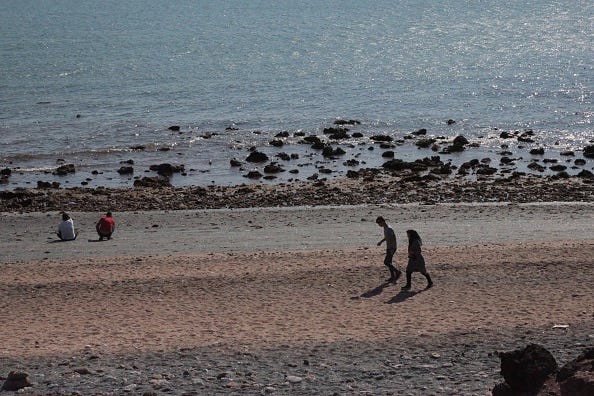
Nowruz arrived on March 21, 2026, almost like a glitch. The air was unexpectedly pleasant, the island pausing. “We felt some kind of relief,” Nader said. They went to the beach and walked on the streets. It felt like borrowing an afternoon from a different life. With the new year, the bombings grew louder, Nader said, but so did rumors of a ceasefire. The group agreed to leave on Sizdah-bedar — the thirteenth day of the year when Iranians traditionally go outdoors to cast out bad luck. This time, it felt like sending themselves away before fate did it for them.
The day before their departure, as they were packing up, Nader felt hit by the war despite all the efforts. A call came from who he believed was Qeshm’s police department: his car, his only material possession, had been damaged in a bombing. His girlfriend was shattered by the news; Nader tried to reassure her with a kind of stubborn faith that “like everything in life, this too must be good somehow.” Everyone felt empathy for him, but he left the group to be on his own and send gratitude to the universe. “I didn’t even want to see my car,” he said.
The next day, they took a boat to Qeshm Island as a column of smoke climbed hundreds of meters into the air.
As they arrived at Qeshm, what they saw was apocalyptic. Cars and shops were burning, streets were quarantined and military forces were everywhere. The ferryman begged them to hurry. At first, the soldiers’ voices were harsh, but they relented and helped Nader reach his vehicle, which, to his surprise, was damaged but still in one piece. The soldiers warned that another explosion could come at any moment.
The car was still badly damaged — no glass, no windshield, its body twisted and scarred. It wouldn’t start. With his girlfriend weeping and his friends screaming at him to move faster, two soldiers leaned in and helped push the car until the engine finally coughed to life and they rolled away from the danger zone. Later, a repairman brought it back to life.
On Qeshm, Nader and his girlfriend visited a friend. One day, they went to the beach, and a bomb fell close to them, Nader told Iran War Dispatches. They packed up and went back to the house, playing games and pretending once more that there was no war.
On April 6, 2026, Donald Trump announced to the world that “a whole civilization will die tonight.” Nader’s family flooded his phone from another city in Iran, asking if he was insane to stay on Qeshm Island. He and his companions kept playing games and music, trying to ignore the push notifications of history. Then, almost anticlimactically, on April 8, 2026, the news of a ceasefire came through.
A number of people in Nader’s life suffered. One friend’s house was destroyed in a strike, forcing the family into a hotel provided by the government, according to Nader. Many islanders, already living on the edge, were pushed into deeper poverty as the island’s economic conditions worsened. “The day after the ceasefire, we left Qeshm,” Nader said. “We explored Shiraz, Khoozestan, Lorestan, Kordestan and headed back toward Tehran and Guilan,” he added. “It was wonderful. Definitely difficult, but it unfolded like a movie that keeps you on the edge of your seat.”
What Nader and his friends did wasn’t just survival — it was defiance. These were people raised on poets like Rumi, hardened by U.S. sanctions, with little left to lose and a deep instinct for beauty.
“Now, I’m back in my hometown, selecting music for my mixes. But I’m flabbergasted by the prices. They’ve skyrocketed. This war made everything worse,” Nader said.
“But I’m always content with my condition, and I try to build my resilience. That’s what makes me have a happy life.”
Editor’s note:
Today’s story comes from a reporter who is remaining anonymous for security reasons. This kind of reporting requires trust, access, and real personal risk. But we believe these stories need to be told.
If you want more deeply reported human-interest stories like this in your inbox, subscribe for free today!
And if you want to help keep our journalism alive, please consider upgrading to a paid subscription.
THE LATEST NEWS AT THIS HOUR:
By: Oleksandra Poda
DAY 1 OF KHAMENEI’S WEEK-LONG FUNERAL TAKES PLACE: On July 4, Iran began a week-long state funeral for Supreme Leader Ali Khamenei, who was killed on the first day of the war, February 28, 2026, during the U.S. and Israel bombardment of Tehran.
Between 15 and 20 million people are expected to pay their respects during the funeral ceremonies, during which the coffins of Khamenei and his family members will be displayed. Delegations from around 100 countries are attending, including senior officials from China and India. Former Russian president Medvedev is also present at the funeral.
Fearing a possible Israeli attack on the procession, Iran will close Tehran’s airspace on July 6, the day of the main funeral ceremonies. The U.S. has agreed to pause negotiations with Iran for one week during the mourning period. The next round of talks is scheduled for July 9.
ISRAEL MAY HAVE PLANNED TO KILL TEHRAN’S KEY NEGOTIATORS: In spring, Washington tried to warn Iran via intermediaries that Israel might assassinate two of Iran’s lead negotiators — Parliamentary Speaker Mohammad Bagher Ghalibaf and Foreign Minister Abbas Araghchi, NYT reported citing U.S. officials.
In the early days of the war, Israel assassinated dozens of senior Iranian political and religious leaders, including the Supreme Leader and the country’s top nuclear scientist.
The U.S. became increasingly concerned about what the consequences of these potential attacks on Ghalibaf and Araghchi could be when negotiations started in April.
Israel has long been against negotiations, and has advocated for harsher action against Iran.
FRANCE, UK AND OMAN AGREE TO ENSURE SECURITY IN HORMUZ STRAIT: On July 3, French President Macron and UK Prime Minister Starmer issued a joint statement announcing an agreement with Oman, in which the three countries will work together to ensure safe transit through the Strait of Hormuz.
The two European nations also declared their readiness to deploy the Multinational Military Mission. The Multinational Military Mission is a coalition of more than 20 countries led by France and the UK, who have affirmed their “commitment to using collective diplomatic, economic, and military capabilities to support freedom of navigation through the Strait of Hormuz.”
The European initiative comes in direct response to a parallel agreement between Iran and Oman, under which the two countries are developing a new system to jointly control the Hormuz Strait. Initially it seemed as though the two countries might charge vessels fees. This was largely seen as controversial since international maritime law prohibits charging for transit in the way.
Oman is now proposing a system based on the model in place in the Strait of Malacca, in which shipping companies will pay to maintain the strait.
OVER 640K LEBANESE RETURN HOME: As of July 3, over 640,000 internally displaced people in Lebanon have returned home after fleeing due to Israeli attacks on Lebanon, according to the International Organization for Migration (IOM). This follows a U.S.-Iran ceasefire which came into effect on June 21, following the U.S.-Iran memorandum signed on June 17. The agreement was said to stop fighting on all fronts, including Lebanon, however Israeli strikes have continued. Earlier this week, Israel attacked southern Lebanon and carried out home demolitions in the town of Hadatha.
At the same time, around 500,000 people are still unable to return to their homes in Lebanon, due to massive destruction near the country’s southern border.
Stay safe out there!
Best,
Mohammad
Thank you for sharing this story. It serves as a reminder that we are all in this crazy world together! Stay safe.
Agreed! Thank you to the anonymous writer who showed us one person’s life and decisions in a time of surreal conditions. Mental strength and commitment to remain sane and enjoy life when death or catastrophic injury are probable. I doubt I could do anything close.