

At the bottom of this page: Latest news at this hour.
Iran refuses direct negotiations in Islamabad… Two-year delay for LNG infrastructure due to Iranian attacks… Israel kills six Lebanese civilians… U.S. freezes $344 million in crypto over links to Iran… Criticism of Iran’s negotiating team holds back progress.
Editor’s note:
In 2003, Christopher Allbritton, the author of this piece, raised money directly from readers to report from Iraq — the first guy to do fully reader-funded war reporting.
More than two decades later, we’re building Iran War Dispatches on that same model. If you want this kind of work to exist, we need your support..
OUR LEAD STORY:
ERBIL, Iraqi Kurdistan — Iran is talking to Pakistan, Pakistan is talking to Washington, Washington is talking to Israel and Lebanon, and no one is listening to the Kurds. As diplomats head back to Islamabad to restart talks over Trump’s extended ceasefire with Iran, the Strait of Hormuz remains mostly closed, the U.S. blockade remains in place, and Israel and Hezbollah are still trading fire in southern Lebanon. From Erbil, this all looks familiar: Deals negotiated over Kurdish heads, then endured on Kurdish ground.
As of April 23, the Kurdistan Region of Iraq had absorbed more than 732 drone and missile attacks since the U.S.-Israel war against Iran began on February 28, killing 21 people and injuring 99.
The attacks have continued despite the U.S.-Iran ceasefire. On April 19, almost two weeks after Trump declared the ceasefire, strikes on Iranian Kurdish opposition sites in Erbil province killed at least three people and wounded five. A missile strike the previous day killed two female KDPI Peshmerga fighters in Khalifan. The U.S. Consulate in Erbil has also been repeatedly targeted, with multiple drone attacks intercepted nearby.
The Kurds have effectively no air defenses, no seat at the negotiating table, and no way to stop what is becoming an increasingly uncontrolled war from consuming them.
They’ve been here before. And so have I.
The Citadel
Three weeks before the ceasefire, on the first night of Nowruz, I stood at the Citadel of Erbil for the first time in 23 years.
Then, in 2003, this place was run down, dusty, and grim. Men in baggy trousers toting Kalashnikovs were common. Broken-down taxis held together with duct tape and baling wire putt-putted around the city, belching black smoke from rattly tailpipes.
In 2026, though, families mingled in the damp night air, as the smell of kebabs and chai wafted from dozens of little stalls. Luxury car dealerships are common. Everyone carries an iPhone and cops wear uniforms and look bored.
History hangs heavy here; the Citadel, an ancient fortress that looms over the center of Erbil, has been continuously inhabited for something like 6,000 years. That’s longer than Rome, longer than Athens, longer than almost anywhere people have built and rebuilt on the same patch of earth. On the first night of Nowruz 2026, it was draped in strings of fairy lights and crowded with families. Masoud and Masrour Barzani, the former president and current prime minister of Iraqi Kurdistan who are also father and son, lit the traditional Nowruz bonfire at the fortress.
The ongoing Iran war was then three weeks old. Drones had been falling on and around Erbil with increasing regularity, thanks to the local government’s decades of forbearance of armed Iranian Kurdish opposition groups. American interceptor systems lit up the night sky over the American base near the airport. And here were families, out for a walk in the mist, because it was Nowruz, and because it was also Eid al-Fitr, and because the two holidays hadn’t fallen on the same day in who knows how long, and because this is what Kurds do. They celebrate anyway.
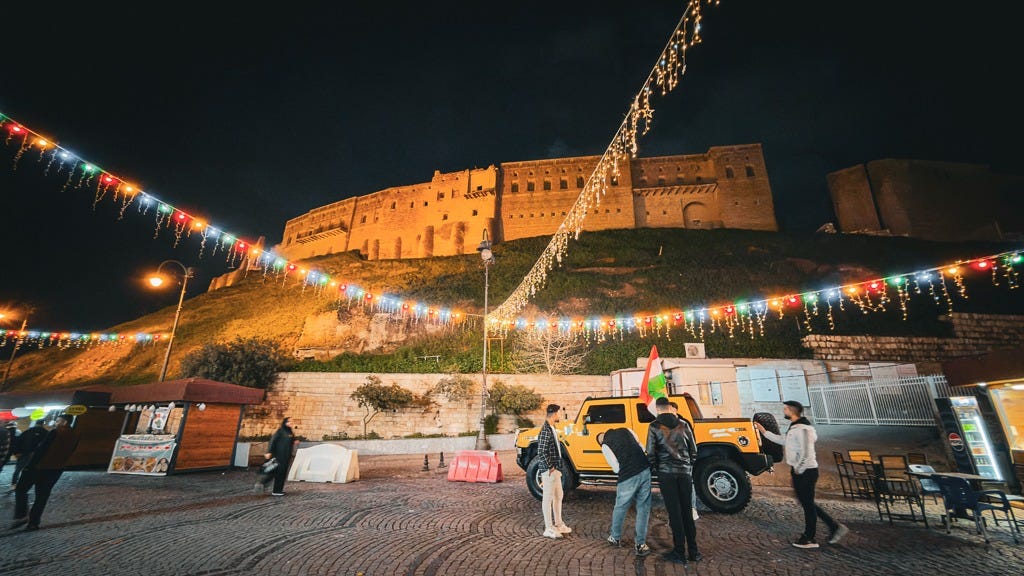
“Weather, or whatever it is, whatever happens, whether it’s political, whether it’s war — for us this is the Kurdish national holiday, it must be done regardless,” said Rayan Zebari, 26, who had come from Akre with his wife Sabreya. “We are proud of this holiday.”
Twenty-three years earlier, almost to the day, I had stood in this same city and watched it erupt in celebration of a different kind.
The Smuggler’s Trail
In April 2003, there was no international airport in Erbil. No luxury car dealerships, no apartment towers called “Park View” and “The Boulevard.” There was a war — a different one — and I was trying to get into Iraq through the back door to cover it.
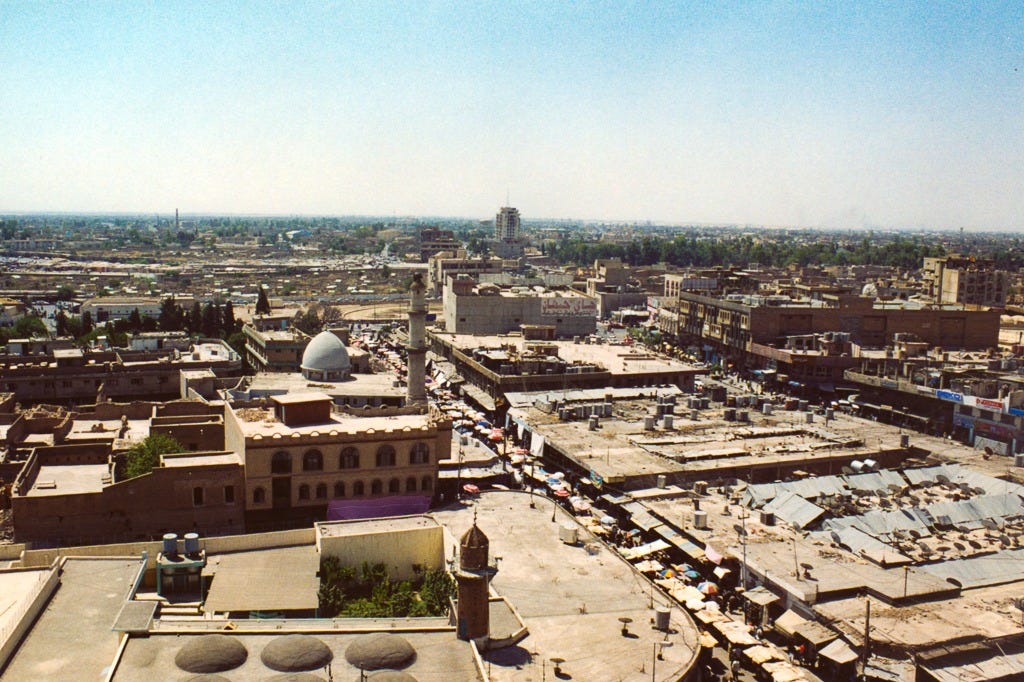
It was a war started on a lie. After the Sept 11, 2001 attacks, the U.S. invaded Afghanistan to topple the Taliban, which it did in fairly short order. The second Bush administration soon turned its eyes to Iraq, claiming Iraqi leader Saddam Hussein was in cahoots with al Qaeda (he wasn’t) and that Iraq was building a nuclear weapon (it wasn’t).
I had raised almost $15,000 from a few hundred readers for my blog, Back-to-Iraq.com, enough to make me the first fully reader-funded war correspondent. I packed a satellite phone, a laptop, a GPS unit, and ran self-hosted blogging software. The plan was to cross the Turkish border into Iraqi Kurdistan on foot.
10 miles from the Iraqi border, sitting in a mountain valley with some Turkish smugglers, I heard the roar of bombers echoing against the mountain walls and the dull thuds of ordnance rolling through the valleys.
That night, we forded a tributary of the Tigris River in the dark and started climbing.
The “travel agent” in Turkey had said we would walk two or three kilometers to a truck after crossing the river’s offshoot. This was a big lie. What followed was a brutal, hallucinatory march through snow and mountains that lasted more than 24 hours — running across a Turkish-lit bridge, scrambling up and down slopes that cut through my skin, sleeping for an hour under camouflage tarps to hide from Turkish snipers.
At one point, at an old mining operation that had taken off the top of a mountain, I gave out. I couldn’t make it and begged our guide, Çimli, to leave me, shoot me, something. It was not one of my finer moments. Instead, he hauled me up by my coat collar and pulled me onto a road.
Our escort on the other side was a peshmerga — a member of the Kurdish armed forces, part guerilla, part soldier — named Abdullah Karim. He was funny and enthusiastic, and offered geopolitical analysis in poor English.
“George Bush: Okaaaaaay!” he said, and gave a big thumbs up. Tony Blair got the same treatment. “Donald Rumsfeld, Colin Powell, Condoleezza Rice,” he said, ticking off their names on his fingers. “Bosch!” But he literally held his nose and sneered when he came to the names of French President Jacques Chirac and German Chancellor Gerhard Schroeder. He even found it in his heart to dis France’s ambassador to the United Nations.
Then he told us about his children. He had five. He ticked them off on his fingers: The Turks killed his first, Iranians the second, Syrians killed his third and the Iraqis killed the fourth. For all the death he had seen, he never seemed embittered, except when it came to Saddam, who ruled Iraq for decades until his capture and execution in 2006.
“Saddam, krrreeeeeek!” he said, drawing a thumb across his throat. “Amrika, Kurdi dost!” America and Kurds, friends.
Erbil, The City That Wasn’t
The Erbil I entered on April 6, 2003, exhausted and filthy after the mountain crossing, was a city on edge.
On the day I arrived, an American F-15E Strike Eagle had just hit a convoy of peshmergas and U.S. Special Forces in a friendly fire incident that killed at least 18 Kurdish fighters and wounded 45, including Wazeri Barzani, a brother of the Kurdish ruling party’s president Massoud Barzani. Also killed was the translator for BBC’s John Simpson. The husk of the BBC’s Range Rover sat outside my hotel, windows blown out, front end torn to hell. Welcome to the war.
The city itself was a fraction of what it would become. The internet cafes were the information lifeline — young Kurds packed into them, glued to Al Jazeera, seeking news of friends or relatives. The sidewalks were cracked but bustling. Merchants tried to refuse my money because I was American. It was unexpected, for sure but the smiles were genuine, and the offers to help were too numerous to accept.
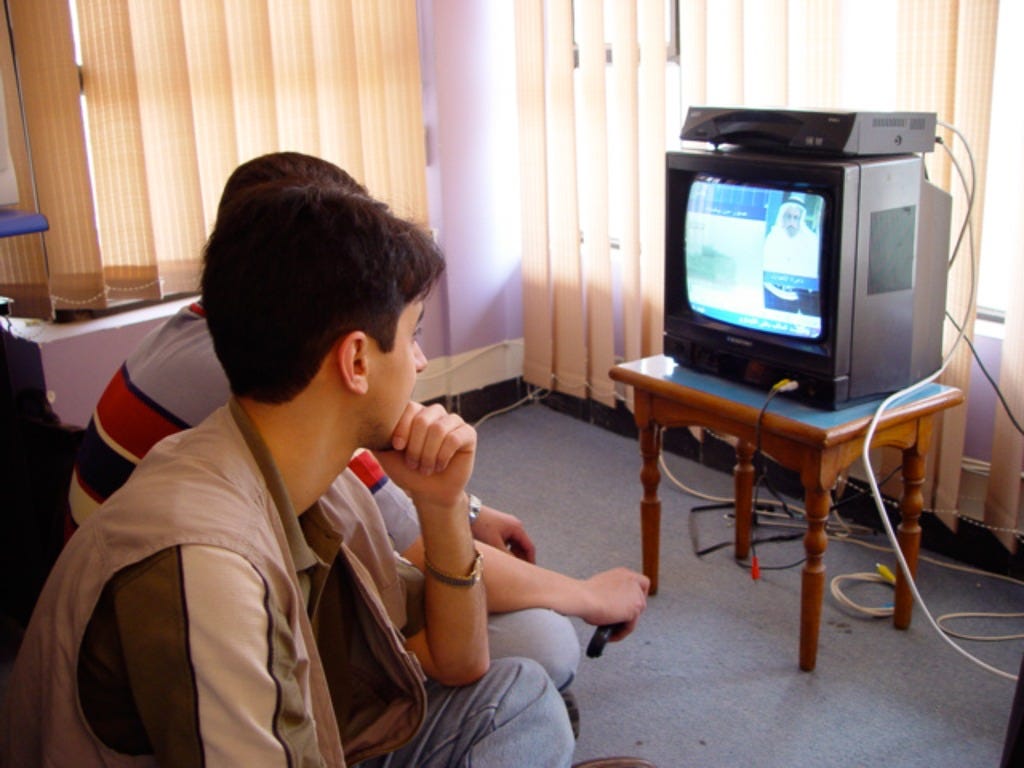
“This may be the only other place on earth — except the USA, of course — where Americans are so well-liked,” I wrote at the time. It was not an exaggeration.
Three days later, I returned from the front near Chamchamal to find the city in full celebration. The U.S. military had entered Baghdad. Saddam’s statues were falling as American soldiers draped them with U.S. flags. Crowds had taken to the streets. It felt, I wrote, like witnessing the Iraqi equivalent of the fall of the Berlin Wall in 1989.
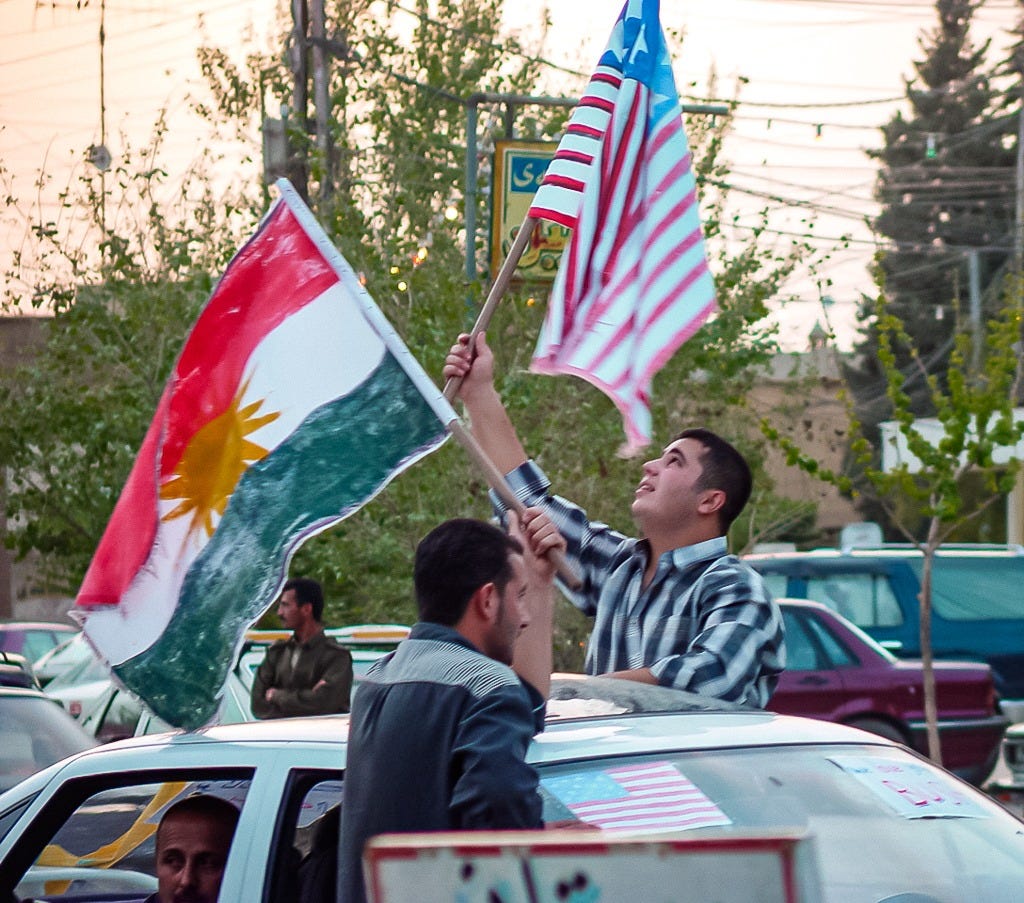
“We are very happy for what is happening in Baghdad,” said Salah Hussen, 36, watching the coverage among a crowd on the street. “We are sorry for the innocent people who are killed and we hope this is finished as soon as possible. But we don’t hope for anything happy for Saddam.”
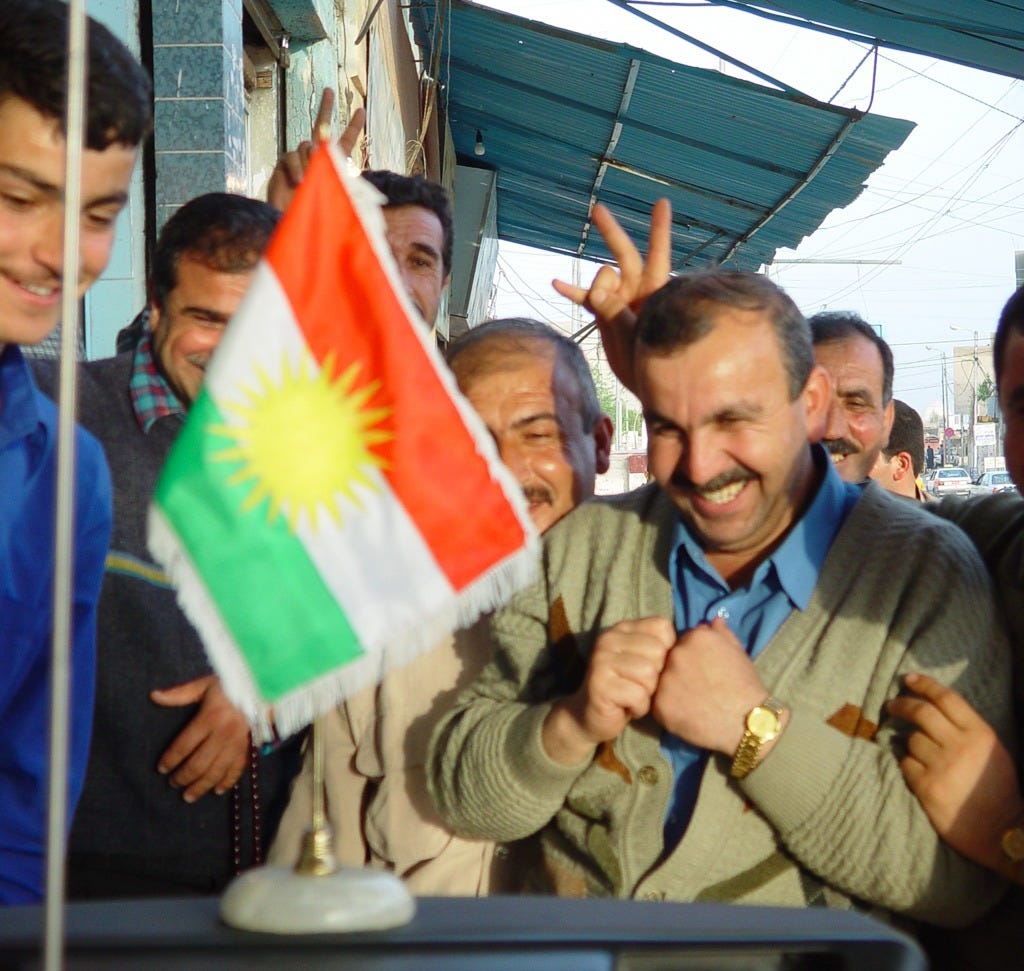
The next day, I rode the highway to Kirkuk with Delshad Fattah, a 33-year-old former resident of the city who found me in Erbil after reading my blog. The road was packed with thousands of vehicles, with people celebrating and hanging off trucks. Armed men waved yellow and green flags, chanting “America!” On the horizon, four thick black plumes of smoke climbed into the sky and the air smelt faintly of burning oil.
Delshad watched people streaming toward the city to loot and shook his head. “This is what Saddam has done to my people,” he said. “He has turned us all into thieves.”
In Kirkuk, the Kurds pulled down a statue of Saddam in the central park — no American troops this time, and that seemed to suit them fine. A peshmerga commander named Jalal Khoshna, born in Kirkuk, returned to find an Arab family living in his old house. He reassured them they could stay until they found a new place. Then he’d like his house back, please.
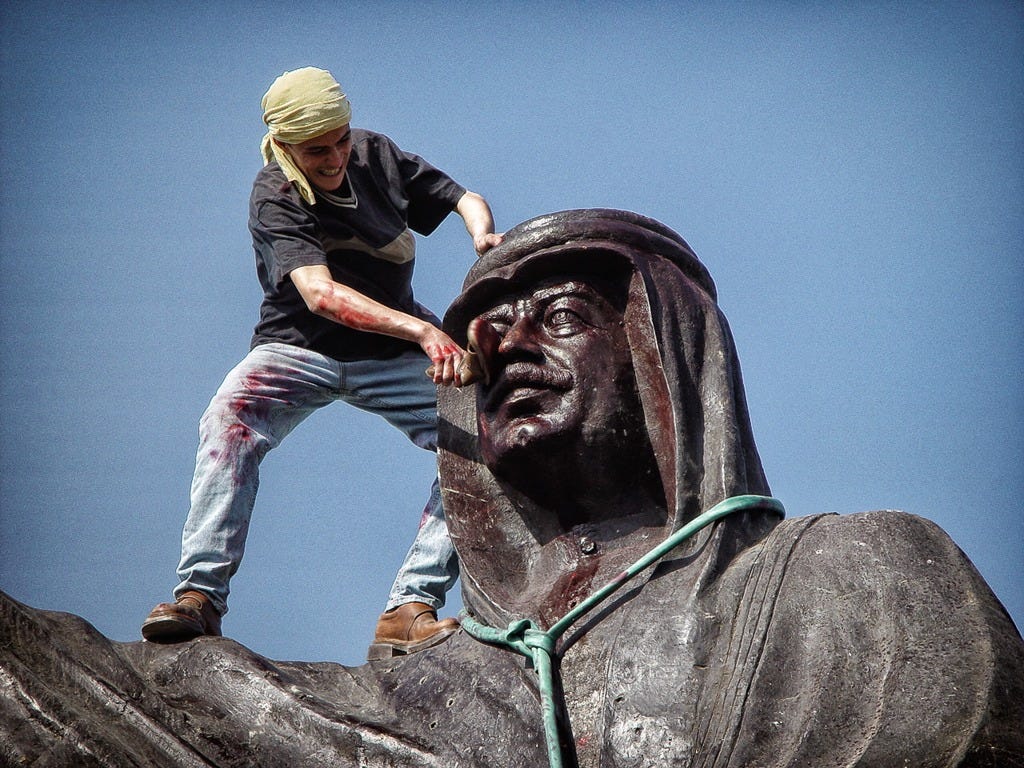
“I feel like I am newly born!” he said.
What Twenty-Three Years Built
In March 2026, I didn’t need smugglers. I took a bus from Batman in Turkey to Silopi, crossed the Turkish border on foot, and was met by my fixer named Mustafa who drove me to a hotel in a city that bore almost no resemblance to the one I’d left in 2003.
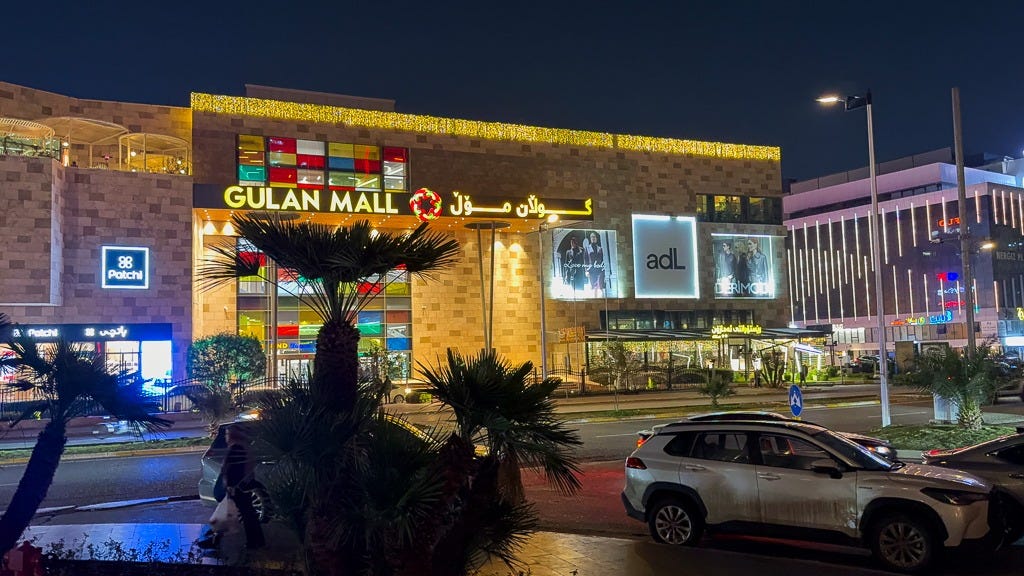
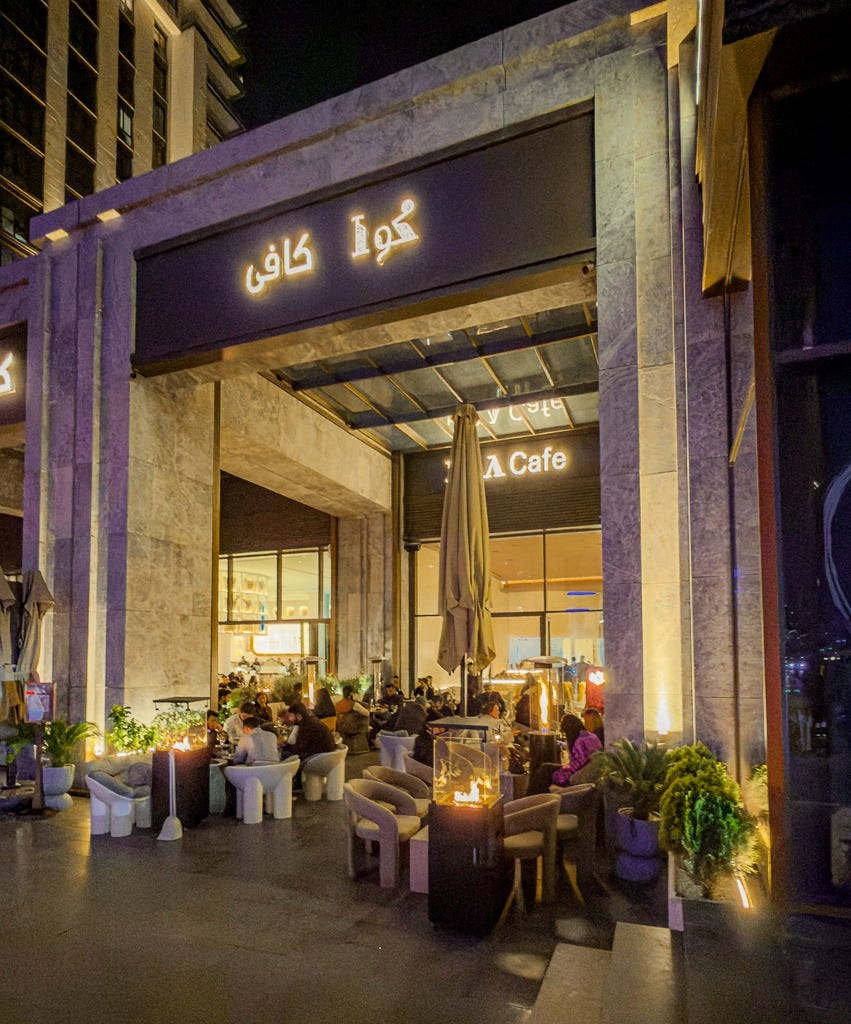
The Erbil of 2026 is a thriving metropolis with an international airport, luxury car dealerships, and a skyline of swank apartment towers. The Citadel, once just the old fortress at the center of a provincial capital, is now a UNESCO World Heritage Site. Twenty-three years of semi-autonomy, oil revenue, and relative stability had built something that would have been unimaginable to the peshmergas I’d marched with in the mountains.
The Kurdistan Regional Government had created a functioning economy, international relationships, a military undergoing genuine reform — 11 divisions under a unified Ministry of Peshmerga Affairs, with party affiliations removed and a unified commander in chief expected within months.
All of it now exists under the shadow of a war that no one here wanted.
Most of the attacks on Kurdish territory target Iranian opposition camps scattered across the mountainous border territory — the Kurdistan Democratic Party of Iran, Komala, the Kurdistan Freedom Party, others — that the Kurdistan Regional Government (KRG) had hosted for decades. But the attacks expanded well beyond those camps. On a single day in early April, 17 drones struck targets in and around Erbil alone. A motor oil warehouse on the outskirts burned.
On April 7, 2026 Musa Anwar and his wife Mzhda As’ad were killed by a drone strike on their home in Zargezawi village, near Erbil.
C-RAM systems frequently lit up the sky over the American base. The consulate was targeted. A March 24 Iranian ballistic missile strike on Peshmerga positions in Soran killed six fighters immediately and wounded 30; a seventh Peshmerga later died of his injuries. It was the first direct Iranian attack on Peshmerga forces of this conflict— not on opposition camps that happened to sit on Kurdish soil, but on the KRG’s own military.
The more immediate danger came from within Iraq itself. The Popular Mobilization Forces — the Shiite militias formally part of Iraq’s security apparatus but operationally aligned with Tehran — were attacking from the south and west. A senior KRG security official described them as functionally part of the IRGC, with Iranian advisors embedded in their ranks.
The KRG had tried to thread this carefully. Iranian officials privately acknowledged Iraqi Kurdish neutrality, but Iran’s foreign minister warned that everything would be a target if opposition groups crossed from Kurdish territory into Iran. The Kurdish stance toward the Iranian opposition on its soil was one of deliberate ambiguity — neither encouraging them to act nor attempting to stop them. A posture that satisfied no one but avoided provoking anyone too much.
The Same Trap
The Kurdish strategic calculus in 2003 was straightforward: survive, don’t provoke, bet on America. They bet correctly and were rewarded with a generation of regional autonomy and prosperity.
In 2026, the threats are layered and contradictory. PMF militias attack from inside Iraq; Iran attacks from the east, killing peshmerga in their own bases, all while the KRG pleads neutrality. And ISIS (remember them?) is waiting. A senior KRG official said there were no structural safeguards preventing an ISIS resurgence, with NATO Mission Iraq pulling out and Operation Inherent Resolve designed for a pre-Iran-war reality.
The Kurdish proverb, “We have no friends but the mountains,” was as true as it had ever been. Arash Saleh, a former KDPI representative in Washington, D.C., said the Kurds know the American history of betrayal: In 2003, the U.S and its partners decided to invade Iraq.The Kurds had no vote, but they made a bet, and it paid off. In 1975, Nixon and Kissinger cut a deal with the Shah and left the Kurds exposed. In 1991, Bush encouraged the Shia and the Kurds to rise, and then watched Saddam’s helicopters mow them down. In 2017, the Kurds held an independence referendum and the United States looked away while Iraqi forces rolled into Kirkuk.
The Coalition of Political Forces of Iranian Kurdistan had been announced in February 2026, about a week before the war started. Six parties — the largest collective Iranian Kurdish opposition formation in decades. But by early April, analysts were already asking whether the moment had passed. Washington appeared to have decided, at least for now, against formally partnering with Iran’s Kurdish opposition. Trump himself had told Kurdish forces not to enter the war.
And then, on April 7, a ceasefire. The one Vance was supposed to finalize in Islamabad. The one that represents, if you are an American or an Iranian, a possible off-ramp from a war that has sent oil past $100 a barrel and closed the Strait of Hormuz.
After 21 hours, the talks collapsed, leaving the world in a held-breath limbo.
For Kurds, though, it represented something else. It’s yet another moment when the great powers sit down to decide their fate without consulting them.
Now a new negotiation, a new room. The ceasefire is between America and Iran. It says nothing about the 700+ strikes on Kurdistan. Nothing about the peshmerga dead. Nothing about Musa and Mzhda, killed in their home by a drone. Nothing about the Iranian Kurdish opposition groups who formed a coalition before the war started and are still waiting for a window that may have just closed.
What I Got Wrong
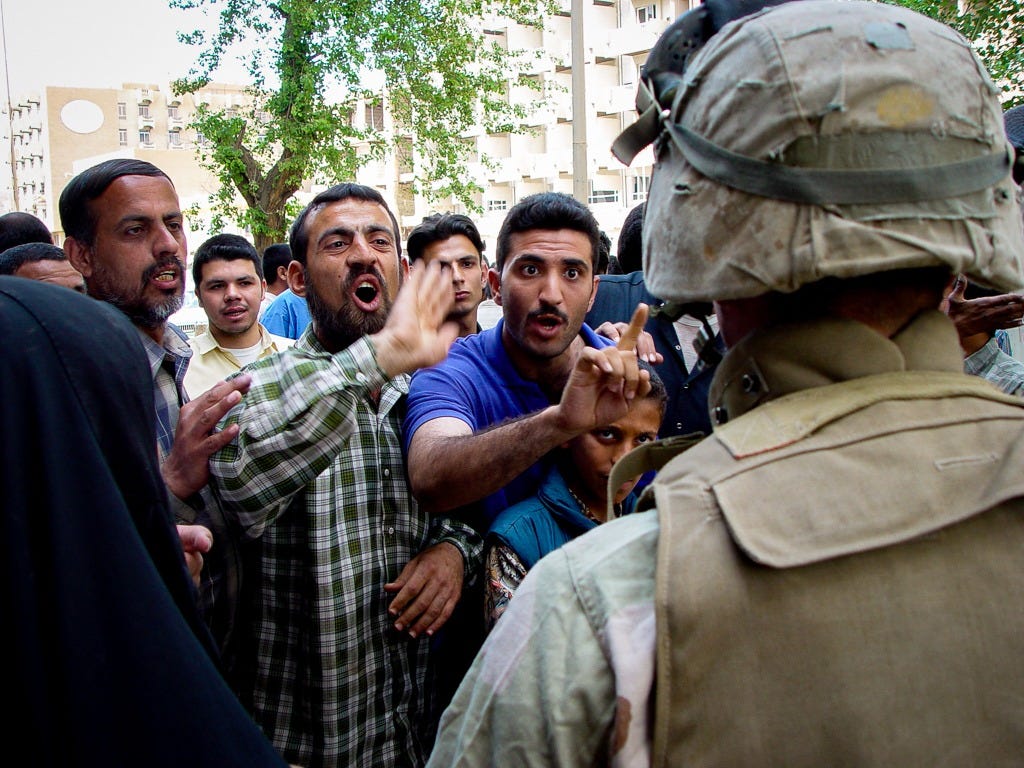
In April 2003, standing in Baghdad on the day I left Iraq, I wrote:
“All of this will settle down eventually — or explode into civil war — but the question is how long will it take?”
It exploded into civil war. It took about two years and I was naive about the depth of what was to come — the sectarian slaughter of 2006-2008, the rise of ISIS, the fall of Mosul, the peshmerga bearing the heaviest burden of the ground war against the jihadists, the abandonment at Kirkuk in 2017 when American-trained Iraqi forces turned American-supplied weapons on Kurdish positions.
Abdullah lost four children to four countries and still believed. Rayan Zebari celebrates Nowruz under drone fire and still believes. The senior KRG security official describes a military with no air defenses absorbing missile strikes it cannot stop — and is still unifying the peshmerga, still building. What is it about the Kurds that keeps them building in the path of the next catastrophe? And what does America owe for that faith?
Editor’s note:
In 2003, Christopher Albritton, the author of this piece, raised money directly from readers to report from Iraq — the first guy to do dangerous war reporting
More than two decades later, we’re building Iran War Dispatches on that same model. If you want this kind of work to exist, we need your support..
THE LATEST NEWS AT THIS HOUR:
By: Oleksandra Poda
IRAN REFUSES DIRECT NEGOTIATIONS IN ISLAMABAD: On April 25, the White House confirmed that Witkoff and Kushner were flying to Pakistan for direct negotiations with Iran. But the Iranian Foreign Ministry stated that no meeting was scheduled.
Iran’s Minister of Foreign Affairs Araghchi also flew to Islamabad to meet with Pakistani officials, not with the Americans. Iran said it refused to engage in direct dialogue until the U.S. blockade of Iranian ports ends.
U.S. FREEZES $344 MILLION IN CRYPTO OVER LINKS TO IRAN: On April 25, U.S. Treasury Secretary Bessent announced the U.S. froze $344 million in cryptocurrency assets linked to Iranian networks.
The U.S. is expanding its economic pressure on Iran into the digital sphere, as Iranian networks have long used cryptocurrencies to circumvent sanctions.
TWO YEAR DELAY FOR LNG INFRASTRUCTURE DUE TO IRANIAN ATTACKS:
On April 25, the IEA published an update stating that the expansion of liquefied natural gas (LNG) infrastructure will be delayed by at least two years because of Iranian attacks which have damaged Qatar’s energy infrastructure..
Qatar is the world’s largest exporter of LNG. Its damaged infrastructure means a structural gas shortage in Europe and Asia for years to come. Europe is already at risk of experiencing fuel shortages as it is seeking alternatives to Russian gas.
ISRAEL KILLED SIX LEBANESE CIVILIANS: Israeli strikes in Lebanon on Friday killed six civilians and wounded two, according to the Lebanese Ministry of Health. This happened the same day that Trump announced a three-week extension of the Israeli-Lebanese ceasefire.
Israel continues operations in southern Lebanon, citing “defense against Hezbollah.” Meanwhile, Hezbollah responds with counterattacks.
CRITICISM OF IRAN’S NEGOTIATING TEAM HOLDS BACK PROGRESS: Ultra-conservative figures and security officials in Tehran have stepped up their public criticism of the negotiators, accusing them of jeopardizing Iran’s interests, the Wall Street Journal reported, citing people familiar with the matter.
Internal pressure and division within Iran’s leadership is complicating the team’s negotiating position and is making it difficult to hold a second round of talks.
Stay safe out there!
Best,
Christopher

They keep making the same mistakes