

At the bottom of this page: Latest news at this hour.
Netanyahu urges world leaders to join the war… Trump gives Iran 48 hours to open Strait of Hormuz… Israel prepares to strike a coastal bridge in Lebanon… Iran strikes Israel near nuclear facility… Hezbollah claims cross-border attacks.

Editor’s note:
Our sister publication in Ukraine is watching how the war in Iran is impacting food prices around the world. That global coverage is something we’re uniquely positioned to give you, and we need your support to keep it up.
What are you waiting for? Subscribe below!
OUR LEAD STORY:

A pink neon sign displays four letters: “BPSH.” It is a chain that serves affordable food, such as donuts with sweet filling.
Inside, there’s a line of customers, all waiting for their favorite sugar-dusted donuts. But in the kitchen, there’s no sound of oil bubbling in the fryer. Only the vertical grill is working, sizzling loudly as it cooks another crowd favorite — shawarma.
“The fryer uses a lot of power. So when we don’t have electricity, we switch to shawarma — it’s a vertical grill and uses much less energy. Our key items like donuts and belyashi don’t work in those moments,” said Olena Borysova, CEO and owner of the Ukrainian Gastro Family restaurant group, including the BPSH chain.

War in Iran has recently triggered global energy disruptions. The regime has restricted shipping through the Strait of Hormuz, leading to supply shortages for things like liquefied petroleum gas. This has driven up the price of LPG, a key fuel used in commercial fryers by many small restaurants and street-food stalls.
Rising LPG costs are already forcing some businesses to rethink their menus and pricing. Small and medium-sized enterprises make up more than 99 percent of all businesses in Ukraine, and around 90 percent worldwide. Disruptions are putting extra pressure on Ukraine’s war‑strained economy, which struggles to survive after a harsh winter.
For customers, prices for borshch have risen by roughly 40-50 percent in U.S. dollar terms, which in hryvnias effectively means they have doubled since 2022. For example, a bowl now costs 169–298 UAH (around $4-8 USD) compared to 80–150 UAH (around $2-4 USD) when the full-scale war broke out.
In the midst of these challenges, local entrepreneurs like Olena had to navigate both rising costs and operational hurdles to keep their businesses thriving.
Once a 17-year-old girl working as a cashier, she transitioned to a role as an accountant, and later, a manager. Today, Olena is the owner of ‘Gastro Family’, which includes 50+ venues across Ukraine and Europe, like the BPSH chain.
This winter was already rough for Ukrainian small businesses due to frequent energy and heat blackouts, which forced additional expenses such as buying generators and heaters.
Around 80 percent of businesses felt the impact of power outages, forcing many to invest in their own energy sources. About 90 percent now have alternative power, including in the form of gas generators, which increases the cost of their products due to the rising prices.
Blackouts have become a major factor in increasing the cost of products and services in businesses like restaurants and cafes, causing prices to rise between ten and thirty percent.
The winter of 2026, especially January–February, was critical for Ukraine’s restaurant sector, particularly in Kyiv, due to blackouts, extreme cold, and economic strain. Many venues were already operating at a loss, and January made business unprofitable.
Up to twenty percent of restaurants in Kyiv were at risk of closing by spring 2026. Many did not shut down permanently but temporarily paused operations, as it was cheaper than closing entirely.
Olena’s restaurants needed to deal with blackout challenges as well. Besides batteries and other equipment, they bought extra LED strips, energy-saving bulbs, and lots of candles.
Prices in Ukraine are already expected to rise up to ten percent due to the war in Iran, driven by higher fuel and fertilizer costs. Vegetables, meat, and dairy products are among the goods likely to become more expensive, though the cost of borshch ingredients alone has already increased by more than 50% since 2022.
These figures reflect only the cost of ingredients: in restaurants, where energy, labor, and logistics costs have also surged during the war, menu prices for borshch have likely followed a similar or even steeper trajectory.
Partially due to Olena’s restaurant’s internal policies, the price of borshch in her restaurants has risen only slightly since 2025.
“We try to keep menu prices stable or adjust them as gently as possible,” said Maryna Lavrenchuk, communication manager of the Gastro Family restaurant group.
And the crisis seems to be becoming global, hurting people’s wallets worldwide. In India, restaurants are also facing a fryer crisis. The restaurant association advised its 500,000 members to reduce working hours and remove dishes that require long deep frying. Up to one-fifth of hotels have already stopped operating.
The LPG crisis is not the only challenge Ukrainian local restaurants face. It also escalates to supply chain disruptions, which are an even bigger problem for the consumer’s dining experience.
“We haven’t changed anything in the guest experience…We don’t sleep at night, and when I pay money, I want to get the same service and product as before the war. You want to feel some comfort, like a flashback to life before the war,” said Olena.
Olena tries to make sure guests are satisfied despite the rising prices by preserving the most popular dishes. Even though some prices have changed, everyone’s favorite borshch is still on the menu, which is a traditional Ukrainian first course.
It is based on beetroot, which gives it a deep red color. It’s usually cooked with meat broth, cabbage, potatoes, beans, and spices.
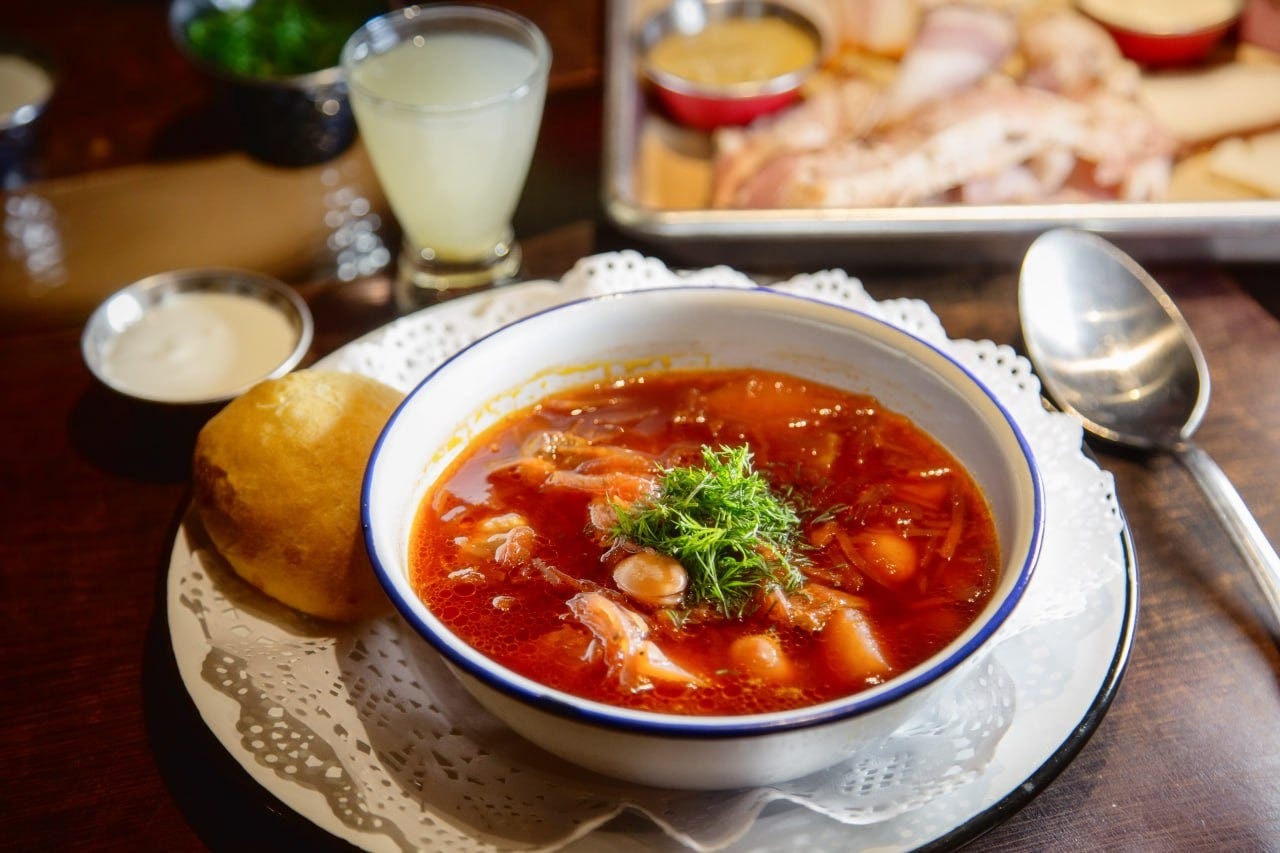
“Borshch is the number one dish ordered by Ukrainians, foreigners, and visitors to Ukraine. It ranks first in sales,” said Olena.
And it doesn’t change despite the price spike. The phenomenon of Ukrainian borshch is not only about its taste, but also its deep cultural and social meaning. It is a symbol of identity, passed down through generations, and a sign of unity and hospitality, bringing people, families, and communities together.
“Today, guests visit restaurants less often—both because of the shelling and falling purchasing power—but they still expect high-quality food and service,” said Maryna.

Guests at Olena’s restaurants might sigh and mention the price increases to the waiter. Olena’s team understands that prices are rising, but wages are not, so guests are visiting the restaurants less often. They might skip dessert, but they still order two main dishes, including borshch.
Despite mounting challenges, Ukrainian businesses have learned how to adapt in times of crisis. One of the chain’s restaurants, an old wood-fired oven remains in use, capable of cooking nearly the entire menu, even during blackouts.
“History shows that everything is cyclical. So now, together with the team, we are preparing for post-war times — maybe in about ten years, that’s how we see it. We don’t know exactly how it will be, but we are getting ready,” said Olena.
Editor’s note:
Our sister publication in Ukraine is watching how the war in Iran is impacting food prices around the world. That global coverage is something we’re uniquely positioned to give you, and we need your support to keep it up.
What are you waiting for? Subscribe below!
THE LATEST NEWS AT THIS HOUR:
By: Oksana Stepura
NETANYAHU URGES WORLD LEADERS TO JOIN THE WAR: Netanyahu called on world leaders to join the U.S. and Israel in their war against Iran, suggesting that some countries are already considering involvement, Al Jazeera reported. He accused Iran of targeting civilians and warned it has capability to strike long-range targets, potentially reaching Europe.
TRUMP GIVES IRAN 48 HOURS TO OPEN STRAIT OF HORMUZ: On Saturday, Trump threatened to “obliterate” Iranian power facilities if the navigation in the Strait of Hormuz isn’t restored within 48 hours. In response, the Iranian parliament speaker, Mohammad-Bagher Ghalibaf, warned that attacks on its power plants would trigger immediate retaliatory attacks. He said “energy and oil facilities across the region will be considered legitimate targets and will be irreversibly destroyed,” the New York Times reported.
ISRAEL PREPARES TO STRIKE A COASTAL BRIDGE IN LEBANON: The Israeli military warned it is preparing to strike the Qasmiyeh Bridge in Southern Lebanon to disrupt the movements of fighters and weapons, urging civilians to evacuate, Al Jazeera reported. The bridge is a critical coastal route, and its destruction could isolate the region. It also reported that Israel ordered demolitions of Lebanese homes in “front-line villages.”
IRAN STRIKES ISRAEL NEAR NUCLEAR FACILITY: Israeli authorities reported that at least 180 people were hospitalized following Iran’s attacks on the cities of Arad and Dimona. The strikes forced the evacuation of over 2,700 residents, with approximately 1000 coming from the targeted cities, which are located close to a nuclear facility, Al Jazeera reported.
HEZBOLLAH CLAIMS CROSS-BORDER ATTACKS: Hezbollah said it carried out overnight drone attacks on Israeli soldiers and military sites along the border, and targeted locations in Northern Israel and Southern Lebanon, Al Jazeera reported. The group claimed it struck a troop gathering and barracks, but the reports couldn’t be independently verified.
Stay safe out there!
Best,
Anastasiia
