


At the bottom: Latest news at this hour.
Strikes on the Iranian agencies that targeted protesters… UAE, Qatar request a short war… gas prices spike… Israeli ground incursion in Lebanon… France sends fighter jets to Middle East…

Editor’s note:
With reporters in Iran’s neighbor Armenia, and more reporters in Kyiv at our sister publication, we’re uniquely positioned to connect the dots between U.S. and Israeli strikes on Iran + Russia’s war in Ukraine.
If you want to support our Iran-focused work, subscribe to Iran War Dispatches!
OUR LEAD STORY:

More than two decades ago Dmytro started a company that owns a network of Ukrainian gas stations.
So after the joint U.S.-Israeli strikes on Iran and Tehran’s retaliation, he noticed that oil prices jumped fast, reaching above the $80 per barrel mark within days, the highest price in more than a year.
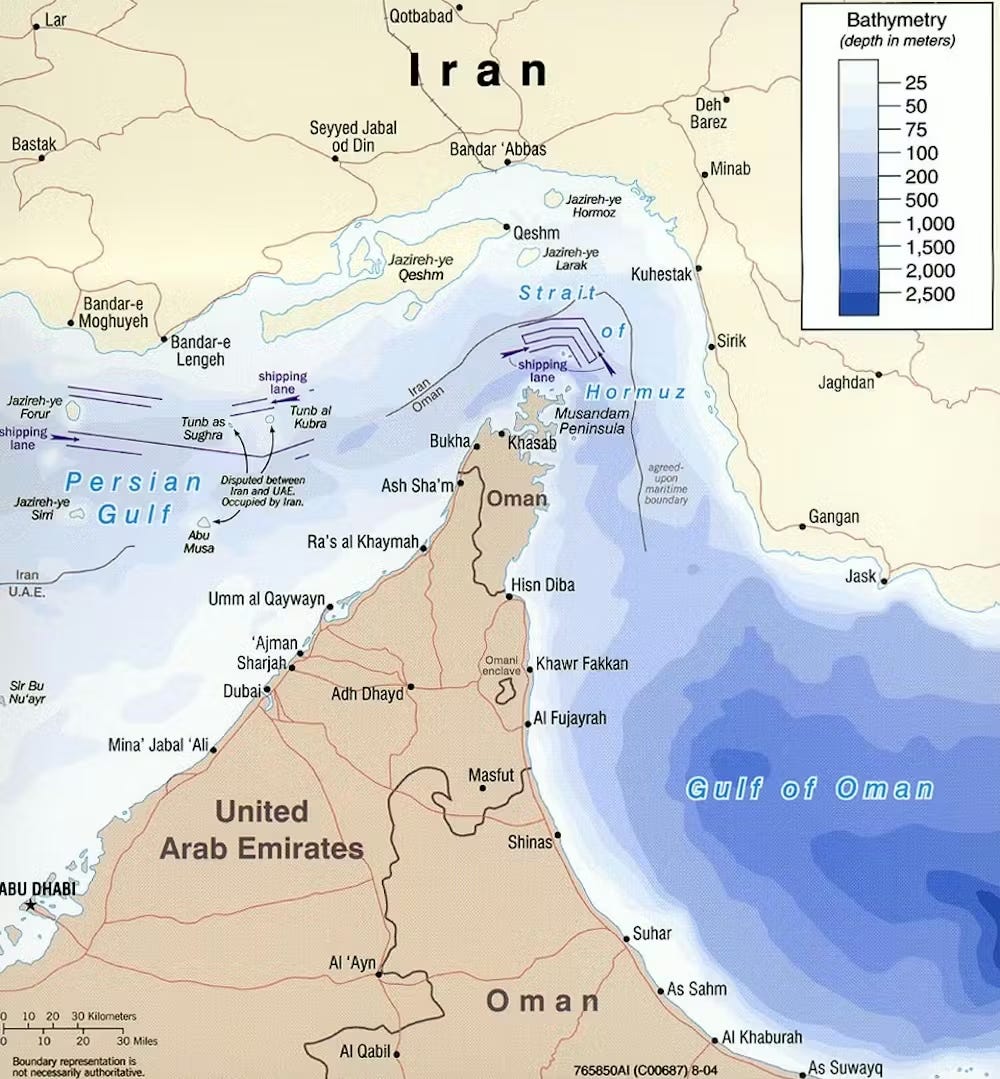
The price surge was driven by the safety risk around the Strait of Hormuz, a key shipping route that links the Persian Gulf to the rest of the world. Through this key passageway transits about one-fifth of the world’s oil.
There have already been reports of attacks on tankers, and now many vessels have slowed down or anchored near the strait.
Russia’s economy is teetering. According to The Washington Post, some experts’ had forecast it could collapse as early as this summer due to falling oil and gas revenue and budget deficits despite high military expenditures.
25 percent of Russia’s total governmental budget is driven by oil revenues, according to Reuters.
Before the Iran strikes, this increasing tension would create pressure for the Russians to sit down at the negotiating table.
But Trump’s decision to open fire on the Iranian regime is an unexpected gift. As oil prices rise, Moscow will be able to generate more income to sustain its military operations, blunting the effect of Western sanctions on authoritarian countries.

Dmytro Loushkin might be among those who desire the downfall of the Russian economy, as it not only ruined his business but also took away his homeland.
In 2006, the logistics business was something new for Ukraine, and Dmytro, along with his partners, was interested in implementing something new.
Moreover, the region had ports, and promising growth in the fields of metallurgy, agriculture, and mining — a great environment to start a transportation business. So Dmytro started a logistics company in his native city Kadiivka, in the Luhansk region.
“My youth was there. My best years were there. My home is there, and my loved ones are buried there,” Dmytro said.
He left the Luhansk region in 2014, not long after an assassination attempt was made against him with the aim of seizing his business, after Russia began invading the Luhansk and Donetsk regions. He was stabbed in the chest. It forced him to flee with the family to Kharkiv.
“A raider seizure of the business took place, they tried to kill me, and they almost succeeded,” Dmytro said.
The puppet state of Russia, the Luhansk People’s Republic, imposed sanctions against Dmytro and nationalized — that is, took away — his business. Dmytro has not been home since.
After moving to Kharkiv his company expanded into a network of gas stations. He jokes about current situation in Iran:
“If the whole world were populated only by Ukrainians, [we] would not pay attention to this, because [we] have long been accustomed to it. But since the world is experiencing for the first time what it is like when bases and oil depots explode, [oil traders] are very frightened. That is why oil and gas prices skyrocketed, and everything went up”.
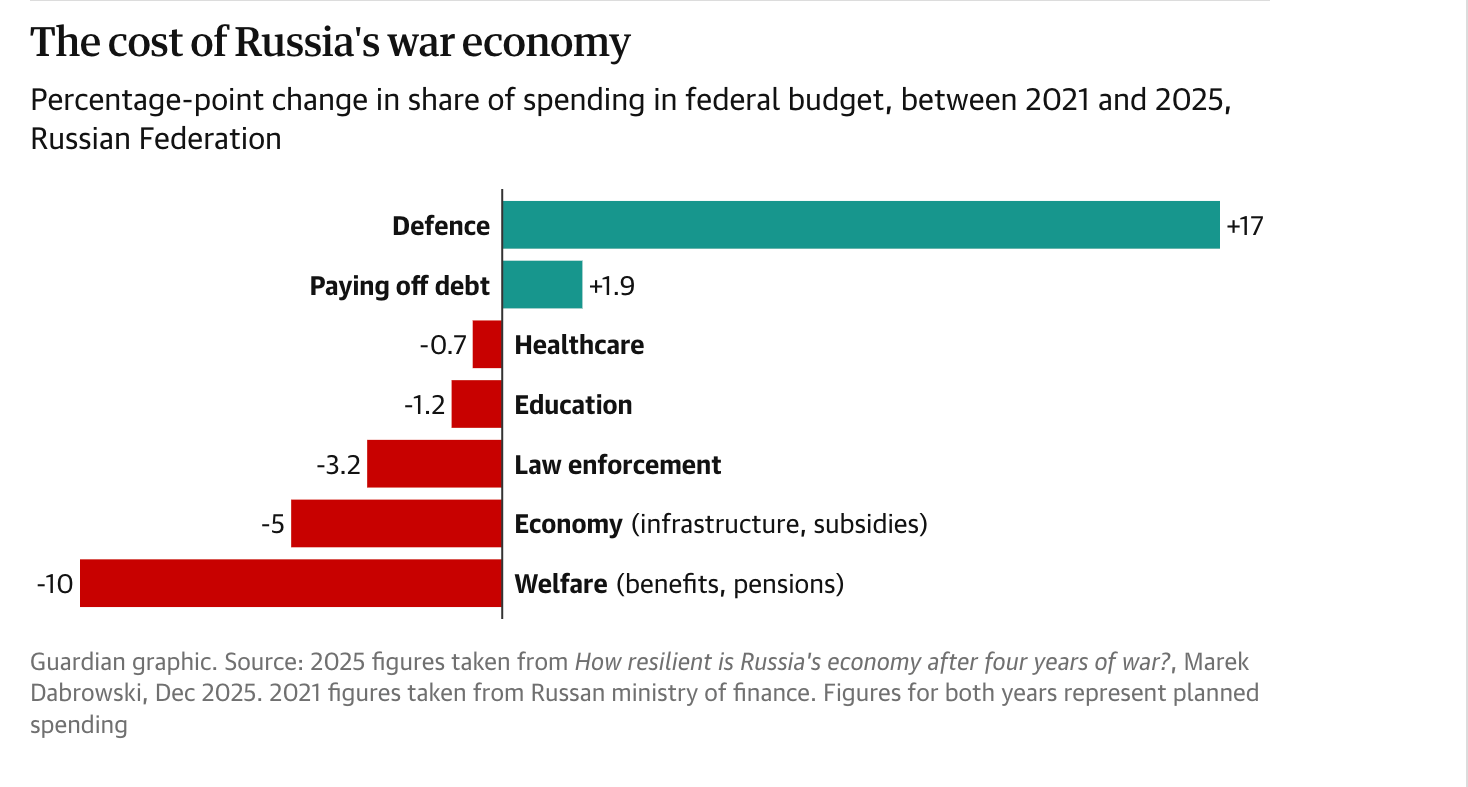
For the average Russian, the economic crisis is already tangible. Over the last four years, budget expenditures increased only for defense spending and national debt payments.
Declining spending on civilian sectors of the economy will, in practice, mean constant infrastructure accidents, housing sector failures, and cuts to public sector workers’ pay, which, by the way, can already be seen by scrolling through Russian news.
For example in Omsk, a city in Siberia with a population of over one million one of the city’s districts had no heating for more than two weeks, 70-80% of the city’s heating networks are in disrepair according to the local authorities.
Because of U.S. and European price caps implemented due to the full-scale invasion, Russia is forced to sell oil, one of the biggest sources of its budget revenue, at a steep discount. Western countries are actively trying to reduce their dependence on Russian energy resources, which has significantly cut Russia’s export volumes and weakened a key pillar of its economy.
However, the war in Iran will flip the table.
If buying oil from the Persian Gulf countries becomes too expensive, it could shift the buyers’ behavior. They may look for alternative sources — including Russian crude. Analysts have suggested that India could increase purchases of Russian oil again if the disruption continues, while China continues to buy large amounts of oil.
Therefore, if Russian oil sells at prices higher than those provided for in the budget for a long time, it will allow the Russian Federation to reduce the state debt and use ‘extra’ money to fund its campaign of murder and torture in Ukraine.
“I believe that the prices are gonna be really high for oil and gas for a couple of weeks, but they will stabilize more or less by then,” Dmytro said.
For millions of Ukrainians, the stability of the Russian economy will mean the continuation of Russian terror.
This includes Dmytro, who in 2022 was forced to move again from Kharkiv to western Ukraine due to Russian aggression, as they were trying to occupy at the time, bombarding the city daily with all possible weapons.
Now he lives with his family in the western Ukrainian city of Rivne and hopes he won’t have to flee anywhere else. After all, it is relatively safe here; power outages, if not entirely absent, are at least much shorter.
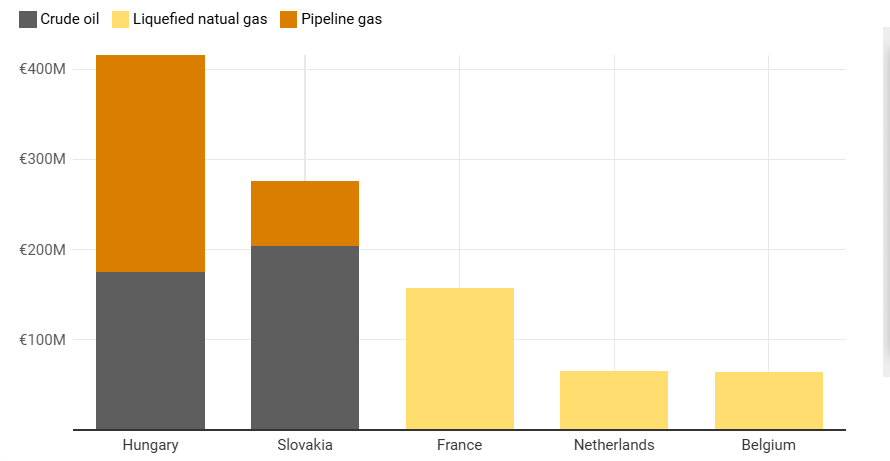
Europe has sharply reduced its dependence on Russian oil and gas since the start of the full-scale invasion. But a handful of countries still purchase Russian energy.
One of the biggest buyers of Russian oil in the EU is Hungary and Slovakia, whose leaders claim that buying oil elsewhere would be more expensive and endanger their energy security.
They’re allowed to do so because of a temporary EU exemption intended to help them prevent energy shortages as landlocked countries. Europe had planned a full oil embargo on Russia, but amid an oil crisis, this may become harder to implement.
When oil prices rise, it reduces pressure on the Russian government to raise taxes, borrow more money, or draw down reserves, so expensive oil makes it easier for Russia to sustain high military spending for longer.
However, ISW analysts believe the benefits for Russia are only medium-term, as Iran will not be able to block the strait indefinitely.
As one of the biggest Russian oil buyers, it’s possible that China and India might increase the purchases of Russian oil. More demand from them would help Russia keep their export revenues steady, further weakening the impact of Western sanctions.
Dmytro is cynical about the way the current situation might go, saying it might be similar to Iraq or Libya — a seemingly quick operation turning into a messy conflict.
“We’re Ukrainians so we’re used to living with this kind of threat,” he said. “But the rest of the world isn’t, so they’re terrified – and that fear is pushing the prices higher.”
The latest news this hour:
By Anastasiia Lutsenko, Alessandra Hay, Jacqueline Cole, Myroslava Tanska-Vikulova, Mariana Lastovyria
U.S., ISRAEL STRIKE IRAN AGENCIES TARGETING PROTESTORS: The U.S. and Israel have struck police stations and intelligence offices in Iran, which could be an effort to weaken the forces that brutally cracked down on protesters earlier this year, according to the New York Times. Targets have included bases of the Iranian Revolutionary Guard Crops (IRGC) and the Basij, a volunteer paramilitary milita within the IRGC. The strategy hinges on whether degrading these security forces can embolden civilians to rise up.
UAE AND QATAR LOBBY FOR A SHORT US OPERATION AGAINST IRAN: The United Arab Emirates and Qatar are working with partners to convince Trump not to prolong a US operation against Iran. They advocate for a swift diplomatic resolution to avoid escalation and a spike in energy prices.
GAS PRICES JUMP AFTER QATAR HALT: Gas prices in Europe rose sharply after production stopped at the world’s largest liquefied natural gas (LNG) export facility in Qatar. The shutdown followed an Iranian drone strike. Europe’s main gas benchmark, climbed nearly 30% to the highest level in more than a year. Analysts say this is the biggest risk to global gas markets since Russia’s full-scale invasion of Ukraine in 2022.
ISRAEL GROUND INCURSION IN LEBANON: Israeli troops have entered southern Lebanon as the conflict in the region escalates following U.S. and Israeli strikes on Iran. Israel said the operation is a “forward defense” to protect border settlements.
Hezbollah responded sharply, saying Israel “wanted open war, so let it be an open war” and adding that “the era of patience has ended.”
The Lebanese army has withdrawn from several forward positions along the border to ensure the safety of its troops, according to state media and witnesses. Israel’s Defense Minister instructed forces “to advance and seize additional controlling areas” to prevent attacks on civilians, a military spokesperson said.
FRANCE SENDS FIGHTER JETS TO MIDDLE EAST: France has deployed Rafale fighter jets to patrol airspace over its military bases in the Middle East, Foreign Minister Jean-Noël Barrot said. He said the operations had a “deterrent effect.” The announcement follows an Iranian drone attack on a French military base in the UAE. Meanwhile, Germany said it would not take part in U.S. or Israeli attacks on Iran.
U.K. MAY SEND WARSHIP TO CYPRUS: The United Kingdom is considering sending a warship to Cyprus following an attack by Iranian drones on a military base in the Mediterranean on Monday, Politico reported. It could take several days for it to reach Cyprus.
Cyprus had previously criticized London’s actions in the Iran war. It argues that a lack of clarity over whether US forces were using British bases had drawn Cyprus into the conflict.
At the same time, PM Starmer said that after British personnel came under attack from Iranian drones and missiles on Sunday, prompting him to allow the limited use of British military bases by the U.S. However, he stressed that he is maintaining his decision not to join offensive strikes against Iran despite Trump’s criticism.
US DEPLOYS NEW LUCAS DRONE SIMILAR TO IRAN’S SHAHED: The United States has used a new long-range drone called LUCAS in strikes against Iran. Analysts say the drone closely resembles Iran’s Shahed-136 loitering munition.
Some open-source analysts have suggested LUCAS could be based on reverse engineering of captured Iranian drones, though U.S. officials have not confirmed this. Washington has acknowledged the drone’s first use in Iran.
Stay safe out there.
Best,
Tania and Oksana

