

At the bottom of this page: Latest news at this hour.
Trump to abandon Ukraine if Europe doesn’t help open Strait of Hormuz… Trump threatens to hit Iran “extremely hard” in the coming weeks… Europe expects fuel shortages this month… An air strike hits a century-old medical center in Iran… Iran war hits Australian agriculture.
Featured subscriber comment:
“You all comprise an entry in my gratitude journal— truly for your grateful sane, steady, reliable voices penetrating the smoke filled chaos that surrounds us.”
By Susan Hudson
OUR LEAD STORY:

Since the start of the war in Iran, Sina thinks the revenue at his online cryptocurrency exchange company has been chopped in half.
But he can’t prove it. His accountant doesn’t have internet.
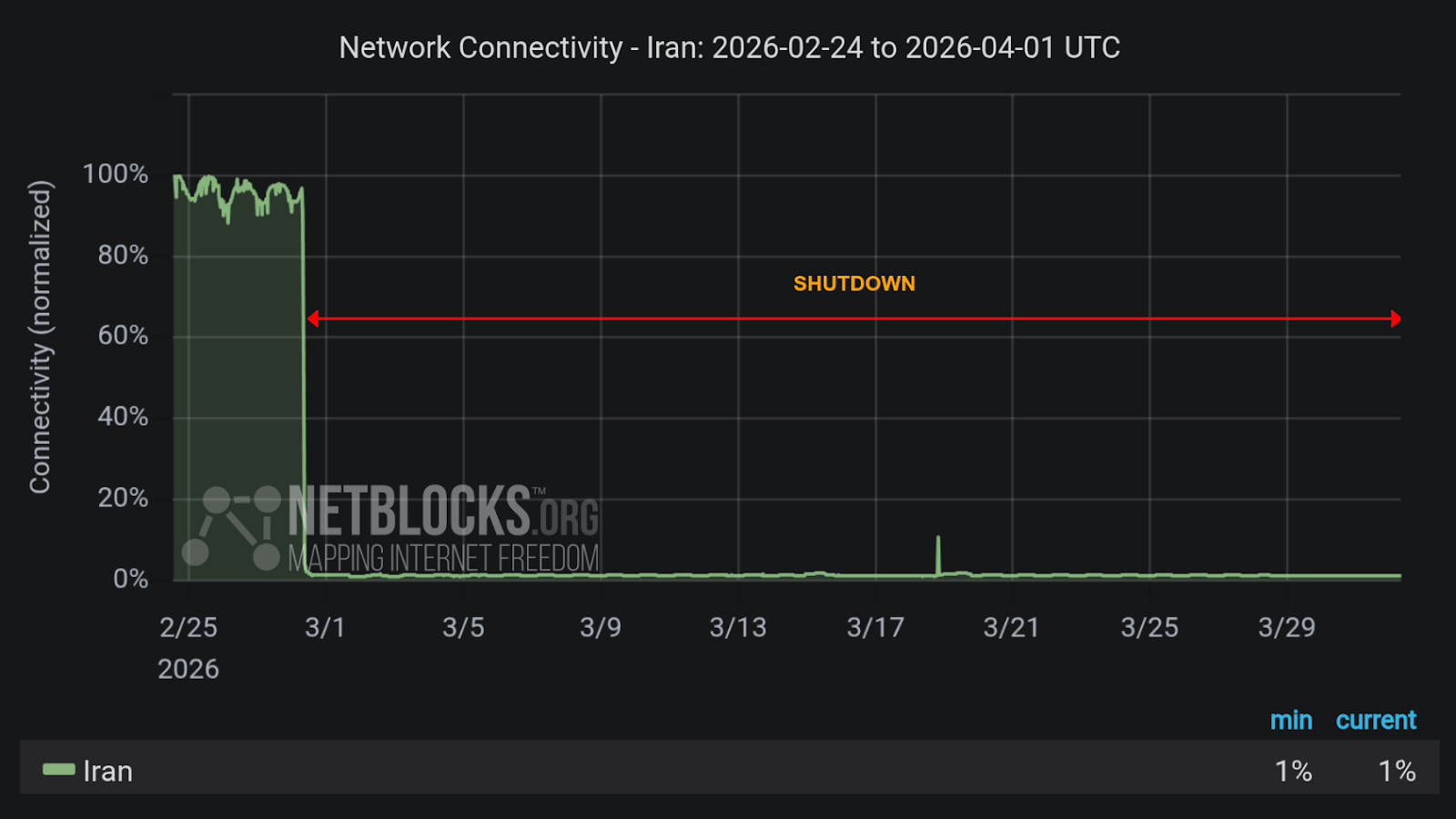
In Iran, which has been in a near-total internet blackout since the war started on February 28, that kind of problem is becoming common. Businesses that run online are flailing. Sina’s crypto business is one of them.
In Iran’s sanctioned economy, where inflation often soars above 40 percent, cryptocurrency, a digital currency that operates without a central bank and allows international money transfers, has become a financial lifeline. Just recently the Iranian government started to charge tolls on ships passing through the Strait of Hormuz and is only accepting Chinese yuan or crypto.
But that lifeline depends on something that is now even more scarce in Iran than the dollar: internet access. Without the internet, people like Sina are finding that even the crypto workaround is starting to collapse.
As Iran’s currency reaches record lows and cryptocurrency is becoming both more necessary and more difficult, this war could be reshaping the Iranian economy for good.
Sina is 30 and is what’s known as a local cryptocurrency exchanger.
“Imagine you’re Iranian,” he said. “Your [country is] sanctioned. You don’t have those fancy Mastercards, you [sanctions stop you from using] any worldwide crypto exchanges.”
So when Iranians have hard cash but they want to turn it into crypto to save it from the rapid inflation, they find somebody like Sina: “I will receive the Iranian money with love and give them Bitcoin, or vice versa,” he said.
Sina remembers the moment he realized how weak the Iranian rial really was. He compared his finances over a two-year period, converting everything into U.S. dollars to get a clearer picture of his earnings.
“I was blown away by the fact that I didn’t earn a single buck,” he said, referring to the depleting value of his money. On paper, he felt richer. He had more Iranian rials, but in reality, it was worth less.
“That’s what happens to every Iranian,” he said. “They think they’re richer while they’re actually getting poorer and poorer.”
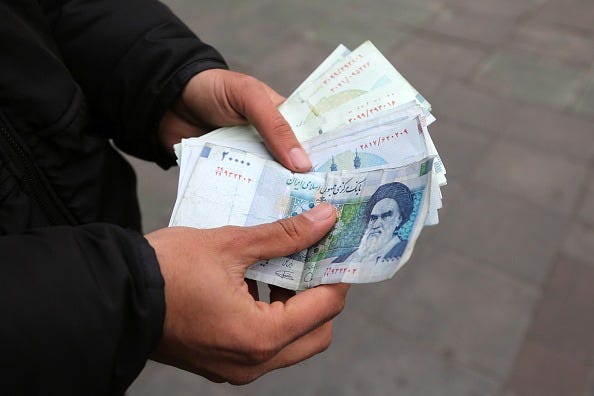
1 U.S. dollar is worth roughly 1.3 million Iranian rial. The currency has become so unstable that many Iranians no longer trust it to hold value. This collapse is what fueled massive unrest at the end of December 2025, which turned into bloody government suppression in early 2026, killing tens of thousands of Iranians.
Crypto is on the rise everywhere, Sina acknowledged. Internationally, it’s largely considered an investment, but in Iran, it’s something closer to a necessity. Without this war, “it would have been a hot season, I’m sure,” Sina said. “We would have had a lot of transactions.”
Sina didn’t dream of crypto as a little boy, but he stumbled upon the industry when his “Iranian dream” of becoming a doctor was interrupted by a part-time gig to work in Bitcoin.
He got swept up, fast. “I couldn’t even eat,” he said. He was so busy working.
Six years later, that side job turned into a company with 10 employees.
The U.S. sanctions on Iran have mounted since 1979, when the Islamic Revolution brought the Ayatollahs to power and Iranians seized the U.S. embassy.
In terms of sanctions on Iran’s financial sector, the country has been isolated from the global banking system. Sanctions not only prevent transfers between Iranian and international banks, but they also threaten punishment against any entity even loosely involved in these transfers.
This war is reshaping those sanctions too. On March 20, the U.S. lifted sanctions on Iranian oil at sea to alleviate some pressure on U.S. markets, a move that temporarily reversed the very policies meant to keep Iranian oil out of global markets.
U.S. officials are now scrutinizing Iran’s growing crypto ecosystem, which hit about $8-10 billion in transaction volumes in 2025, concerned it is being used to bypass sanctions and move money abroad, not just by citizens but by the IRGC itself, according to Reuters.
As the U.S. was building up its military presence in the Middle East, Sina had a sense the war might start. He filled out the paperwork that allowed his car to leave the country and packed it up. Some clothes, a couple of pairs of shoes, money, and an emergency battery. He loves to travel (although his Iranian passport strictly limits the countries he has access to visit), so the idea of leaving the country for the duration of the war didn’t rattle him.
On the Saturday that the U.S. and Israel launched their first strikes on Iran, Sina was ready to drive north to reach Iran’s border with Armenia, but he heard news that Supreme Leader Ayatollah Khamenei had been killed and decided to stay for a few more days — back then it felt like the war might end really soon. He soon realized that the bombing would last a while. Four days into the war, he was at the border, and by day five he was in Armenia.
Sina’s days are a mix of digital and physical work when he’s in Iran. He facilitates transactions through his website and communicates with clients via Telegram, a messaging app. He goes to the bank to withdraw cash for clients, too, often hitting the transaction limits of just $1,000-2,000 at a time.
But now that his company’s website is down, Sina and his employees can’t access the website for transactions, so they rely solely on Telegram — an emergency measure, he said, as the platform itself requires spurts of internet to work.
Sina’s company operates in a legal grey zone. The Iranian government hasn’t gotten around to regulating it yet, so it’s neither legal nor illegal, he said. For those clients who are wary of digital trade, he meets them in person for a physical exchange, something he also can’t do now that he left the country for internet access.
Most of his clients are young men who are either investing or just trying to turn income they got from outside of Iran into hard cash. Sina’s clients tend to come from wealthier backgrounds, so many of them are able to circumvent the internet blackout by buying VPNs or Starlinks. As of now about half of them are still able to exchange with him.
Sina has dealt with internet blackouts before, most recently during the protests at the beginning of this year. Those moments prepared him to handle things manually, via Telegram, as he is now.
Sina was able to buy a VPN for his employees who are still in Iran, which one person can use at a time.
“VPN sellers are like the wealthiest people nowadays in Iran,” said Sina.
Nowadays in Iran, it’s clear that value is not just in the cash you hold. It’s in how quickly, and creatively, you can turn it into something with worth.
Featured subscriber comment:
“You all comprise an entry in my gratitude journal— truly for your grateful sane, steady, reliable voices penetrating the smoke filled chaos that surrounds us.”
By Susan Hudson
The latest news at this hour:
By: Oleksandra Khelemendyk
TRUMP TO ABANDON UKRAINE IF EUROPE DOESN’T HELP OPEN STRAIT OF HORMUZ: Donald Trump is threatening to stop the NATO supply of weapons for Ukraine if European countries don’t help the U.S. reopen the Strait of Hormuz, Financial Times reported, citing people briefed on the discussions.
In response, NATO Secretary-General Mark Rutte urged key European allies to change their positions. Previously, the U.K., Germany, France and other states expressed their willingness to ensure safe passage through the Strait in a joint statement on March 19. Today, 35 signatories that pledged to form a coalition and reopen the Strait of Hormuz will discuss further steps at a virtual summit organized by the U.K.
TRUMP THREATENS TO HIT IRAN “EXTREMELY HARD” IN FOLLOWING WEEKS: In his April 1 address, Trump reiterated that the U.S. military’s goals in Iran might be close to completion, but said that he was planning to bomb Iran “back to the stone age” in the coming two or three weeks.
Iran claimed that the war will continue until its foes are completely defeated and warned that its weapons production sites remain out of the U.S. reach. The Foreign Ministry spokesman Esmaeil Baqaei called the U.S. demands “maximalist and irrational.” To end the war, Iran demands a guaranteed ceasefire, but there have been no attempts to negotiate it, Iranian sources told France 24.
The oil market reacted to mutual threats with a new surge in prices. Brent crude rose by 7 percent to near $108 per barrel, according to CNN. Before Trump’s speech, it was trading as low as $99.08 a barrel, Financial Times reports.
EUROPE EXPECTS FUEL SHORTAGES THIS MONTH: In March, ports around the world were receiving oil and gas tankers that left the Middle East before the first strikes on the region, but this month, there could be no supplies. The Head of the International Energy Agency warns that Europe could face shortages of jet fuel and diesel by the end of April or in early May, CNN writes.
The International Air Transport Association reports a twofold increase in the
global prices for jet fuel, compared to February. In response, airlines had to increase air travel fees and cut flights.
IRAN WAR HITS AUSTRALIAN AGRICULTURE: Due to high costs from the war in Iran, Australian farmers are encouraged to switch to less fertilizer-intensive crops like feed barley, Reuters reported.
Some farmers are also reducing the planted area. As a result, Australia’s wheat planting might drop by 10 to 12 percent, as well as the cultivation of canola, of which Australia is the world’s second largest exporter.
Farmers around the world are struggling to secure fertilizer supplies as planting season begins in key regions. With the disruptions in the Strait of Hormuz, roughly one-third of global fertilisers cannot pass through, severely impacting flows amid the Iran war.
Since the beginning of the war, fertilizer prices have soared. For instance, the price of urea has risen about 60% in Australia.
AIR STRIKE HITS CENTURY-OLD MEDICAL CENTER IN IRAN: Iran’s health ministry spokesperson Hossein Kermanpour said that the Pasteur Institute, a historic medical center in Tehran, was attacked and extensively damaged earlier today, The Guardian reported.
He said this act was a direct assault on international health security and called on the World Health Organization and the International Committee of the Red Cross to support the reconstruction of the hospital.
Stay safe out there!
Best,
Jacqueline
Many years ago I took a finance class in which the first week of 2 was about the history of money. Or what was considered money when purchasing things. Two points has always stood out to me. 1) the dominance of the US dollar is not permanent. History teaches us that nothing is permanent. 2) and please remember this is based on a decades old memory. The stock exchange exists because people, in the street, were betting on the future and prospects of American companies. It was so popular that it became difficult to control and police. So they were given an ultimatum forcing them to develop rules and behave legitimately. So they moved inside and developed the stock exchange system. It’s not a perfect system but it works to the benefit, mostly, for everyone good or bad. This makes me think of cryptocurrency as much aligned, dark, and with a lot of illegality associated with it. Yet it still sticks around and provides a lot of positive options to people who need it. Just like this story illustrates.
I really loved this article Jacqueline. Learned a lot and really interesting. Where did you meet this guy?