

At the bottom of this page: Latest news at this hour.
Trump doubles down on Iran blockade as oil hits $126… Hegseth clashes with Congress … War draining funds from the U.S. and EU … Pakistan opens land routes to Iran as sea blockade bites … CENTCOM says 42 ships turned back as Iran is locked out of $6 billion in oil .

Editor’s note:
Critical shipping routes impact every reader, no matter where you’re living. Multiple are now at risk.
That’s the headline, but what it means for the people caught in between is what we’re reporting on.
If that’s what you’re here for, you’re in the right place. Subscribe now!
OUR LEAD STORY:
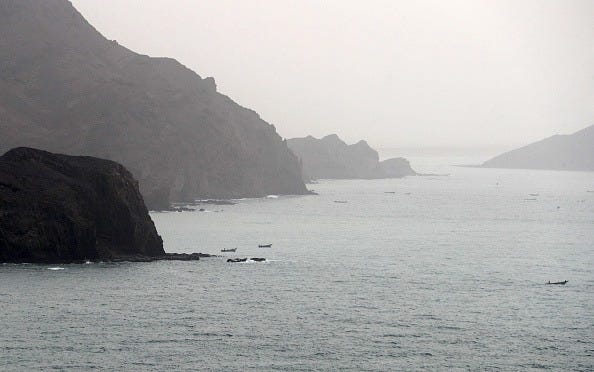
The wild wind that rips across the Bab Al-Mandeb’s choppy waters and thrashes over jagged reefs has earned the 29 km-wide strait between Djibouti and Yemen the name ‘Gate of Tears.’
The Bab Al-Mandeb — much like the Strait of Hormuz — is a crucial shipping route, and the political environment around this waterway is just as hostile as its rugged nature.
While the U.S. and Iran enforce their own blockades of one of the world’s most critical shipping routes, the security of another shipping route could be at risk: the Bab Al-Mandeb.
Sami*, 28, lives in the south of Yemen and has spent nearly a decade organizing humanitarian aid deliveries — everything from free medication to boat motors and GPS equipment for fishermen to safety equipment for beekeepers.
He relies on Bab Al-Mandeb to keep critical aid coming in and fears the consequences if Bab Al-Mandeb’s security is threatened.
Since the start of the war in Iran the Bab Al-Mandeb has been a valuable recourse for countries struggling with the Hormuz Strait shutdown. Saudi Arabia, for example, started transporting their oil across land to the port of Yanbu where it is loaded onto tankers and exported via the Bab Al-Mandeb strait.
However, since the U.S. military has started seizing ships leaving Iranian ports as part of their maritime blockade, Iran has responded by doing the same and promised further retaliation.
Earlier in the conflict, Iran threatened to shut off the Bab Al-Mandeb, located near territory controlled by Yemen’s Iran-backed Houthis, just as it did with the Strait of Hormuz.
On Wednesday, the threat was renewed when a senior Iranian lawmaker said that Iran has yet to show its “new cards” and again warned that Iran’s allies, the Houthis, are “waiting to block [the Bab Al-Mandeb] and deliver another blow to America, its economy, and its illegitimate interests worldwide.”
Two weeks ago, the Houthi Deputy Foreign Minister reminded the world that the Bab Al-Mandeb could still be closed, adding that “all of mankind…will be utterly powerless to open it.”
Closing the Strait of Hormuz has already dealt a blow to Yemen’s fragile economy – Sami is already feeling its impact: two weeks into the war he cost of shipping to Yemen was already 3-6 times higher than it was before the war, which is worrying for a country that imports 85 percent of its food.
As time goes on, this disruption will also likely further delay Sami’s aid shipments, which are a critical lifeline for a country suffering from one of the world’s worst humanitarian crises.
While the damage of closing the Strait of is still yet to reveal itself in full — if the strait of Ban Al-Mandeb closes, global food insecurity could be pushed to new limits.
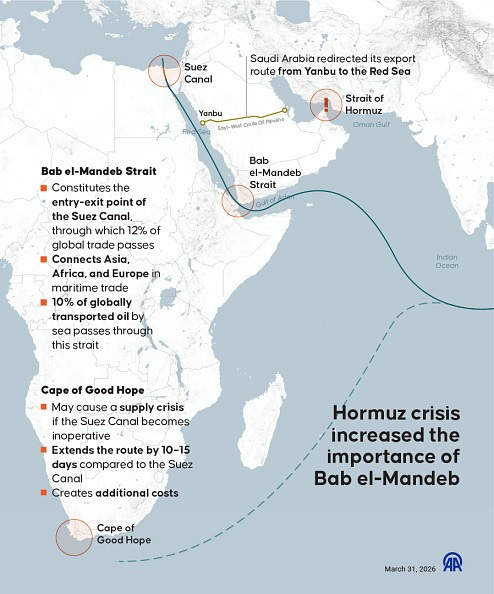
In 2024, the Houthis, an Iran-backed militant group that controls the majority of northern Yemen, traded blows with the U.S. in the Bab Al-Mandeb Strait which flows between Africa and the Middle East – which resulted in shipping through the strait decreasing significantly.
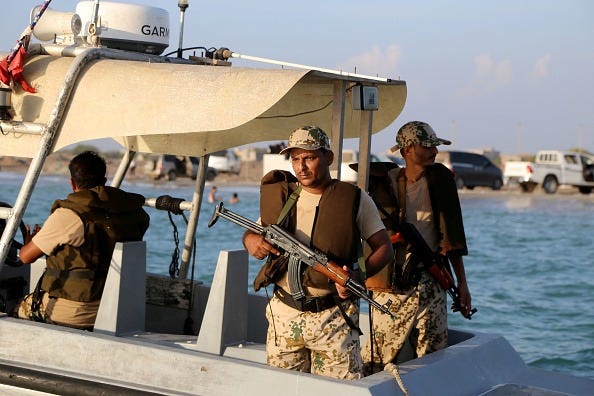
Following Israel’s military response to Hamas’ October 7, 2023 attack, the Houthis began launching missiles and drones at Israel, claiming solidarity with “the Palestinian people.” In late 2023, the Houthis started targeting commercial shipping vessels linked to Israel in the Red Sea, which feeds into Bab Al-Mandeb; the U.S. and UK responded by launching strikes on Houthi targets.
In 2025 the number of ships moving through Bab Al-Mandeb had more than halved since 2023, but after the Gaza ceasefire, ships slowly started returning to the strait.
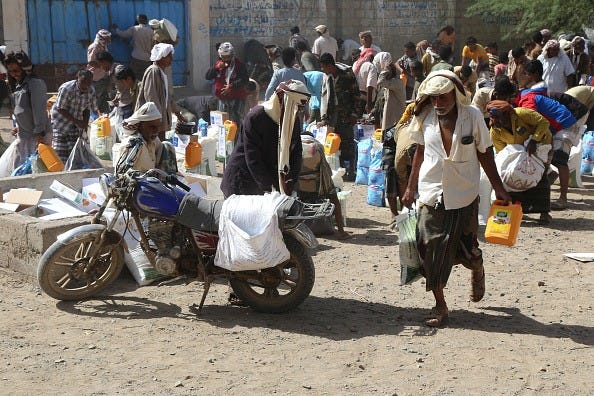
Yemen’s civil war began in 2014 between Yemen’s internationally recognised government and the Houthis; the war has displaced over 4.5 million people and has destroyed much of the economy, with 80% of the population living below the poverty line and nearly half living in acute food insecurity.
Sami’s own family was among those pushed into food insecurity by the war.
When the civil war escalated with a Saudi-led intervention into Yemen in 2015, Sami and his family decided to stay in the city, despite the danger. “It was catastrophic…there were heavy strikes, so many people from our neighborhood died, there were medication shortages and blockages,” Sami explained.
The government in Sami’s area of Yemen was no longer able to pay salaries. “There were no resources, no salaries, so we were relying on the aid just to survive,” Sami said.
Sami had just graduated from university where he studied to become a mechanical engineer, when he found his first job at a power plant set up by a company from the UAE. But sustaining such an expensive project in a country as unstable as Yemen was difficult.
Eventually, the government failed on their payments to the company and the power plant was shut down, leaving Sami out of a job; that is when he started to work in humanitarian aid.
Today Sami’s job involves receiving aid shipments from abroad when they arrive in Yemen and making sure they arrive when and where they are meant to. His organization receives shipments from all over the world: rice and beans from Kenya, solar panels from China, food parcels from Jordan, and medication from Europe and India.
If the Houthis once again bomb ships in the Bab Al-Mandeb strait, it could put shipping insurance premiums through the roof and vastly decrease shipments flowing through the strait – as happened in the Strait of Hormuz.
It wasn’t long after Iran first threatened ships in the Hormuz Strait, that Sami started to notice that a lot of his shipments were being delayed.
“We just know that [the shipments] have been delayed but we don’t actually know why, but the rumors are that it’s because of the Hormuz issue” Sami said.
It’s not just Sami’s organization. A spokesperson from the United Nations Office for the Coordination of Humanitarian Affairs told Iran War Dispatches that they were “concerned about potential disruptions to critical supply routes which could affect the flow of food, fuel and other essential goods into Yemen.”
When Houthis attacked shipping lanes in 2023, Sami’s organization’s aid shipments were disrupted and the local cost of food was driven up.
This time Sami’s organisation is trying to prepare and explore external routes. “If access to seaports is blocked, they might go through Jordan and go over land… [each shipment] has to be done on a case by case basis. It’s not just for NGOs, it’s also for cement factories and power plants - they all have to go through the same thing,” he said.
The internal unrest in Yemen is also at risk of worsening the humanitarian situation, as in the north Houthis have increasingly been attacking and detaining humanitarian workers: 69 UN staff were detained by Houthi’s in 2024 and 2025.
Sami still believes the current crisis is worse than it ever was in 2023.
“The crisis in 2023 was not like the crisis now…the fuel prices were stable in 2023, but now it’s getting worse and worse day by day,” he said.
Skyrocketing fuel prices and fuel shortages will likely impact production costs in Yemen, making everything more expensive, Sami explained.
With the situation unravelling in Yemen, Sami’s years of work could be undone: “War will set you back years…nothing good comes from war,” Sami said.
Editor’s note:
Critical shipping routes impact every reader, no matter where you’re living. Multiple are now at risk.
That’s the headline, but what it means for the people caught in between is what we’re reporting on.
If that’s what you’re here for, you’re in the right place. Subscribe now!
THE LATEST NEWS AT THIS HOUR:
By: Kateryna Antonenko
TRUMP DOUBLES DOWN ON IRAN BLOCKADE: Trump has told advisers he wants the naval blockade of Iranian ports to continue, according to CNN, with his team laying groundwork for a longer-term closure of the Strait of Hormuz. The strategy aims to maximize economic pressure on Iran without resuming airstrikes. At the same time, the head of U.S. Central Command will brief the president on Thursday on new plans for potential strikes against Iran. According to Axios, CENTCOM has prepared a “short and powerful” wave of strikes likely targeting infrastructure.
… AS OIL HITS $126: Brent crude oil, the global benchmark, surged past $126 a barrel Thursday, a high since 2022 during Russia’s full-scale invasion of Ukraine. The markets reacted to Trump’s move to extend the naval blockade of Iranian ports with no set end date. Iran’s oil minister responded by urging citizens to cut energy consumption. This is the wartime high for Brent crude prices, leaving Republicans scrambling to decide how to discuss soaring oil prices with voters ahead of the midterm elections.
HEGSETH CLASHES WITH CONGRESS: In his first testimony since the war began, Hegseth sparred with House Democrats who accused him of misleading the public and firing senior military leaders. Democrats pressed on three points: no congressional authorization, no exit strategy, and rising costs for Americans. Hegseth faced the Senate on Wednesday, 29 April.
WAR DRAINING FUNDS FROM U.S. AND EU: The Pentagon confirmed the conflict has cost $25 billion so far. As Iran chokes commercial shipping through the Strait of Hormuz, the conflict is costing the EU nearly €500 million ($600 million) every day, European Commission President von der Leyen warned — driving up fuel prices and raising fears of a jet fuel shortage within weeks.
PAKISTAN OPENS LAND ROUTES TO IRAN AS SEA BLOCKADE BITES: With over 3,000 containers stranded at Karachi — Pakistan’s largest port and main transit hub for Iran-bound cargo — Pakistan has opened six overland routes to move goods into Iran. The move formalizes a road corridor as an alternative to the blocked Strait of Hormuz. Washington is now pushing allies to form an international coalition to restore freedom of navigation in the Strait of Hormuz, according to a State Department cable seen by Reuters.
CENTCOM: 42 SHIPS TURNED BACK, IRAN LOCKED OUT OF $6 BILLION IN OIL: U.S. Central Command confirmed 42 ships have been turned back by the U.S. blockade of the Strait of Hormuz, with 41 tankers carrying 69 million barrels of oil currently stranded — oil Iran cannot sell, worth over $6 billion.
Best,
Alessandra