


At the bottom of this page: Latest news at this hour.
U.S. aircraft shot down in Kuwait… Israel strikes on Lebanon… Saudi oil refinery shut down… protesters killed in Pakistan…. uncertainty, but not cancellation, for Ukraine peace talks in Abu Dhabi…
Editor’s note:
Regime change is discussed in capitals and conference rooms, but its consequences are felt in streets and homes.
We report from the ground to understand what this moment means for the people living through it. If you value reporting that centers those voices, support our work.

OUR LEAD STORY:
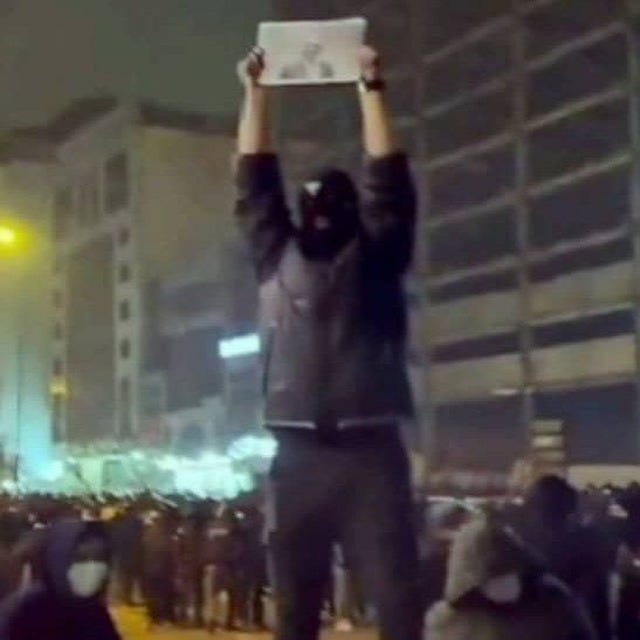
In Tehran’s Sadaat Abad in early January, Arman Ketabchi raised a photograph of Reza Pahlavi above his head as gunfire cracked across the crowd.
Pahlavi is an emblem of Iran before the Supreme Leader, when his father, Shah Mohammad Reza Pahlavi, ruled Iran.
Security forces had taken positions on rooftops. Protesters scattered as gunshots rang out.
“Whoever was in the front of the protests was instantly dead,” said Arman.
A 40-year-old former animal rights activist from Tehran, Arman had joined thousands calling for the end of the Islamic Republic.
They chanted:
Death to the dictator.
Death to Khamenei.
Flags with a lion and sun, the flag of Iran before the 1979 Islamic Revolution, waved alongside depictions of the former Shah’s son, Reza Pahlavi. Arman held one straight above his head.
Long live Reza Pahlavi.
The U.S. and Israel are launching strikes on Iran that have killed Supreme Leader Khamenei and other top government officials. President Trump is encouraging Iranians to take over their country in an attempt at regime change.
With Iran’s regime on the brink of collapse, Iranians are now faced with a new question: who should come next?
The fall of a regime is not only about new leaders, but a test of the system: whether an autocratic state can survive without its key leadership.
Reza Pahlavi, the eldest son of Mohammad Reza Pahlavi, Iran’s last Shah, is emerging as a popular option for the next leader. But some Iranians, like Farhad, remember that the monarchy was the reason for the revolution in the first place.
Farhad has heard a similar story from his grandfather and father: protests and gunshots.
But this time the gunshots weren’t killing pro-Shah protesters – they were coming from the Shah’s authorities, and Farhad’s grandfather fell in the crossfire.
The Shah’s reign was known for its brutal tactics on opponents of the government. SAVAK, the Shah’s secret police trained by French forces and the CIA, was particularly notorious for its torture tactics.
“The first time we had a revolution, we got rid of the Shah and now we are having another revolution to bring back the Shah,” Farhad said.
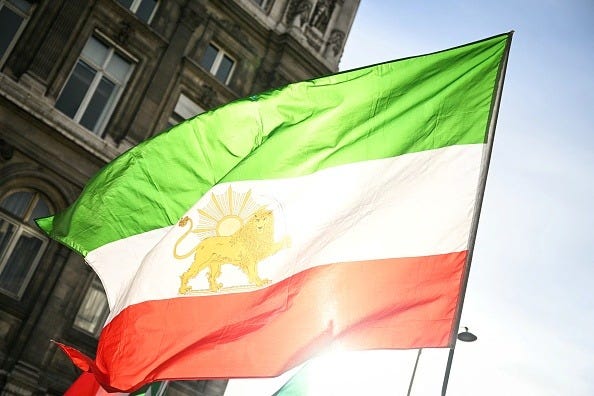
When Iran’s spiraling economy and rising living costs sparked protests last December 2025 people filed out onto the streets, many of them under the Shah’s flag.
Some Iranians, like Arman, are coming out in support of the Shah, not because they want the restoration of the monarchy, but due to his promise in January 2026 to lead the country in a transition to democracy.
For decades, the exiled son of Iran’s last Shah has lived outside the country his father ruled from 1941 until 1979, when the Islamic Revolution ended his reign.
Now Reza Pahlavi, 65, has emerged from his home in the U.S. as one of the few figures capable of commanding attention across Iran’s fragmented opposition.
He has been a major force in calling protesters out onto the street, positioning himself as a legitimate leader by meeting with heads of state like President Trump and President Zelenskyy.
In January, Pahlavi even went on Fox News and spoke of the future of American investment into Iran.
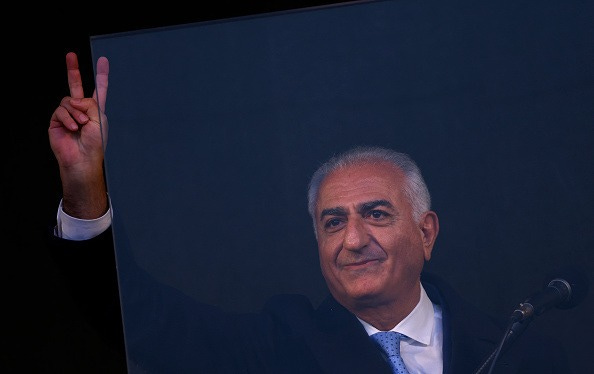
Many, like Arman, want the version of Iran that they knew before the Islamic regime to return, and Reza Pahlavi represents that.
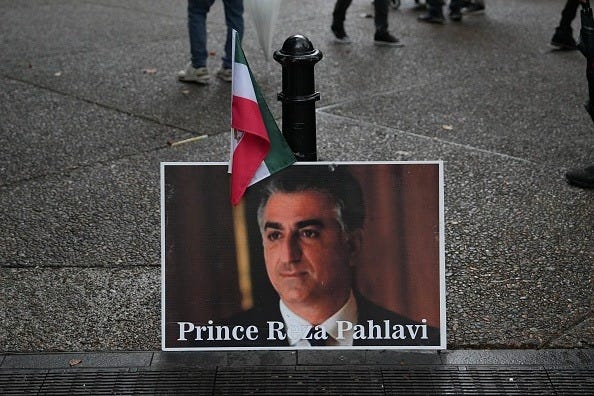
Arman has always taken part in protests, sometimes fleeing the country to Turkey after being identified by the IRGC as a dissident, just to return back for the next wave of resistance.
He calls himself a “freedom-loving person,” and he can’t bring himself to stay away from the fight for a new leadership at home.
Like many protesters, Arman is attracted by Reza Pahlavi’s promise of acting as a transitional leader to a democratic future.
Arman thinks Pahlavi is not like his father, the former Shah, and that instead of restoring a monarchy, he will help the country transition toward democracy. He described Pahlavi as educated, modern, and capable of uniting factions during a transition.
“This regime destroyed every social and political system, and mismanaged the country to a point that we had a natural and economical disaster. We need a restart. Reza Pahlavi offers one. So for now, I endorse him,” said Arman.
But Iranians who hope for the fall of the current regime do not have a singular vision for the future — Farhad wants nothing to do with the Pahlavi family.
While Farhad thinks the idea of democratic elections and a transitional figure is a nice idea, he thinks it will never become a reality. Many Iranians, particularly Kurdish people like Farhad, believe that Reza Pahlavi could send Iran into a new dictatorship.
Under Mohammad Reza’s reign Kurdish people were brutally oppressed. Although both the supporters of Reza Pahlavi and Kurdish opposition groups are pushing for the fall of the current regime, Kurdish opposition groups today have a distinctly different agenda: they want to establish their own state and separate from Iran.
Kurdish opposition groups recently reminded Pahlavi that his family was remembered for the “massacre of civilians and suppression of democratic freedoms of the Iranian people, especially the oppressed nations of this country,” while Reza Pahlavi accused them of violating the “territorial integrity and unity of Iran”.
Around 15 years ago, when Farhad served in the Iranian military as a border guard at 18, he witnessed a family get caught trying to cross into Turkey. He claimed the Iranian forces committed atrocities on that family, which The Iran War Dispatch cannot independently verify.
After that, Farhad understood that the Iranian regime was not something he wanted anything to do with. Farhad left his position and joined a Kurdish militia group.
Before Farhad hit his mid-twenties he had been a member of two different Kurdish militia groups, switching affiliation as he began to understand what he believed in.
Mohammad Reza’s brutality towards Kurdish people often manifested in brutal crackdowns on protests, one anti-Shah protest in Kurdistan in 1978 took the lives of 15 protesters.
When Mohammad Reza was in power, he led a brutal crackdown on the Kurdish part of Iran in the city of Sanandaj where his family was from, Barzan explained.
“When my father was 9 or 10 years old, he joined the protests with my grandfather. They were calling for Kurdish people in administrative positions in Kurdistan,” Farhad said.
But for the Iranian monarchy this was a problem.
“The government knows that if the Kurdish people stop being deprived of resources, Kurdistan could separate from Iran,” Farhad explained.
Although Farhad’s grandfather ended up getting shot in the foot, he never spoke about what happened.
Farhad only found out about his experience from family friends.
He didn’t want his grandson to take the risks of getting involved in other protests, Farhad said.
“I am sure that no Kurdish people want the prince to come to power,” Farhad said.
*Fahrad’s name has been changed to protect his identity.
CORRECTION: Iran War Dispatches made a mistake regarding the location of the photograph of the protests. It occurred in Sadaat Abad in Tehran. We apologize for this error.
NEWS OF THE DAY:
By Oleksandra Khelemendyk
U.S. AIRCRAFT CAUGHT IN FRIENDLY FIRE IN KUWAIT: Yesterday, 3 U.S. F-15E Strike Eagle jets were accidentally shot down in Kuwait due to friendly fire, the U.S. Central Command reports.
ISRAEL STRIKES HEZBOLLAH IN LEBANON: Israel said it targeted the militants of Hezbollah, Iran’s ally in the Middle East, including its senior officers. Lebanese journalists report that at least 31 people have been killed and 149 injured in the southern suburbs of Beirut.
These strikes were a response to the first Hezbollah attack on Israel since the war in 2024, which the group called a retaliation for the killing of Iran’s Supreme Leader Ali Khamenei.
Lebanese President Joseph Aoun criticized Israel for the attacks, as well as the involvement of Lebanon in the conflict.
MAJOR OIL REFINERY IN SAUDI ARABIA SHUT AFTER A STRIKE: The country’s largest oil refinery in Ras Tanura is shut as a precautionary measure after two drones were intercepted on the site.
According to Saudi officials, the event will not affect local oil markets. Still, two major oil producers in Iraqi Kurdistan and large Israeli gas fields were temporarily stopped due to the conflict. Strikes could have affected facilities on the Kharg Island in Iran, OPEC’s third-largest oil producer.
The supply anxiety in the oil market made crude oil futures surge by 10 per cent.
U.K. WILL TURN TO UKRAINIAN EXPERTS TO SHOOT DOWN IRANIAN DRONES: According to Keir Starmer’s nightly address, the U.K. will take defensive action in the Middle East, where at least 200,000 British citizens currently reside.
British and Ukrainian experts will cooperate to intercept Iran’s drones more effectively. Zelenskyy said that Ukraine is ready to assist in shooting down Shahed drones and other air targets. He noted that Russia attacked Ukraine with over 14,000 bombs, more than 700 missiles and almost 19,000 drones in the last three months.
23 PROTESTERS KILLED IN PAKISTAN: After the death of Iran’s Supreme Leader Ali Khamenei, protests erupted in Iraq and Pakistan, which have the largest populations of Shi’ite Muslims after Iran itself. At least 23 Pakistani protesters were killed in clashes in the cities of Karachi, Skardu and Islamabad.
American citizens also oppose U.S. military action. Yesterday, U.S. Senator Tim Kaine of Virginia condemned the U. S. attack on Iran, as other U.S. officials do not believe that the U.S. will be able to topple the Iranian autocratic regime. The recent Reuters Ipsos poll shows that only one in four citizens approves of the U.S.-Israeli attacks.
UKRAINE PEACE TALKS IN ABU DHABI UNCERTAIN BECAUSE OF WAR: Military conflict in the Middle East might affect the trilateral peace negotiations between Ukraine, Russia and the U.S., planned for 5-6 March in Abu Dhabi. Zelenskyy said that he cannot confirm the exact location, yet the meeting was not cancelled.
Previously, he called this meeting important to Ukraine and said that he “updated the instructions” for the Ukrainian delegation.
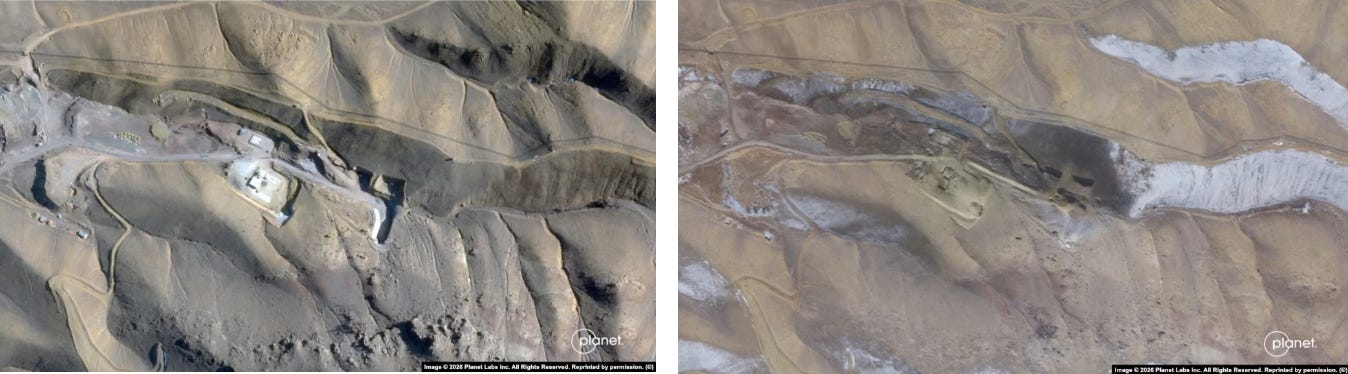
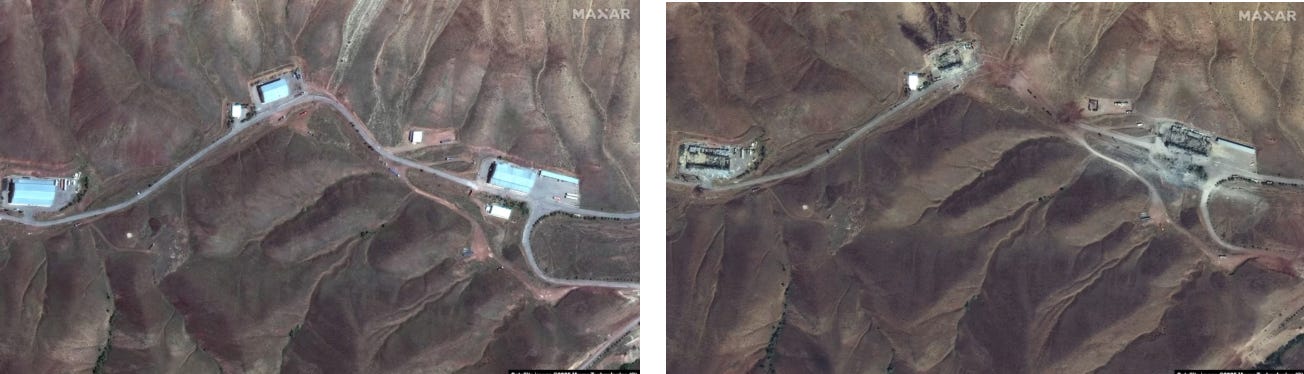
SATELLITES SHOW IRAN’S MISSILE BASE AFTER STRIKE: Satellite photos taken by Planet Labs PBC show the missile launching site in Tebriz damaged by the U.S.-Israeli strikes on February 28.
Israel also attacked this base in June 2025 and damaged its storage units.
CAT OF CONFLICT:
Oleksandra’s cat Kompot looks really serious today. She thinks he might judge her for something.

Stay safe out there.
Best,
Jacqueline and Alessandra
Thank you for the diverse coverage of what is happening with Iran. The insight you provide helps make this conflict more understandable.
Kompot probably is judging the news content, and finds it lacking in ways the animals understand and we're too simple to recognize.