


At the bottom of this page: Latest news at this hour.
Iran could reopen the Strait of Hormuz ahead of peace talks.…Hegseth says the U.S. could still take Iran’s uranium…Iran continues attacks on Gulf States…Both the US and Iran claim victory after the ceasefire deal…Lebanon is excluded from the ceasefire.

Editor’s note:
It’s the 40th day of the Iran war, and a two-week ceasefire was just announced. But fighting continues, and so do we—working to keep you informed.
If you value our work, subscribe, and tell your friends, too!
OUR LEAD STORY:
Arash* found out about the ceasefire while he was driving to Armenia from Iran to join his family — they drove north to Armenia just days before the war started. “The U.S. was building up its military forces in the region; we knew what was coming. So my wife and children left,” Arash explained.
Arash had promised his family that he would join them in Armenia but remained in Iran until Trump threatened to bomb civilian infrastructure, including bridges and power plants, if Iran did not open the Hormuz Strait. Many experts deemed this a threat to commit war crimes.
Arash knew that if the U.S. started bombing the railways and roads, it could become very difficult to leave.
“I heard about the ceasefire while I was on the road [to Armenia]. I was happy when I heard about it…I think it’s wrong that Trump was planning to bomb civilian infrastructure. It has nothing to do with him,” he explained.
Today, people living in Iran and neighboring countries have been left reeling by recent peace talk developments between Iran and the U.S.
Yesterday, just hours before Trump’s 8 p.m. deadline to open the Strait of Hormuz, Trump said that Iran’s “civilization will die tonight.” Then, just over an hour before the clock struck 8 p.m. EST, he announced a two-week ceasefire.
Trump said he had received a 10-point proposal from Iran, one of the points calling for an end to attacks on Iran and its allies, which he described as a “workable basis on which to negotiate.”
But the first day of the ceasefire has already proven shaky: Israel is hitting Lebanon with the heaviest strikes of the war thus far, Iranians are fleeing across the border with little faith in the ceasefire, and many Israelis spent the morning in a bomb shelter. Bahrain, the UAE and Kuwait all reported fresh strikes from Iran this morning.
Iran War Dispatches spoke to people across the region about how they are experiencing the first 24 hours of the ceasefire.
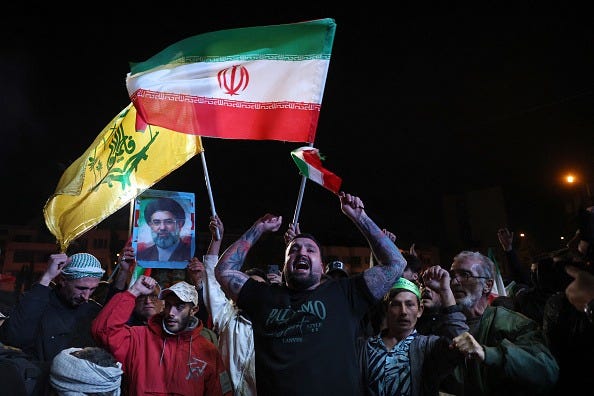
Danial*, 23, arrived in Armenia from Iran just as the ceasefire was being announced. “As soon as I crossed the border and turned on my phone, I found out that there was a ceasefire,” Danial explained, chuckling at the irony.
He said that he is happy that the ceasefire means his family will be safer, but he also doubts that it will hold. “I don’t think this ceasefire will last…[Trump] has a 50 billion dollar budget for war…he can’t just tell [the military] to go home,” Danial explained.
About 20 days ago, he decided to try to make life work in Armenia. Although he is only 23, Danial has been planning how he will make it to Germany, where he dreams of working in dentistry, for a few years.
He explained that living in Iran puts children under so much pressure that they are forced to grow up much quicker than in other countries.
For some Iranians, like Sara*, Trump’s threats fell on deaf ears. “He never does what he says he’s going to do,” Sara said. She explained she didn’t believe the threat of the attack, nor did she believe the promise of the ceasefire.
While there are those like Sara that don’t believe Trump, there are also those who have been left out of the ceasefire completely.
For 33-year-old Anthony, a native of Beirut, the day following the ceasefire in Iran was brutal: “What’s happening now is actually the heaviest strikes on Beirut since day one…I’m not sure if this is the final day, which is why it feels so horrible, or if it’s just the beginning.”
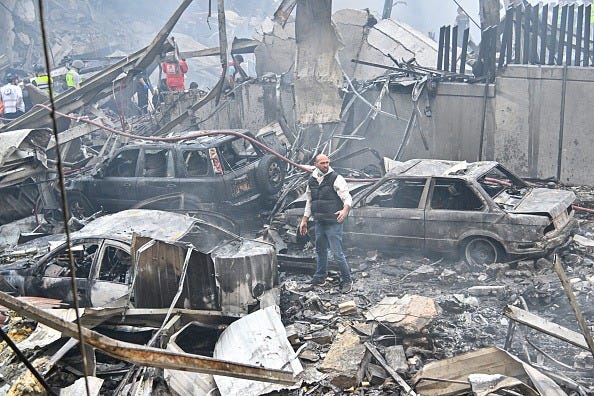
Anthony described the situation as one of the worst since the start of the war, with nonstop bombings over the past several hours. The relentless attacks have left many in Beirut doubting that peace will come to Lebanon anytime soon.
Despite the newly announced two-week ceasefire, Israeli Prime Minister Benjamin Netanyahu made it clear that Lebanon is not included in the deal. He stated that military operations against Hezbollah will continue. Later in the day, Israeli officials confirmed new attacks on Lebanon.
“This is the largest attack carried out against Hezbollah’s infrastructure since the start of Operation Lion’s Roar,” Israeli army spokesperson Avichay Adraee said on X.
Pakistan, which is mediating negotiations, said the ceasefire does apply to Lebanon, according to PBS.
Since the outbreak of the war, Israel has rarely targeted central Beirut, focusing its strikes on southern and eastern Lebanon and the city’s southern suburbs.
However, on Wednesday afternoon, Israeli airstrikes hit several densely populated commercial and residential areas in central Beirut without warning, hours after the United States and Iran announced a two-week ceasefire.
Wednesday’s airstrikes left dozens dead and hundreds more injured, according to Lebanon’s health ministry.
Anthony, who has lived in Lebanon his entire life, and currently works at an NGO assisting the displaced people from Southern Lebanon, feels very skeptical about the future of his country.
“Somehow, Lebanon always gets hit the worst,” he said. “My father lived through this war, his father too, and now I am feeling the consequences of it. It feels like it has no end.”
In Israel, whose military is launching these very strikes, air raid sirens continue to sound across the country.
On a kibbutz in the Negev desert in Israel, Jared White, 41, watches his three young children jump on a trampoline and spray water on themselves while Israeli jets fly overhead. “This entire conflict I think of my children, and the world we will leave them,” Jared said.
No one slept last night, he said. Everyone was on edge from Trump’s threats to end Iranian civilization.
Just this morning, after many Israelis woke up to news of the U.S.-Iran ceasefire, he and his family heard air sirens and ran into a bomb shelter. Rockets fell not far from his kibbutz. As he spoke to Iran War Dispatches, there were sirens sounding in the north of Israel, the site of many more attacks than where he is. His wife was inside their home, baking a cake for a holiday that symbolizes the end of Passover, Mimouna.
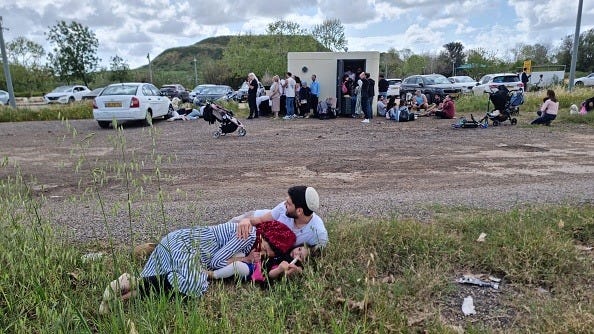
“People are a little bit skeptical,” he said of the ceasefire. “We all know this is not the end of the game.”
Jared feels he has more questions than answers at this point. Will his kids return to school tomorrow? Will he get called up to the reserves in the morning? Is this the way the war should end, if it’s ending at all?
“The uncertainty is the worst, by the way,” Jared said. “Not knowing what tomorrow will bring.”
Editor’s note:
It’s the 40th day of the Iran war, and a two-week ceasefire was just announced. But fighting continues, and so do we—working to keep you informed.
If you value our work, subscribe, and tell your friends, too!
The latest news at this hour:
By: Kateryna Antonenko
IRAN COULD OPEN HORMUZ BEFORE PEACE TALKS: Senior Iranian officials involved in the peace negotiations have told Reuters that the Strait of Hormuz could be opened on Thursday or Friday under certain conditions. In its 10-point ceasefire proposal, Iran included a provision allowing both Iran and Oman to charge a transit fee for ships passing through the Strait of Hormuz.
Oman rejected the idea, stating that “no tolls can be imposed for crossing Hormuz.” Oman’s Transport Minister noted on Wednesday that the Sultanate signed agreements ensuring that ships can pass through the strait free of charge.
HEGSETH CLAIMS U.S. COULD STILL TAKE IRAN’S URANIUM: Defense Secretary Hegseth said that he hopes that Iran hands over its enriched uranium but that if Iran fails to do so the U.S. will “reserve [the] opportunity” to do it their own way. “It’s buried and we’re watching it, “ Hegseth said.
If the U.S. were to seize uranium by force, the operation would require thousands of ground troops.
IRAN CONTINUES ATTACKS ON GULF STATES: Iran increased strikes on Gulf states despite the ceasefire.
Just after the ceasefire was announced, the UAE said that Iran attacked the country with 35 drones and 17 ballistic missiles. This was a larger attack than on the previous day. Bahrain and Qatar also reported attacks from Iran and Kuwaiti officials reported that Iran launched 28 drones on Wednesday.
VITAL OIL PIPELINE ATTACKED IN SAUDI ARABIA: Two anonymous sources said that one of the pumping stations along Saudi Arabia’s east-west pipeline was damaged by a drone attack, The Financial Times reported.
The pipeline, where crude oil is carried from the Gulf to the Red Sea for export, became vital for the Saudi economy since the closure of the Hormuz Strait. It was attacked hours after Iran and the U.S. agreed on a ceasefire.
IRAN SAYS U.S. DEFEATED WHILE HEGSETH DECLARES VICTORY: Defense Secretary Hegseth declared a decisive victory over Iran, saying that Iran’s defense production had been destroyed.
Meanwhile, Iran’s senior adviser on international affairs, Ali Akbar Velayati, said that the U.S. was strategically defeated when it accepted the ceasefire in the Middle East.
Iranian state-aligned news agency Tasnim cited Velayati saying that Iran should be prepared to respond to any further threats.
LEBANON EXCLUDED FROM CEASEFIRE: Pakistan’s Prime Minister Sharif, who brokered the deal, declared the truce applied “everywhere, including Lebanon.” But Netanyahu’s office swiftly contradicted him: the two-week ceasefire does not cover Lebanon. Israeli strikes on southern Lebanon and Beirut continued. Lebanon’s status under the agreement remains unresolved.
Before the ceasefire was announced, the IDF issued evacuation warnings as the military prepared strikes against Hezbollah in the area. Residents were ordered to evacuate north of the Al-Zahrani River. “Hezbollah’s activity forces the IDF to act against it. The IDF does not wish to harm you,” said IDF spokesperson Avichay Adraee.
OIL TUMBLES AFTER U.S.-IRAN CEASEFIRE: The announcement of a conditional two-week ceasefire between Washington and Tehran — contingent on reopening the Strait of Hormuz — triggered an immediate reaction across global financial markets. Brent crude plunged roughly 13% to $94.80 a barrel, while US-traded oil dropped more than 15%. Still, both benchmarks remain well above the $70-per-barrel level seen before hostilities broke out on February 28.
Tim and crew -- I so greatly appreciate you all providing these updates. Here in the US it can take awhile for the news to be released.
Invaluable news from the region today! Worth every penny of my subscription.