

At the bottom of this page: Latest news at this hour.
Search for second F-15 pilot continues… Iran refuses to negotiate in Islamabad… Iran claims essential goods are passing through the Strait… debris from interception hits Oracle building in UAE… Iraq closes border crossing with Iran after Iraqi citizen killed.

Editor’s note:
As this war enters its second month, our human-focused reporting is more important than ever. Stories like Elias’s, which you’re about to read, are easy to lose in the headlines. We promise not to.
If you care about this kind of coverage — recentering the war on the people living through it — subscribe now. It’s free!
OUR LEAD STORY:
Three Humvees descended the outskirts of Kfarkela, a Lebanese border town by the Golan Heights, kicking up sand behind them. The Israeli convoy moved north, following a strategic highway on the way to an equally strategic hilltop, past a series of caved-in roofs.
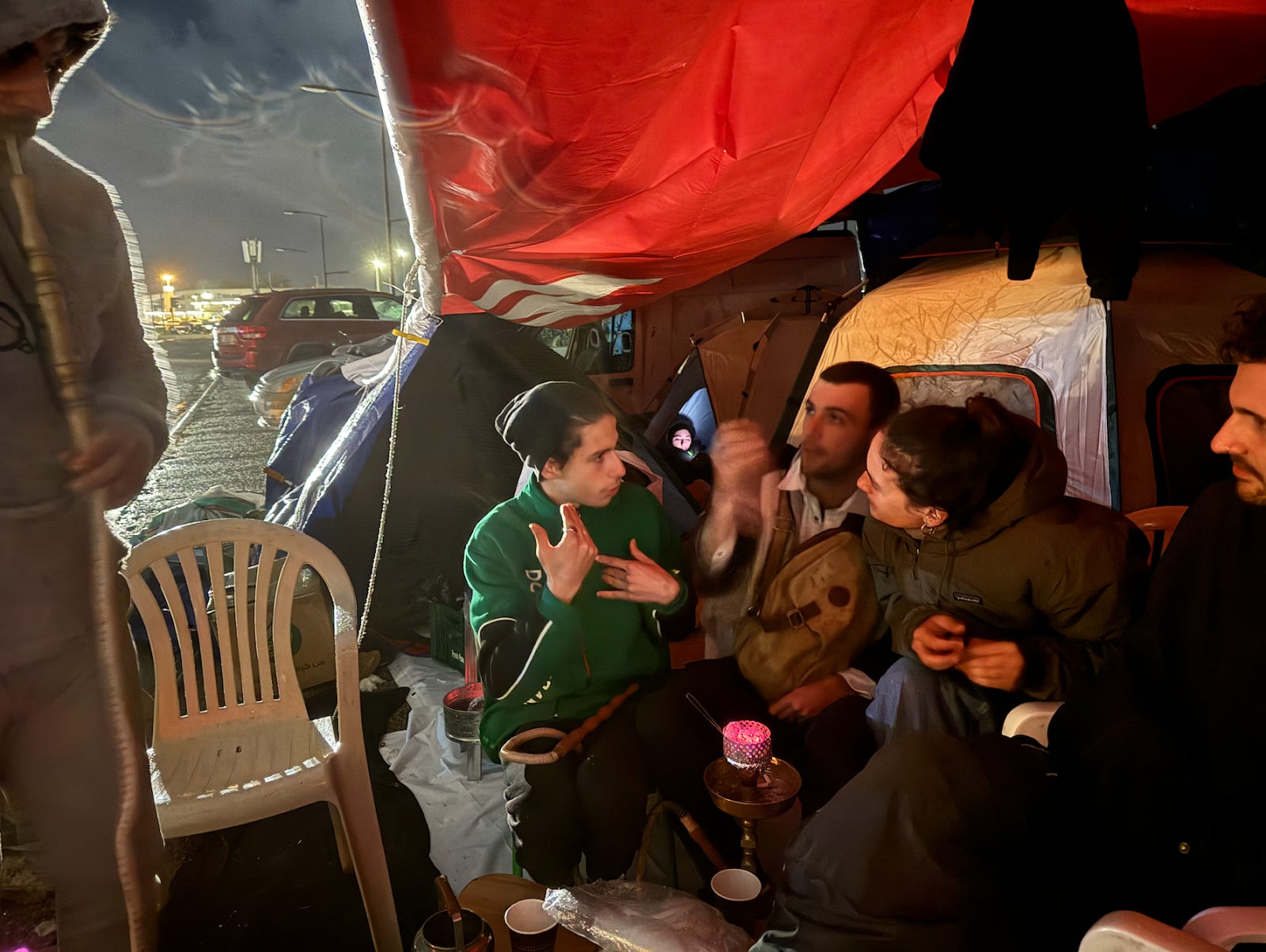
By the time they passed Elias’s house, he was halfway across the country, sitting beneath a polyurethane cover on Beirut’s waterfront. Most of his family now lives under the rectangular structure, next to ever-expanding rows of tents dotted with small fires.
Last week, the Israeli army received new directives to begin demolishing border towns ahead of what the defense minister called a defensive buffer zone. Elias’s childhood home and school, less than one mile from the border, are in this buffer zone.
As the Israeli war with Hezbollah threatens to permanently shift Lebanon’s borders, roughly one fifth of the country is now displaced. Many have found their way to Beirut’s public spaces, left to make impossible long-term decisions as the world shifts rapidly around them.
Among them are taxi drivers, salesmen, farmers, and doctors, as the war collapses ordinary social distinctions. One month into the invasion, Beirut is quickly becoming a symbol of what mass displacement does to a city.
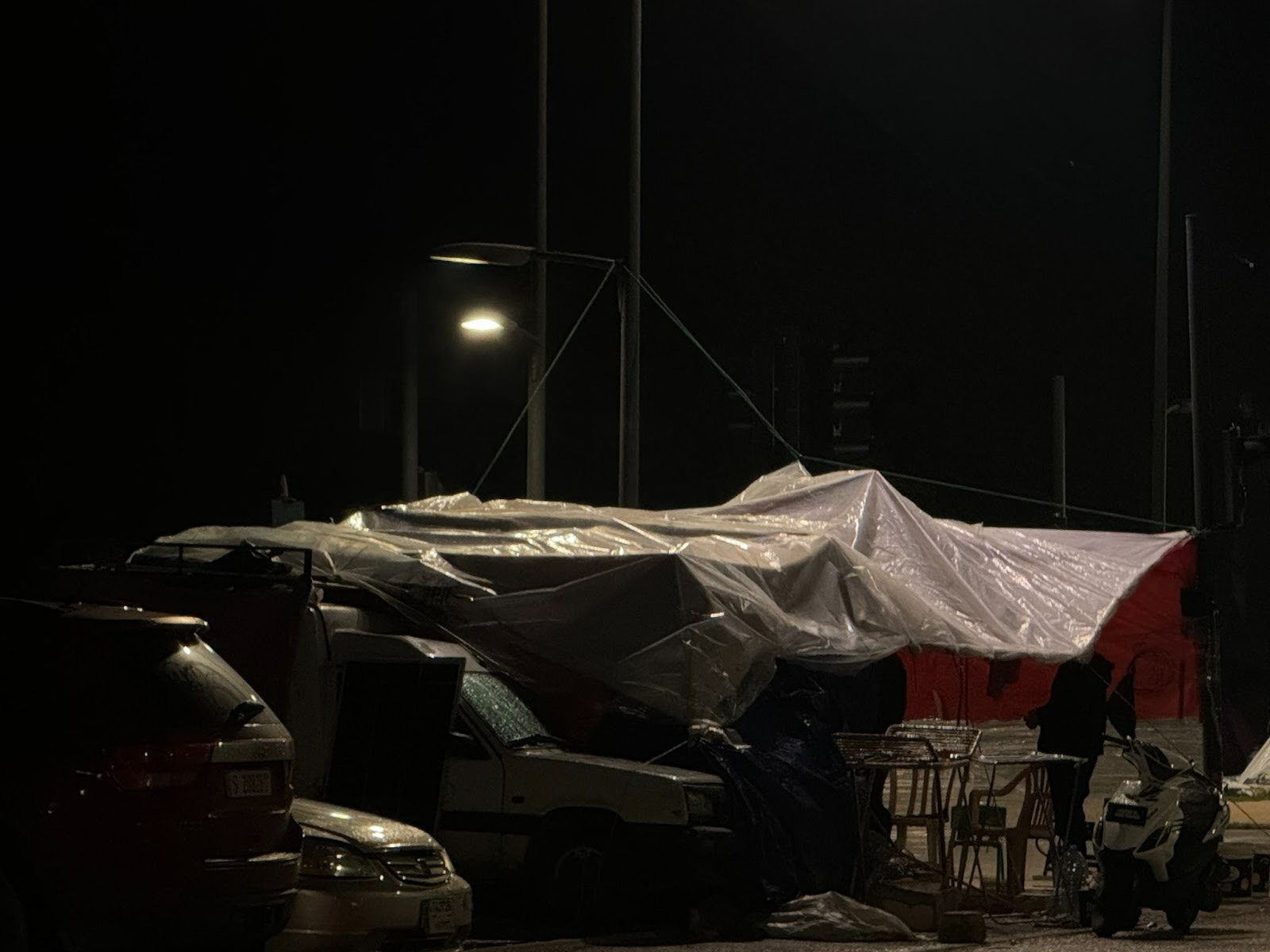
In the last few weeks, Elias’s uncle had kept his four daughters busy, leading them in the construction of a proper lean-to. Once a building contractor in the south, he showed them how to counterbalance the nylon cables, affixing a series of tarps to the family van and a nearby streetlight. In the kids’ tents, he layered mats and pillows.
The real brilliance, Elias explained, was the other side of the streetlight, where the pair recently finished a covered room tall enough to stand in, filling out tarp walls with wooden pallets wrapped in cellophane.
That side was the first to go when the rain came.
After midnight on March 28, the Israelis conducted heavy low-altitude flights over Beirut. Hours later, while the daughters were sleeping in their tents, and Elias and his uncle sat smoking hookah, the sounds of thunder reached the seaside parking lot.
They unfurled the door and gripped the roof.
From inside the dark cover, they felt sharp pains of water and cords tearing. The cover of the new addition whipped back and, being attached to the original structure, split the old roof down the center.
Without the cover, the rain started pelleting the tents, waking up the girls. As they unzipped their doors to find the sky above them, it only took a moment for their cushions to fill with water. Then the aluminum poles snapped, and the family hurried to the van, watching through the windows as the water flattened their tents.
As a child, Elias remembers knowing not to get too close to the border. His family, owners of a prominent local private school, had a ring of houses in the hillside village, connected by large yards and a vegetable garden.
A year and a half ago, the last war tore through Kfarkela, when Hezbollah and Israeli forces took turns bombarding the border town.
Like many of the town’s residents, Elias fled to Beirut’s southern suburbs in a neighborhood called Ghobeiry, living with his uncle in a rented flat. The new neighborhood, like Kfarkela and much of south Lebanon, is predominantly Shia, the religious sect to which Hezbollah belongs.
For 140 days, he read WhatsApp feeds of town landmarks being destroyed, keeping a mental map of what had been hit.
Then, one day in February 2025, the Israelis withdrew, and Elias and his friends drove down to see their houses.
Over the sounds of curious Israeli helicopters, they set up chairs in the yard, smoked hookah, and reminisced about where the walls of their kitchens and their flowerbeds used to be.
For a year, Elias lived in the Beirut suburb of Ghobeiry with his uncle and four cousins, clinging to normalcy and trying to find a way to finish nursing school. The first displacement had drained their savings, but the family was slowly regaining its footing. Elias, 20 years old, promised himself he would take his last year abroad.
On March 2, 2026, Hezbollah struck northern Israel with a missile barrage, and within fifteen minutes, the family of six, plus Elias, was packed into his uncle’s car headed north.
For three nights, the family slept in a car in central Beirut, on the corner of the Parisian Hotel.
In the south, Elias’s hometown was once again a frontline, split down the center by Israeli convoys headed north to the real battle in the village of Khiam.
For days, Elias held out hope that the war might stay in Kfarkela and that the family could soon return home to their new house in Ghobeiry.
Israeli spokespeople had been publishing maps ordering evacuations from the border regions. By the end of the week, they were also releasing maps of Beirut, he said, with red rectangles superimposed on seven neighborhoods. One was Ghobeiry.
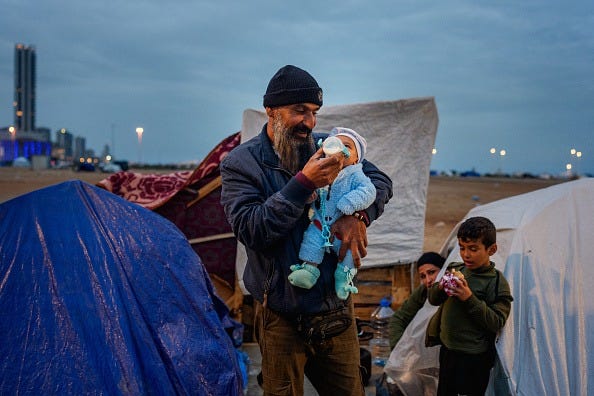
The family bought a few tents and made their way to a large industrial parking lot on Beirut’s waterfront, where dozens more families, dazed and tired, were doing the same.
That day, hundreds of thousands clogged Beirut’s main arteries seeking refuge from the airstrikes.
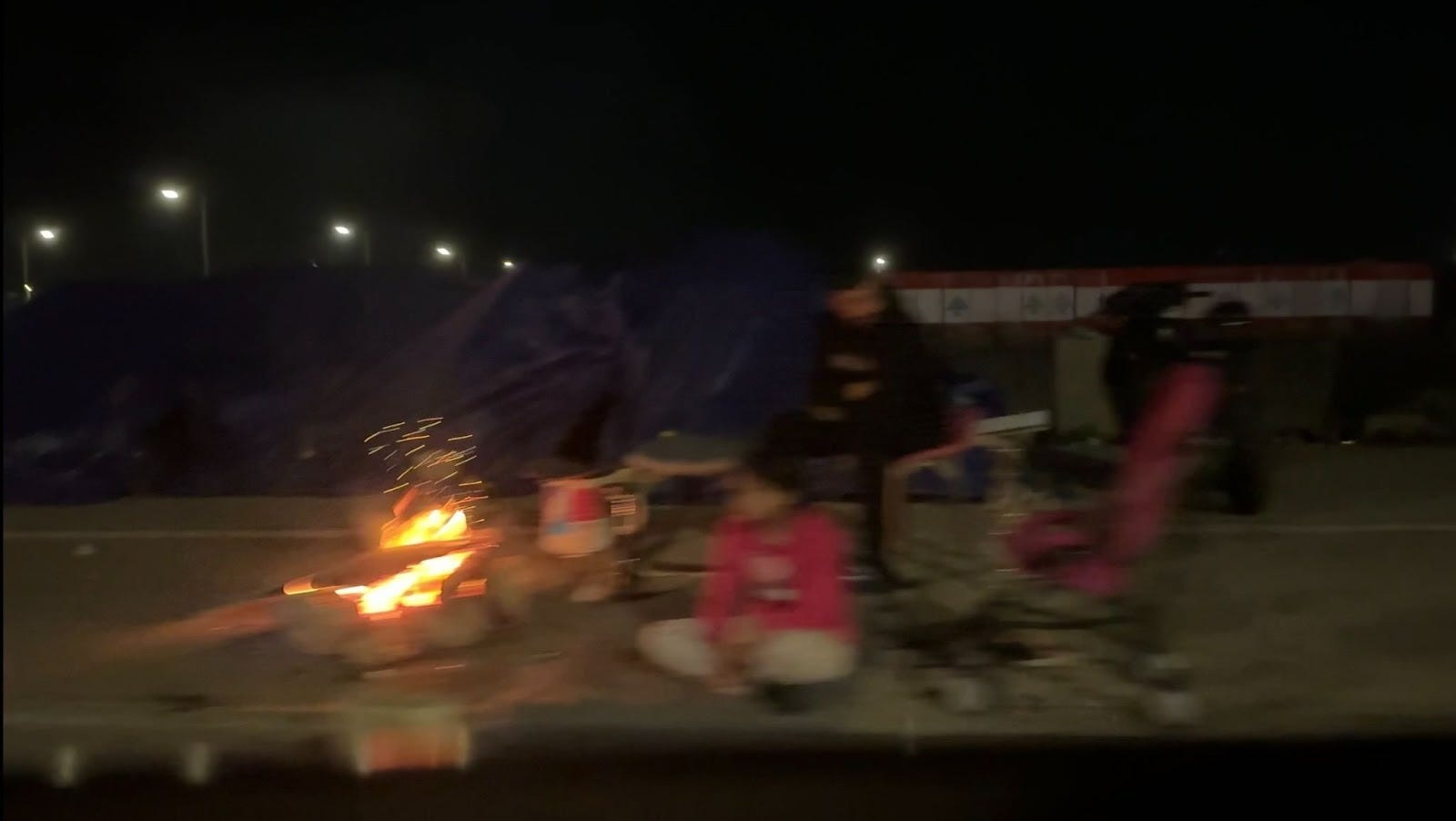
Elias jokes that you can tell, based on the tent, where someone’s from and how long they had to evacuate.
A man from Khiam lives in a small tent down the block from a neighbor he vaguely recognizes from back home. A family from Hayet Hreik sleeps under a large canopy.
A Bangladeshi domestic worker from a wealthy couple in the south pitches a bivouac by a row of Syrian families, almost all of whom, only months prior, had found safety in Lebanon.
During the day, some men leave the camp to work, driving cabs around Beirut. Other times, mothers teach impromptu school classes or lead rows of small children in chorus.
After a day of heavy strikes, the camp is sometimes blanketed in the suffocating smell of burning apartment blocks and furniture.
Elias has been smoking seven hookahs a day, up from his daily tally of three before the war.
At dawn on March 29, his hookah stand was caught by the tent and shattered during the storm. The family piled into the van as the rain beat down the boardwalk and their tent cover disappeared into the distance.
Elias’s uncle sat still, thinking about returning to the family house less than four miles away to grab fresh blankets and couch cushions.
There had been strikes in the suburbs the previous night, and since the evacuation orders, he and Elias had only made the trip once. They resolved to wait for the bulk department store to open, watching the rows of downtown coffeeshops turn on their heated lamps across the street.
Two weeks ago was the last time Elias visited his neighborhood. He had waited nervously in the car while his uncle ran upstairs and collected medicines, a coffee pot, and some clothes. The TV was still there, sitting beside the couch and the dining table.
The streets below had no parked cars.
From up in the mountains at night, the city of Beirut looks like it has a park in the center, a black void in the shape of their neighborhood.
Editor’s note:
As this war enters its second month, our human-focused reporting is more important than ever. Stories like Elias’s, which you just read, are easy to lose in the headlines. We promise not to.
If you care about this kind of coverage — recentering war coverage on the people living through it — subscribe now. It’s free!
The latest news at this hour:
By: Oleksandra Poda
SEARCH FOR SECOND F-15 PILOT CONTINUES: The second crew member of the downed F-15E has not yet been found. U.S. special forces continue their search operation on Iranian territory, while Iran is mobilizing its own population.
Iranian state media aired footage showing individuals heading into the mountainous areas of Khuzestan with rifles, searching for the missing crew member, according to The Washington Post. Earlier reports claimed that “many people” had traveled to the region to try to capture the American, while Iranian armed forces urged the public not to harm the pilot.
IRAN REFUSES TO NEGOTIATE IN ISLAMABAD: Iran has officially informed mediators that it is not willing to meet with U.S. officials in Islamabad and considers the U.S. demands unacceptable.
Turkey and Egypt are looking for alternative venues, considering Doha or Istanbul. Qatar, in turn, has declined the role of chief mediator.
GLOBAL FOOD PRICES ROSE BY 2.4% IN MARCH: Global food prices rose by 2.4% to its highest level since last September. The FAO’s chief economist warned: “Farmers will have to choose: plant less or switch to less intensive crops.”
The Strait of Hormuz handles up to 30% of internationally traded fertilizers. The Iran conflict coincided with the global planting season, and every week of the blockade directly threatens the 2026 harvest worldwide, particularly in Africa and South Asia.
IRAN’S TASNIM CLAIMS ESSENTIAL GOODS ARE PASSING THROUGH THE STRAIT: Iranian media reported that Iran authorized the passage of essential goods through the Strait of Hormuz, according to Reuters. The letter cited by semi-official Tasnim states that vessels bound for Iranian ports, including those currently in the Gulf of Oman, must coordinate with authorities and adhere to established protocols in order to transit the strait.
At the same time, U.S. intelligence assesses that Tehran is unlikely to ease its control over the Strait of Hormuz in the near future, even after the active phase of hostilities ends, as the blockade is an effective lever for maintaining sustained pressure.
China, India, Pakistan, Iraq, and Russia are already on Iran’s “white list.”
DEBRIS FROM IRANIAN ATTACK HIT ORACLE BUILDING IN UAE: Debris from an intercepted Iranian drone fell on an Oracle office building in Dubai Internet City.
This attack follows the Iranian Parliament Speaker’s threat on American tech companies in the Middle East. Oracle, Amazon Web Services, and Microsoft Azure cloud servers located in the UAE serve millions of customers across the Middle East and Asia․
IRAQ CLOSED BORDER CROSSING WITH IRAN FOLLOWING THE DEATH OF AN IRAQI CITIZEN: Iraq has closed the Shalamcheh border crossing near Basra, one of the key transit points between the two countries, after an Iraqi citizen was killed in an airstrike on the Iranian side.
Iraq’s oil industry had already collapsed due to the blockade of the Strait of Hormuz, with Basra cutting production by 70%. Now the country is also losing its land corridor to Iran.
IRAN WAR CAUSING A GLOBAL AVIATION CRISIS: Before the start of the Iran war, the global aviation industry was expecting record profits of $41 billion in 2026. With jet fuel prices more than doubling, airlines are cutting flights. Air New Zealand and Vietnam Airlines are reducing available routes, while Korean Air is shifting to emergency management mode.
China has banned jet fuel exports to ensure its own supply.
Stay safe out there!
Best,
Ian

A fascinating portrait of the toll of war through the eyes of Elias…the flattening of social distinctions among refugees; the distinction of tents based on where the refugees have come from; and the hookah that reappears in Elias’ life only to be broken. Thank you for helping us see this tragic war in such a human way.
Ian, Great job on this piece. I could feel the family's despair. Please take care of yourself and teh rest of the team. You are providing a bird eye view of the war front.