

At the bottom of the page: Latest news at this hour.
Netanyahu vows “increasing intensity” in air campaign… Trump claims 48 Iranian leaders killed... Trump agrees to talk to interim Iranian leadership… shipping lanes blocked… new explosions in Tehran… tanker hit in Hormuz strait… Russia’s response (thoughts and prayers)…

OUR LEAD STORY:
America has been using Tomahawk missiles faster than production for years.
Air defense interceptors could be depleted quickly at high tempo: Army interceptors in ten days, Navy interceptors in two weeks.
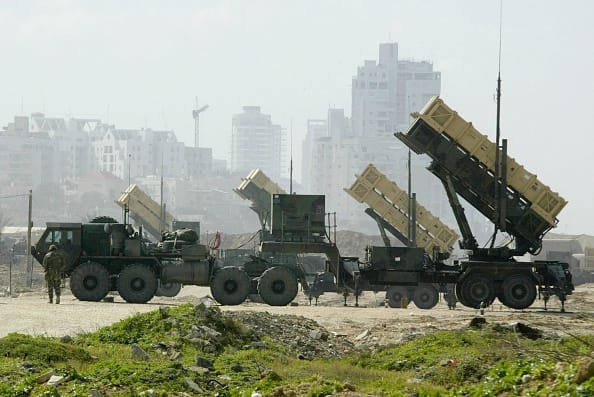
Munitions stocks makes U.S. willingness to sell Patriot air defense to Europe/Ukraine less likely.
Stockpiles may mean that American power is diminished for a potential conflict with China over Taiwan.
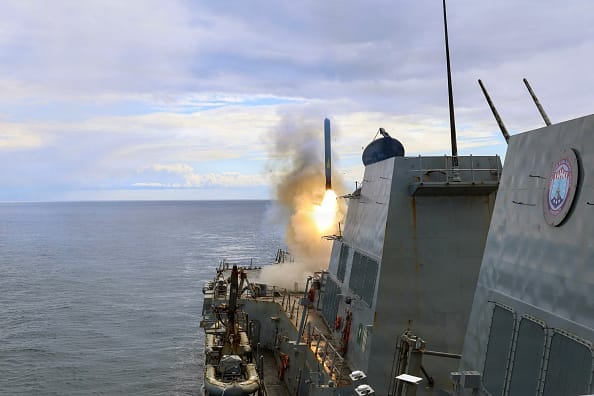
President Donald Trump’s administration is expending a significant proportion of America’s best firepower – at a speed that may take the country’s industrial base years to replenish and leave American power diminished for other wartime scenarios.
Rebuilding that firepower has serious implications for the war in Ukraine, and a potential conflict with China over Taiwan.
It took years and billions of dollars for the U.S. Defense Department to stockpile these munitions. It now risks depleting them in a matter of weeks.
NEW VARIANTS OF TOMAHAWKS SPOTTED, BUT EXPENDED FASTER THAN MANUFACTURED
Low-flying, subsonic cruise missiles apparently accounted for most of the munitions in the initial wave of U.S. strikes on Iran on Feb. 27 and 28.
Publicly-released imagery hints at potentially two new Tomahawk variants: one with what appears to be a radar-absorbing stealth coating and another with forward-canted wings, possibly for improved stealth.
The size of the U.S. Tomahawk inventory is a closely held secret, but it’s safe to assume it’s measured in the thousands. The Pentagon has stated it targeted hundreds of facilities.
The problem is that, for years now, successive U.S. administrations have bought fewer of the $2.5-million Tomahawks than they’ve used every year, meaning the inventory has steadily declined.
The Trump administration expended hundreds of Tomahawks in Nigeria and on Iranian and Iranian-backed Houthi forces in 2025, but bought just 50 or so missiles over this same period.
The gap between cruise missile expenditures and cruise missile acquisitions looms over U.S. strategy for a possible war with China.
An analysis by the Center for Strategic and International Studies in Washington, D.C. concluded U.S. forces would need to fire 3,600 cruise missiles to halt a Chinese invasion of Taiwan.
SURFACE TO AIR INTERCEPTORS DEPLETED IN WEEKS:
U.S. forces are also expending their best surface-to-air interceptors at a dangerous rate. Kelly Grieco, a fellow with the Stimson Center in Washington, D.C., crunched the numbers.
“Even a generous forward deployment could be rapidly depleted in a high-intensity conflict,” she wrote. “Forward stockpiles aren’t limitless: THAAD ~10 days, SM-3 ~2 weeks at high-tempo rates. Sustained attacks would stress U.S. missile defense quickly.”
The U.S. Army had just 400 or so of its best Terminal High Altitude Area Defense interceptors before the current war. Patriots can also hit incoming ballistic missiles under certain conditions, but THAAD flies much higher and farther, making it the best defense against the biggest and fastest enemy missiles.
If the Americans are firing THAADs at the same rate they did during earlier strikes on Iran back in June, they should expect to expend as many as a dozen of the $15-million missiles every day. After three weeks or so, the forward-deployed THAADs could be gone.
After six weeks, all the THAADs would be gone, forcing the U.S. Army to fall back on the less-capable Patriots.
Lockheed Martin is scrambling to boost THAAD production from around 100 to around 400 annually, but the ramp-up could take years. In the meantime, the U.S. Army can’t afford to fire more than 100 THAADs a year without undermining its defenses in the Asia-Pacific region.
Pacific-based THAAD batteries protect the biggest and most vulnerable air bases U.S. forces would stage from for a war with China.
The U.S. Navy’s interceptor problem is no less vexing. The fleet has around 400 of its mainstay SM-3 interceptors, which are optimized for striking incoming ballistic missiles.
Raytheon produces fewer than 50 of the $10-million missiles annually.
UKRAINE, TAIWAN IMPLICATIONS: EUROPE PURCHASES OF PATRIOTS LESS LIKELY
Further U.S. support to Ukraine is now highly unlikely in the near term. Trump and halted direct military aid to Ukraine last year, but still allowed Ukraine and its European allies to purchase U.S. weapons for Ukraine’s defense.
Now these purchases are probably off the table.
Raytheon’s Patriot production line will almost certainly be maxed out for years simply replacing the SAMs the U.S. Army is firing at Iranian ballistic missiles raining down on U.S. and allied bases. The shortage could even extend into the administration of whoever succeeds Trump in January 2029.
Fortunately for Ukraine, the government in Kyiv has been gradually weaning itself off its once heavy dependence on U.S. weaponry, so the consequences of the current war on Iran should be manageable.
Another risk is that, if China invades Taiwan in the next few years and Trump chooses to defend the island democracy, the U.S. armed forces may not be able to sustain a high-tech fight.
Last June, American warships fired SM-3s at Iranian ballistic missiles at a rate of around seven per day. At that rate, the U.S. fleet can fight for a month before it’s down to half of its main interceptors.
Would the U.S. Pacific Fleet be comfortable sailing into battle with the Chinese fleet with just 200 SM-3s spread across dozens of warships? Probably not, given how many hundreds, even thousands, of ballistic missiles the Chinese can fire in quick succession.
LATEST NEWS:
By: Tim Mak
RUSSIA OFFERS THOUGHTS AND PRAYERS: Foreign Minister Sergey Lavrov offered Iran’s top diplomat his verbal support, but the gesture was merely symbolic, Politico writes today. “Iran, thus, became the latest country after Syria and Venezuela to feel firsthand what partnership with Russia does, and doesn’t, mean.”
NETANYAHU: CAMPAIGN WILL CONTINUE WITH “INCREASING INTENSITY” The Israeli Prime Minister said in a statement that “dozens” of Iranian officials were killed along with the Supreme Leader of Iran, and that the air campaign will “increase further in the days to come.”
…TRUMP CLAIMS 48 IRANIAN OFFICIALS KILLED as a result of the strikes in Iran, via an interview on Fox News.
…SAYS WILL TALK TO NEW IRANIAN LEADERSHIP: “They want to talk, and I have agreed to talk, so I will be talking to them. They should have done it sooner,” he told The Atlantic.
AND… EXPLOSIONS IN IRAN, via Open Source Intel:
GLOBAL SHIPPING DISRUPTED BY WAR: Prices may soon rise as shipping is disrupted in a key naval route in the world economy.

… TANKER HIT IN STRAIT OF HORMUZ: Chemicals and oil products tanker was hit near the Strait of Hormuz, illustrating the risks to shipping, Argus reports.
Stay safe out there.
Best,
Tim
