


Editor’s note:
This morning has brought constant breaking news alerts. Here’s everything in one place.
If you appreciate the work we do to make this news cycle digestible for you, subscribe now. It’s free!
The latest news at this hour:
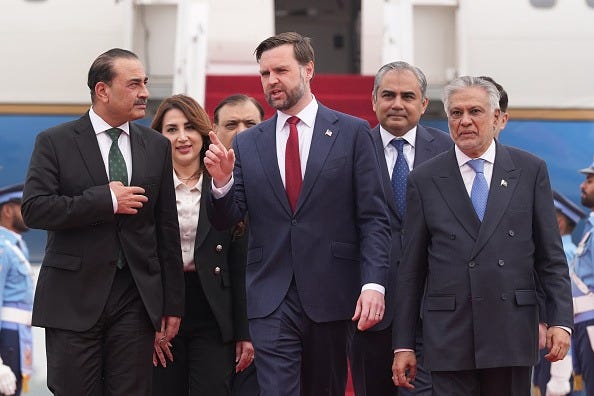
U.S.-IRAN PEACE TALKS FAIL: The U.S. and Iran failed to reach an agreement after the peace talks in Islamabad, Pakistan. J.D. Vance said that Iran wouldn’t give up its nuclear program and declined the “final and best offer” from the U.S.
The leader of Iran’s negotiation delegation and the speaker of Iranian parliament, Mohammad Bagher Ghalibaf, stated that the U.S. negotiators failed to win his team’s trust by declining Iran’s proposals and said U.S. demands prevented any conclusion from the peace talks.
Iran’s foreign ministry spokesperson Esmaeil Baqaei said that no one had expected to end the war in a single round of negotiations and mentioned “two, or three key issues” that stalled the process. Still, he pointed out that diplomatic efforts will continue in coordination with Pakistan and other countries in the Middle East.
Neither side indicated what would happen after the two-week ceasefire ends. Meanwhile, Pakistan has urged both to continue the ceasefire, adding that it will try to bring the new sides together for renewed dialogue.
TRUMP SAYS U.S. WILL BLOCKADE STRAIT OF HORMUZ: In a Truth Social post on April 12, Trump wrote that the U.S. Navy will begin the process of “BLOCKADING any and all Ships trying to enter, or leave, the Strait of Hormuz.” The post came the morning after failed peace talks in Islamabad. He also said there could be mines in the Strait, which the U.S. will begin to destroy.
Two U.S. ships, Frank E. Peterson and USS Michael Murphy, began clearing those mines on April 11, according to CENTCOM, and promised that more U.S. forces, including underwater drones, will join the clearance operation in the coming days.
The U.S. did not coordinate with Iran, as it sent its warships across the strait for the first time since the start of the war. The move aimed to increase confidence in commercial vessels seeking to cross the strait.
The clearance operation might face technical difficulties, as Iran cannot locate all the mines it laid, and the U.S. is uncertain how many of them were planted in the Strait of Hormuz, The New York Times reported.
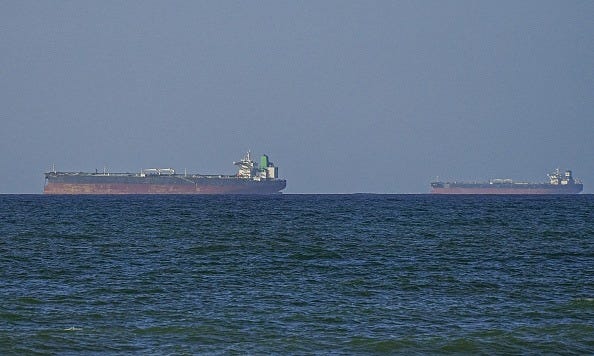
…WHILE TANKERS IN HORMUZ MAKE LAST-MINUTE U-TURN: Two tankers set out on Saturday to make their way out of the Persian Gulf via the Strait of Hormuz but on Sunday reversed their course after ceasefire talks broke down, Bloomberg reported.
DEATH TOLLS IN IRAN, LEBANON REACH THOUSANDS: Lebanon, excluded from the ceasefire and peace negotiations between the U.S. and Iran, continues to face Israeli attacks. In total, more than 2,000 people were killed and at least 6,300 wounded in Lebanon following the latest Israel attacks, according to yesterday’s health ministry report.
The Guardian published a video of mass detonations in the villages of Taybeh, Naqoura, and Deir Seryan along the Israel-Lebanon border and reported that Israel has demolished entire villages in Lebanon. In Israel, at least 20 people were killed in retaliation strikes on the country as of Monday, April 6.
Meanwhile, Iran says at least 3,300 people have been killed since strikes by the United States and Israel began, reported BBC.
The latest update from Iran puts the number of identified bodies at 3,375, including 2,875 men and 496 women. The highest number of casualties has been recorded in Tehran, Hormozgan, and Isfahan provinces. The report presents a significant number of child casualties. Seven of those killed were infants under one year old, 255 were between the ages of one and 12, and 121 were teenagers aged 13 to 18.
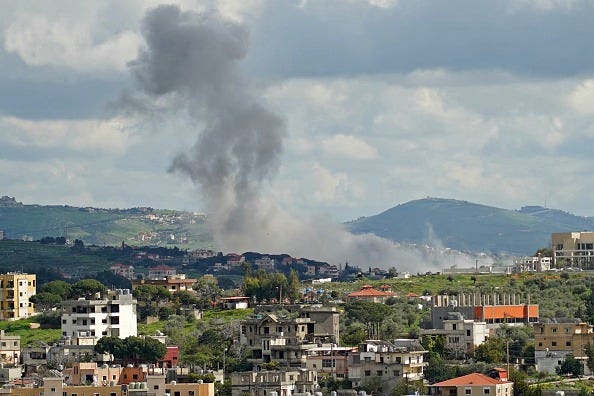
Aftermath of an Israeli strike on an area in the southern Lebanese village of Nabatieh al Faouka, on April 12, 2026. (Photo by Abbas FAKIH / AFP via Getty Images)
IRAN’S INTERNET SHUTDOWN BREAKS GLOBAL RECORD: The internet monitoring group NetBlocks says that the internet in Iran has been completely shut down for 44 days, or 7 weeks now, now breaking global records.
SAUDI ARABIA RESTORES EAST-WEST PIPELINE CAPACITY: Saudi Arabia says it has fully restored oil-pumping capacity through its East-West pipeline to around seven million barrels per day, days after assessing damage caused by attacks during the Iran war.
The energy ministry said facilities and infrastructure affected by the strikes have now recovered, with the pipeline and related sites back to full operational capacity.
Stay safe out there!
Best,
Oleksandra
Thank you for that up to date and accurate reporting. Stay safe yourselves.
Thank you. I appreciate you professional reporting.