

At the bottom of this page: Latest news at this hour.
Lebanon faces a food crisis amid the Iran war.… Benjamin Netanyahu agrees to talks with Lebanon after U.S. pressure.… British public turns against the U.S. after the Iran war.… Donald Trump criticises Iran over control of the Strait of Hormuz.… Trump’s war with Iran tripled US inflation last month.
Featured subscriber comment:
Invaluable news from the region today! Worth every penny of my subscription.
By PTW
You heard it here first — worth every penny. Join our featured subscriber and upgrade today!
OUR LEAD STORY:
YEREVAN, Armenia – The cheers, celebrations, and music playing from balconies and streets as citizens celebrated the death of Ayatollah Ali Khamenei were quickly replaced by a wave of panic as people rushed to stores to stock up on food and essentials. Others clustered at gas stations, eager to purchase what fuel they could before prices skyrocketed.
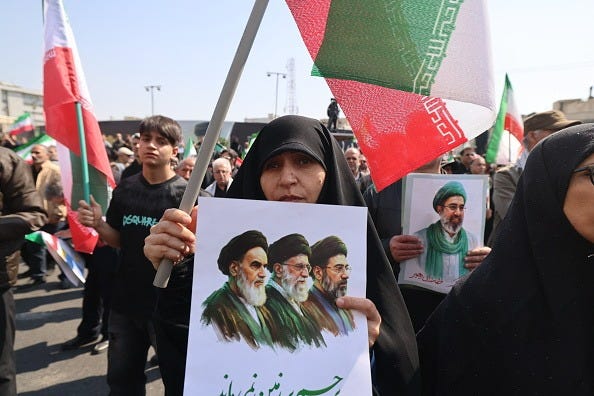
Soon enough, however, Iranian regime forces put a stop to this: dozens of Revolutionary Guards members drove through downtown Isfahan, brandishing assault rifles and shotguns in a clear display that they were still in control, despite the sounds of enemy aircraft overhead.
But while wartime life would soon settle into a sort of rhythm, the twin dangers that Mehrdad and his fellow civilians would find themselves increasingly caught between had already been established: a growing airstrike campaign from above, and the regime’s brutal Basij paramilitaries on the ground.
The two have become increasingly intertwined. On April 7, the regime has called upon young people to form human shields around critical infrastructure. Meanwhile, the Basij have tried to do the same, drawing civilians to their checkpoints by distributing food in an effort to protect themselves from airstrikes.
The Iranian government has found itself facing a growing inability to protect critical infrastructure, including its security forces, from US and Israeli airstrikes. Iran’s meager air defences, already battered during the 12-day war last year, have been rendered nearly completely ineffective. This has led the government to attempt more cynical measures, hoping for the unwillingness of their enemy to inflict mass civilian casualties to dissuade attacks.
The Basij, having killed thousands of Iranian civilians themselves just months ago, are happy to oblige — further proof that when President Donald Trump claims that regime change in Iran has already been achieved, that is far from the reality.
“In the weeks after that first day, life returned somewhat to normal,” said Mehrdad. A 34-year old native of Isfahan, Iran’s second-largest city and historic capital, where he works as a researcher. “People mostly went back to work, although many government-related jobs remained closed. There were fewer airstrikes here than in Tehran in the early weeks, so more businesses remained open,” he said.
Due to severe internet blackouts, the reality on the ground for average Iranians has become almost impossible to ascertain, including related to basic difficulties like inflation - particularly with regards to food.
“Food prices have been rising for years in Iran, always getting worse,” Mehrdad said. “However, in the past few months, inflation - especially for food - has been particularly severe. Prices of items like dairy products and some fruits, like bananas, have more than doubled, and that’s just the start,” he said.
A massive jump in food prices — a 72% increase from the previous year — was one of the catalysts of the January protests.
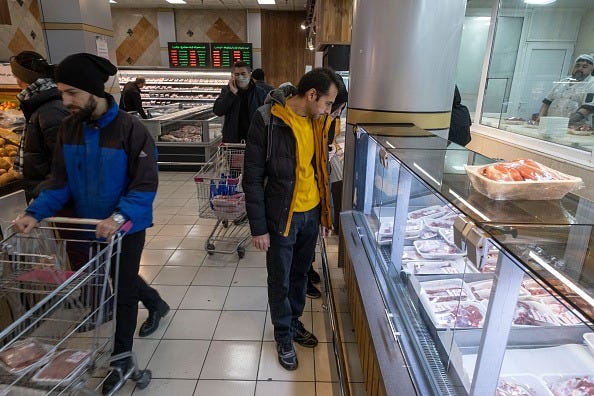
Food has still been more accessible than another basic necessity: fuel.
“Fuel has been strictly limited since the war began,” Mehrdad said. “Each car can only get about 20 liters a day, and it requires lining up at gas stations, which makes people feel vulnerable. Most airstrikes haven’t targeted small civilian buildings like this yet, but they are getting closer all the time.”
For most of the war, Isfahan had been relatively quieter than Tehran or Iran’s coastal cities, which possess most of the country’s critical government and energy structures. That has been changing since late March, Mehrdad said.
“For the past week and a half, I’ve been hearing fighter jets almost every night, flying constantly overhead until dawn,” he said. “There have been very intense attacks nearby, with loud explosions shaking the windows. Some of my family members have been terrified, and it’s been up to me to try and calm them down,” Mehrdad said.
In the meantime, the Iranian regime has stepped up its own shows of power, reminding locals that the Islamic Republic - and the Revolutionary Guards - have not gone anywhere.
“Security forces - Basij members and IRGC - and their families sometimes go out at night in cars, waving regime or Hezbollah flags,” Mehrdad said. “There are also trucks with large speakers playing slogans like ‘Death to the U.S.’ and ‘Death to Israel.’ They want people to notice them,” he said.
Mehrdad said he has seen a number of these checkpoints spring up in his neighbourhood in Isfahan’s suburbs, part of a growing trend of the group’s increasing usage of civilian infrastructure.
“The Basij often set up these food distribution checkpoints, in many different areas,” he said. “They will place them at busy intersections, where a lot of cars and foot traffic are passing by. I’ve also seen Basij gatherings at hospitals and schools, possibly to try and avoid being targeted,” Mehrdad said.
The Basij militias are one of the Islamic Republic’s most feared and effective means of control. Its fighters were deeply involved in the brutal suppression of protests in January, using wanton violence to massacre and disperse demonstrators. The group often recruits child soldiers, launching a campaign to recruit volunteer fighters ‘age 12 and over’ in late March.
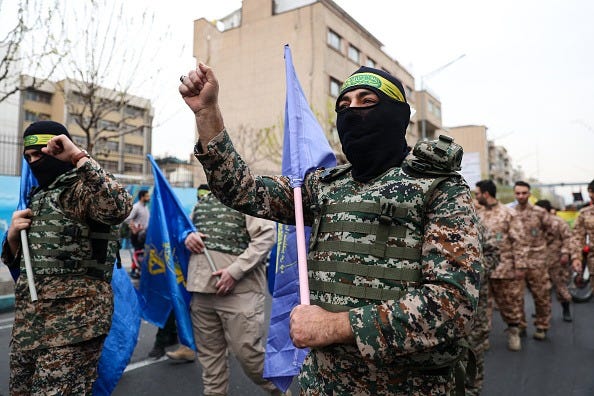
Their status as a key pillar of the regime’s control has made the Basij an increasingly common target for Israeli airstrikes, as Tel Aviv pursues its policy of toppling the Iranian regime. By mid-March, Israeli aircraft had begun regularly striking Basij checkpoints in Tehran in particular, aiming to reduce the Islamic Republic’s control on the ground. This campaign has since spread to Basij targets in other cities, including Isfahan.
Mehrdad said that the Basij are aware that their checkpoints are likely to attract enemy attention. The group has adapted by both reducing their size, dispersing them to smaller outposts across the city, and by regularly moving them.
“They usually set up something like a small temporary booth or station, often in busy areas where a lot of people pass by, like intersections or main streets,” Mehrdad said.
“They play loud, dramatic music with messages like ‘no compromise with the U.S.’ or about destroying the U.S. and Israel. They hand out things like tea and cakes to people in cars or to pedestrians,” trying to draw their attention and bring them closer, he said.
Most people attempt to avoid the checkpoints, either by taking a different route from a known Basij location or quickly moving past the paramilitaries, Mehrdad said. There is no love lost for the regime in Isfahan.
“Most people have mixed emotions right now,” he said. “It’s a war, so there is fear, but at the same time, there is hope that the regime might fall. I believe this hope is the only thing that could truly make many Iranians happy,” Mehrdad said.
The temporary ceasefire announced by the U.S. on April 8 could provide a reprieve. While food prices have been rising, most locals have so far been able to make do without resorting to the aid handed out by the regime. If inflation continues and shortages grow, however, they could have no choice.
“So far, what we’re seeing still feels like the usual pattern in Iran, since only about a month has passed since the start of the war,” Mehrdad said. “But I believe much higher inflation is coming, especially if imports are completely blocked and stores begin to run out of goods in the coming weeks.”
The Iranian regime, and its Basij enforcers, already hold most of the cards in their standoff with Iran’s restive populace. Adding control of the food supply among an increasingly beleaguered civilian population would increase that power further.
*Mehrdad’s name has been changed to protect his identity.
Featured subscriber comment:
Invaluable news from the region today! Worth every penny of my subscription.
By PTW
You heard it here first — worth every penny. Join our featured subscriber and upgrade today!
The latest news at this hour:
By: Anastasiia Lutsenko
LEBANON FACES FOOD CRISIS AMID IRAN WAR: The World Food Programme warns that Lebanon is facing a serious food crisis due to the war involving Iran, according to Reuters. Prices are rising fast, with vegetables up over 20% and bread up 17%, while many families struggle to afford basic food.
Attacks and displacement are making the situation worse, especially in southern Lebanon where most markets are no longer operating. Around 900,000 people now face food insecurity, and delivering aid is becoming more difficult as the conflict continues.
NETANYAHU AGREES TO TALKS WITH LEBANON AFTER US PRESSURE: Benjamin Netanyahu said Israel will start direct negotiations with Lebanon soon after pressure from Donald Trump and US officials, according to Axios. However, Israel says it will continue military actions and not agree to a ceasefire in Lebanon.
The talks aim to reduce tensions and possibly disarm Hezbollah, but disagreements remain. Iran claims Lebanon was part of a ceasefire deal, while the US and Israel deny this. The first meeting is expected to take place in Washington next week.
BRITISH TURN AGAINST THE US AFTER IRAN WAR: People in the UK now see the United States as more negative than positive after Donald Trump’s war in Iran, according to Public First LDC. A new poll shows 53% think the US is a negative force, while only 29% see it as positive.
Most of the British public does not support military action in Iran and say the UK should not join, even if the US asks. However, support grows if the UK is directly attacked or if important oil routes are threatened.
Many people want the government to focus on national interests and work more closely with European countries instead of the US, while concern about global instability continues to rise.
TRUMP CRITICISES IRAN OVER STRAIT OF HORMUZ CONTROL: Donald Trump says Iran is doing a “very poor job” managing the Strait of Hormuz, where about 20% of the world’s oil passes, and warns against charging fees to tankers, according to BBC.
At the same time, fighting continues between Israel and Hezbollah in Lebanon despite a ceasefire, as peace talks in Pakistan are expected with JD Vance and Iranian officials.
TRUMP’S WAR WITH IRAN TRIPLED US INFLATION LAST MONTH: US inflation tripled in March amid the conflict with Iran, which drove a sharp rise in energy prices, according to CNN. The annual inflation rate rose to 3.3% in March, up from 2.4% in February. On a monthly basis, prices increased by 0.9%, according to the Bureau of Labor Statistics.
The spike was mainly caused by surging energy costs, with gasoline prices jumping a record 21.1% due to disruptions in global oil supply linked to Iran.
Stay safe out there!
Best,
Neil

I appreciate this reporting. Stay safe! Thank you!
Thanks for the information. I did not know that the Basije was involved in controlling the population at this moment. It seems the strikes have done nothing beyond fulfilling Netanyahu's agenda. The Iranian people are suffering even more.