

At the bottom of this page: Latest news at this hour.
Editor’s note:
Today marks 23 years since the start of the Iraq War. This update comes from our reporter in northern Iraq, where explosions are now part of daily life.
If this kind of reporting matters to you, support us by subscribing now.
OUR LEAD STORY:
ERBIL, Kurdistan Region of Iraq (March 19) — The faint braaaap from the sky sounded like a deck of cards riffled against a steel file. The following explosion tumbled, west to east, across the night. Our group — me and some half-dozen Kurdish businessmen gathered at a neighborhood mosque — paused our chat and looked up.
“Boom,” said Salih Albarzinja, an Erbil businessman who owns one of the largest travel agencies in the region. His tone was casual and he sounded unfazed by the aerial explosion of the drone that was likely targeting the U.S. airbase next to Erbil’s international airport. But every drone launched by Iranian-backed militias targeting U.S. facilities might as well be a bullet to his bank account. His business has come to a standstill thanks to the war next door in Iran.
“Now our profit is zero,” he says glumly. “I’ve lost a lot of money.”
Three weeks into the war, the economy of Iraqi Kurdistan, a relative island of stability in a turbulent region since the Iraq War, is reeling. Across Erbil, merchants and businessmen say the war is freezing the economy, shutting airports, draining dollars and leaving a region that depends on foreign investment cut off from the outside world.
The Kurdish region, protected by U.S. airpower after the Gulf War and later a key ally in the fight against ISIS, is now expected to be the staging ground for a possible ground offensive into Iran using Iranian Kurdish opposition fighters.
The price for a war paid for with billions of U.S. taxpayer dollars and ostensibly aimed at breaking Iran’s power and influence in the region is now falling on business and families who have been some of America’s staunchest allies, despite a series of U.S. betrayals.
Salih has been in the travel business for 20 years. His company, London Sky, arranges flights, hotels, and private jets for the oil executives and contractors who give Erbil its glossy, half-built skyline. BP. TotalEnergies. Weatherford. Halliburton. Gazprom.
Erbil’s International Airport has been closed since the war began on Feb. 28. Salih’s bread-and-butter clients — expats who flew to Dubai for the weekend — have been replaced by people who need to get out, urgently, on whatever route is still open. That means south overland through Baghdad to Jordan, or via the Turkish border crossing at Ibrahim Khalil and then a flight out of Şırnak. Every plane is full. The border queues stretch for hours, he says.
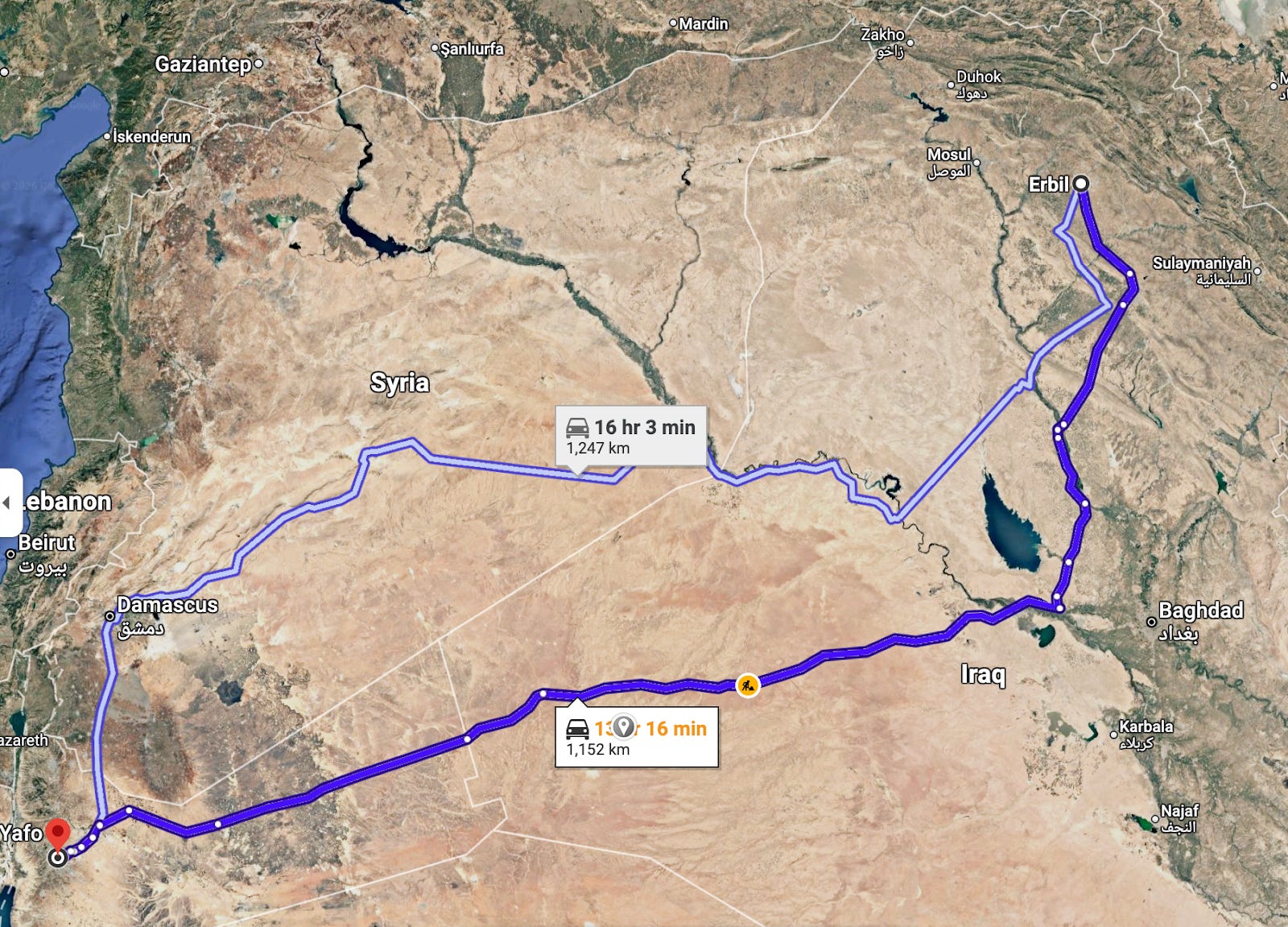
The numbers from London Sky tell the story: According to figures provided to Iran War Dispatches, Salih booked 2,016 flight tickets and assisted 268 visa applications in January 2026. Since March 1, a day after the war began, the company has only booked 666 tickets and helped 31 visa applications this month..
“Corporate travel has largely been suspended or minimized,” Salih’s general manager, Dr. Mahmood Scott, wrote to me. He added that much of the company’s March business was driven by emergency evacuations, an unsustainable revenue stream. “London Sky played a key role in facilitating evacuation plans for our clients operating in Iraq,” Scott added, “which explains the continued, albeit reduced, level of transactions during this period.” Should the current situation persist, he said, April will see a further decline in revenue.
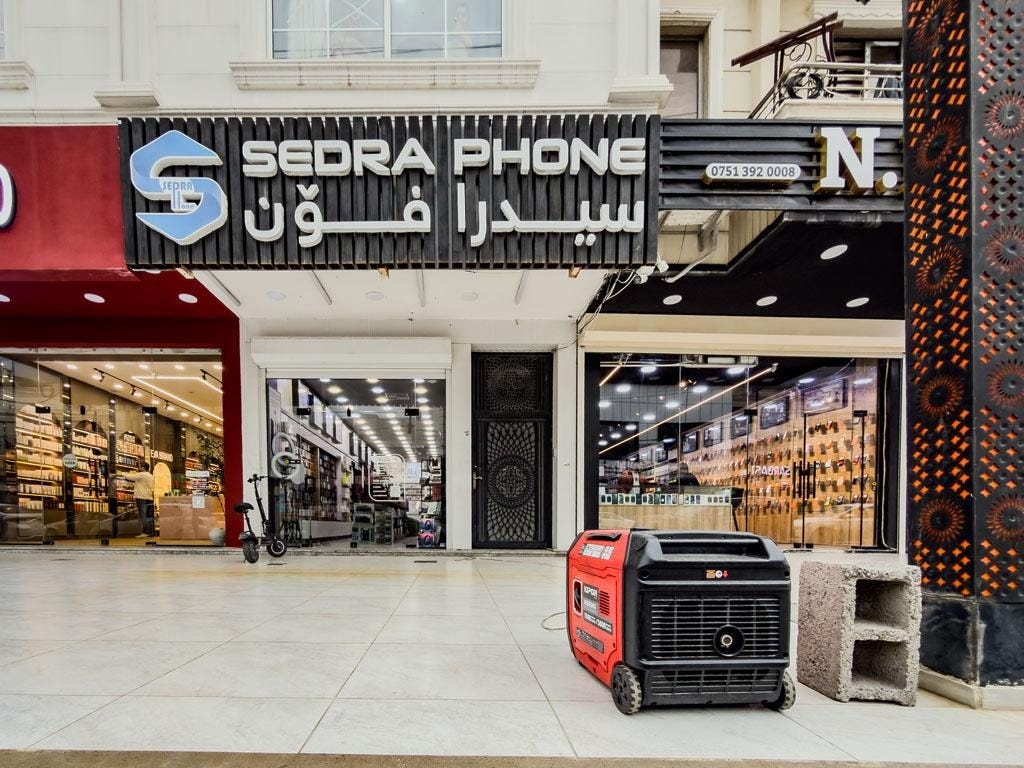
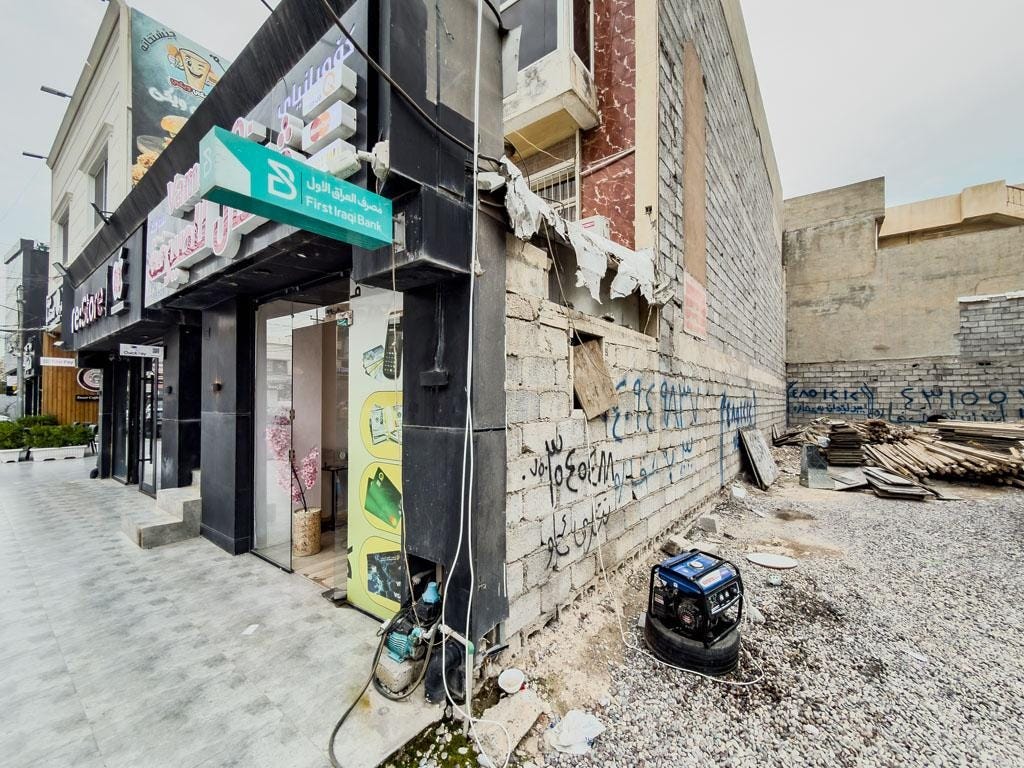
And then there’s electricity, or rather, the lack of it. Every few storefronts, portable generators line the sidewalks of Erbil, highlighting the ongoing electricity crisis that has affected the region since the start of the war due to threats and attacks against the region’s energy infrastructure. The Lanaz Oil Refinery just southwest of Erbil has been hit by Iranian drones in the last few days. A key natural gas plant has been shuttered since day one. A dollar shortage that predated the war is now acute. And Salih and his buddies who run small businesses say they have, at best, a few weeks before their cash reserves run out.
The Kurdistan Regional Government has long been at a disadvantage in its dealings with Baghdad. The federal government has withheld budget transfers for years and an entrenched political deadlock in Baghdad, which has not formed a government since elections last November, leaves the KRG with a very small fiscal margin.
A war it didn’t start is now draining its coffers.
Salih’s travel business may have been one of the first commercial casualties of war, but energy came next.
His brother, Taj, owns a gas station. He says his business is down 70 percent. Why? “Everyone is at home,” he says. “They are afraid.”
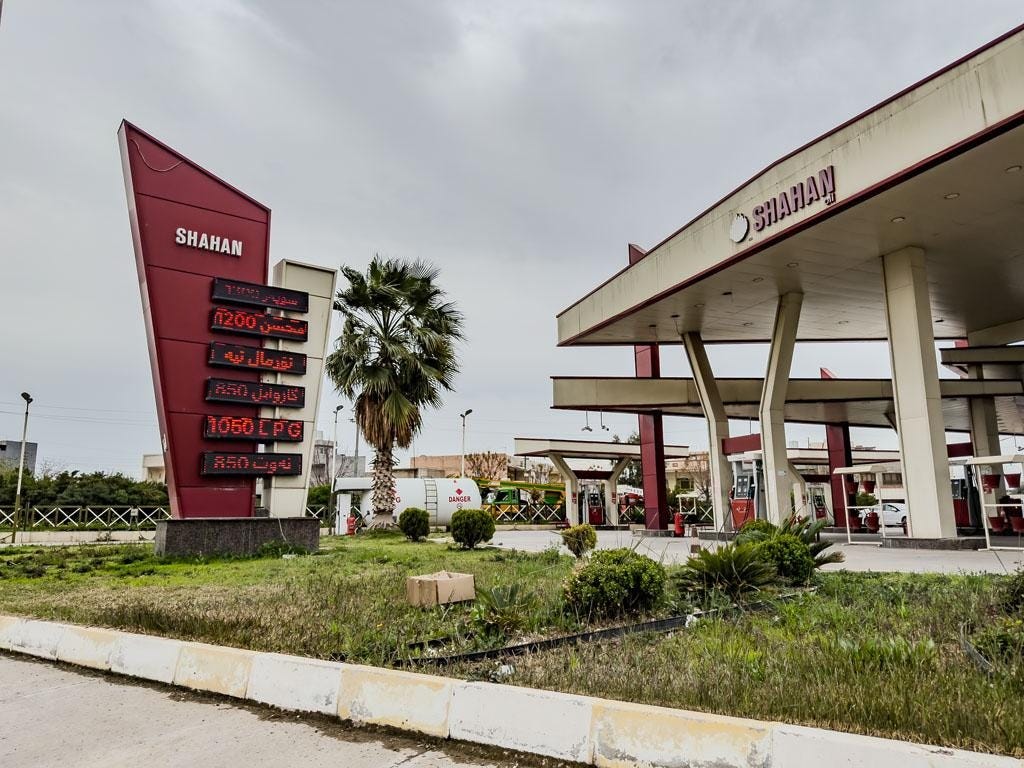
Petrol is still available. Iraqi Kurdistan has its own refineries, including the Lanaz and KAR Group facilities, so the price has crept up only a little, from 800 to about 900 Iraqi dinars per liter, Taj says, an 11 percent increase. But liquefied petroleum gas, the fuel that heats homes and runs a significant portion of the city’s cooking, is a different story.
The Khor Mor gas field, operated by UAE-based Dana Gas, is the primary source of natural gas for the entire Kurdistan region. The company shut it down early in the war to protect its staff from drone threats. And this week, the company evacuated all remaining personnel entirely following Iranian threats to strike energy facilities across the Gulf in retaliation for an Israeli attack on its South Pars field. Khor Mor’s shutdown knocked an estimated 2,500 to 3,000 megawatts off Iraqi Kurdistan’s power grid, according to the regional government.
The result for LPG: prices have almost tripled, from 300 dinars to around 1,000, although it’s increasingly hard to find at any price. Taj says what little can be found is being distributed informally as part of an ad hoc rationing system.
“It’s only [distributed] with motorcycles among neighbors,” he says. “Otherwise there isn’t any.”
It wouldn’t be an economic crisis without an accompanying currency crunch. A dollar crisis that predates the war is simultaneously roiling the banking system.
For years, Iranian-backed militias have used Iraqi banks as a financial lifeline for Iran, says Basim Razzo, a Mosul-born human rights advocate who has spent years documenting the stranglehold these militias have on the Iraqi economy. (Full disclosure: Razzo is a board member of the Center for Civilians in Conflict, an NGO I worked for from 2016-2017.) Businesses linked to these militias will “buy” millions of dollars in, say, farm equipment from Tehran. The equipment is never delivered and Iran keeps the money, Razzo says.
Washington has been trying to close that cash pipeline since 2023, cutting off more than two dozen Iraqi banks from dollar transactions. But Iraq holds nearly $100 billion in reserves in the US and relies on Washington’s say-so to access its own oil revenues, so the Central Bank of Iraq has reluctantly cooperated.
The result? Salih says only BBAC and Byblos banks reliably provide greenbacks.
For businesses that deal in dollars, this is a catastrophe. The Central Bank’s official exchange rate is 1,310 dinars to the dollar. Store windows in central Erbil are advertising the street rate at around 1,550, an 18.3 percent premium. Every dollar a business needs to buy at street price costs them nearly a fifth more than it should.
Salih feels that 18.3 percent loss on every dollar he holds in a non-BBAC account. Since the war began and oil revenues collapsed, fewer dollars are flowing into the Central Bank of Iraq’s daily dollar auction, widening the gap between official and street prices.
Rebwar Abdullah, who runs a wholesale stationery operation, perhaps has it the worst of the men at the mosque. He ordered 11 shipping containers of goods from China in November: paper, school supplies, folders. This is a market that runs on children and classrooms. The containers arrived at Umm Qasr, Iraq’s southern port, months ago. They are still there, thanks to changes in Iraq’s custom systems and bad timing.
He relies on school business, but the schools are closed because of the war. His business is down 40 percent and frozen in place.
Meanwhile, he owes his Chinese suppliers $500,000. The money was supposed to come from sales that aren’t happening in dollars that were supposed to be almost 20 percent cheaper than they are. Every payment he makes costs more than the last.
Salih says after two months, he will have to cut his headcount from 45 to 20. After four or five months, he will have to reduce to three people.
“Because I don’t have profit,” he says simply.
He also doesn’t think he is unique. He thinks it describes Erbil, maybe all of Iraqi Kurdistan.
“Not only [the] government,” he says. “Everybody here.”
There are about 20 days of various reserves for households, businesses, everyone, before things get genuinely difficult, he estimates.
And when the war is over? What does he want?
He doesn’t hesitate: the end of Iran’s government. The Iranian-backed militias stripped of their hold on Iraqi politics and the economy. A Baghdad that can actually govern.
“When Iran’s government is down, in [the] Middle East, every business will be very good,” he says.
For now, his brother’s gas station is open even if people are afraid to drive. The Khor Mor plant sits silent, its staff evacuated. And Salih continues to book a dwindling number of evacuation routes.
Editor’s note:
Today marks 23 years since the start of the Iraq War. This update comes from our reporter in northern Iraq, where explosions are now part of daily life.
If this kind of reporting matters to you, support us by subscribing now.
THE LATEST NEWS AT THIS HOUR:
By: Oleksandra Khelemendyk and Alessandra Hay
MAJOR GAS FIELDS IN MIDDLE EAST DAMAGED: Qatar Energy, the world’s second-largest LNG exporter, was extensively damaged by an Iranian missile attack on the energy hub Ras Laffan. Ras Laffan is located 80 km (50 miles) north of Doha and hosts major international companies, including Shell.
Trump has threatened to retaliate and “massively blow up” the South Pars gas field in Iran if the attacks on Qatar continue. The gas field was previously attacked by Israel.
Meanwhile, global fuel prices continue to soar. Brent crude oil price rose to $112 per barrel, by 48% since the beginning of the war in Iran. Today, gas prices climbed by 35% in Europe and to $3.88 a gallon in America, which is the highest since 2022, when Russia invaded Ukraine.
U.S. CONSIDERS DEPLOYING TROOPS TO SECURE STRAIT: Trump’s administration considers deploying thousands of U.S. troops in the Middle East to secure safe passage for oil tankers through the Strait of Hormuz. This could also mean deploying ground forces along Iran’s shoreline or the Kharg island, which accounts for 90% of Iran’s oil exports.
POTENTIAL FEES FOR SHIPS IN STRAIT OF HORMUZ: Iran considers monetizing its control over the Strait of Hormuz by demanding transit fees and taxes on vessels passing through there, Reuters reported.
This comes after European nations and Japan issued a statement saying they were prepared to jointly secure the strait.
PENTAGON REQUESTS $200 BILLION TO FUND IRAN WAR: The Pentagon submitted a more than $200 billion funding request to Congress for the Iran war, however some officials are doubtful it will pass.
“The number could move. It takes money to kill bad guys,” Secretary of Defense Pete Hegseth said. He also recently said that there is no timeframe for the war in Iran.
KEY PORT FOR OIL BRIEFLY STOPPED SHIPPING: Oil loading at the port of Yanbu in Saudi Arabia was temporarily halted after an Iranian ballistic missile was intercepted in its vicinity, and a drone fell at the nearby Sanref refinery. The refinery has a capacity of about 400,000 barrels a day, in retaliation for the Israeli strike on the South Pars gas field.
The Yanbu port is vital for the oil market stability, as it remains the only alternative way of crude oil exports, apart from the Strait of Hormuz.
U.S. F-35 MADE EMERGENCY LANDING: A U.S. F-35 fighter jet was forced to make an emergency landing at a U.S. base after the aircraft was hit during a mission over Iran, CNN reported.
The attack is under investigation, but is believed to be launched by Iran, which would be the first time Iran has targeted a U.S. aircraft in the war in Iran.
Stay safe out there!
Best,
Christopher
