

At the bottom of this page: Latest news at this hour.
Russia advises Iran on drone tactics… Three vessels struck the Strait of Hormuz… Senators worry about ground forces in Iran… U.S. tech companies are potential targets… Protest banned in London… Australia shuts embassies in Middle East… Romania allows U.S. access to airbases.
Editor’s note:
Grounded in local insight, our reporting tells stories that only human experiences from Iran can reveal. Subscribe to see how this war is being felt in communities big and small. It’s free!
OUR LEAD STORY:
At the start of March, Iran’s farmers should be preparing for the rainy season.
They sow their crops and wait for the rain.
But this season, when Tehran’s residents looked up at the sky, droplets of oil-infused water fell instead.
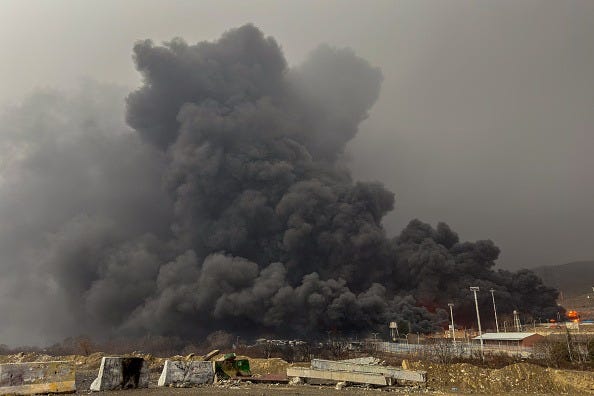
On March 8, Israel attacked fuel depots in Tehran and the nearby province of Alborz for the first time, filling the sky with dark clouds that rained down.
If these strikes on Iranian oil infrastructure continue, they could pose a threat to small-scale, traditional farmers, who rely heavily on rain and water supply systems.
That toxic fallout, especially at the start of the rainy season, could threaten the fragile agricultural system that many rural communities still depend on and ripple across larger food markets.
Fereshte spent decades working alongside these farmers and teaching practices to strengthen the self-sufficiency of rural communities. She watched those communities struggle through Iran’s drought, which began around the mid-1900s. Now she fears the war could make things far worse.
In 2025, Iran’s average rainfall was 45 percent less than normal, and Tehran itself was already reaching a crisis point.
Last year, the Iranian president even suggested that Iran’s capital be relocated, as the strain on water resources was making the city “uninhabitable.” This drought drove up the price of water and contributed to the skyrocketing price of food, which sparked nationwide protests in January.
For Fereshte, the drought is nothing new.
While Fereshte was at university studying biology 24 years ago, she founded the first all-female mountain climbing club after the Islamic Revolution in 1979.
Her climbing trips took her all over Iran, where she was exposed to the impact of its drought on the environment.
Frogs are Fereshte’s favorite animal. During university, she took a trip to Joumian in northern Tehran, where she could sit by the pond and hear them croak.
But after she arrived in Joumian, she was unpleasantly surprised.
“When I visited the pond, I got attacked by flies and didn’t hear any frogs. I realized the pond was polluted, and this created the bad smell and flies,” Fereshte explained.
In a nearby village, she discovered that the farms were growing a variety of fruits and vegetables that required a lot of water, and as a result, the small canal feeding the pond had grown very weak.
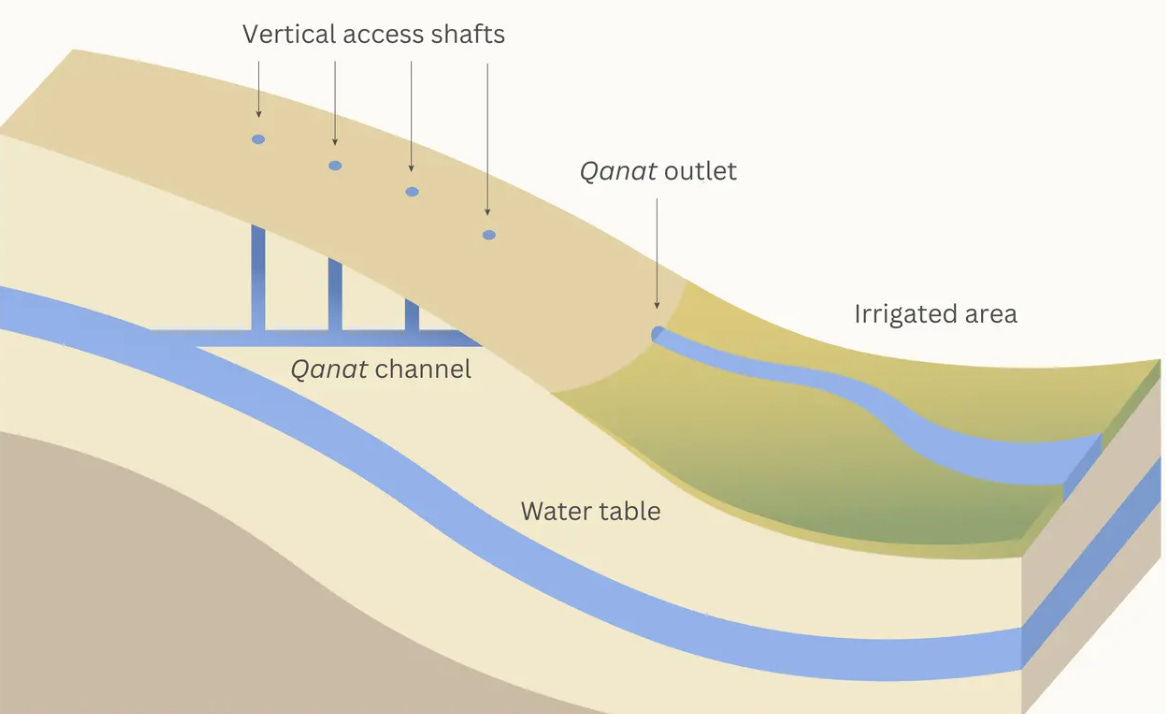
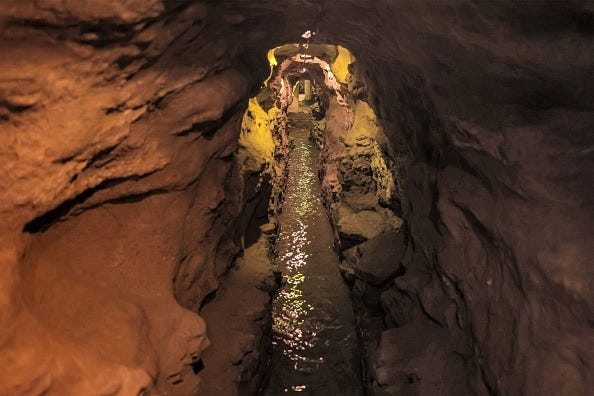
Traditionally, Iran has irrigated its land through shallow horizontal wells, or qanats, a sustainable water supply system that transfers water from highland to lowland through gravity and is replenished by the rain, according to the Yale School of Environment.
Today, large farms in Iran rely on deep ground wells, which overuse Iran’s water resources, causing significant portions of land to sink over 10 cm throughout the year.
But as this year’s rainy season starts, a new threat has emerged. Israeli attacks on Iranian oil depots in and around Tehran sent up massive clouds of carcinogenic fumes endlessly skywards.
Toxic chemicals from the explosion mixed with a storm that was already brewing. Sulphur and nitrogen compounds from the explosion could dissolve in the rain, turning it acidic, The Guardian reported.
Fereshte has written 3 books about community self-sufficiency. While the books focused on tourism, they also advised on finances, civic participation, and, of course, the environment.
There are two types of farms, Fereshte explained. There are the large-scale farms, which usually rely on deep underground aquifers to irrigate their crops, and small-scale, traditional farming, where farmers work with the environment.
The small farms take into account the rain and don’t over-plant. They choose seeds appropriate for Iran’s dry climate, and they sow them in March, the rainy season, rather than all year round.
These farmers rely primarily on the rain to water their plants, and they often supplement by using water from qanats, meaning they could be more vulnerable to polluted rain.
Following Israel’s strikes on fuel facilities, the World Health Organization warned that food, water and air could be contaminated by the fallout from the strike. Iran’s Red Crescent and the Iranian environmental agency also urged Tehran’s residents to stay home. Some people were wearing masks outside.
Fereshte believes that the farmers in places like Varamin in the lowlands of South Tehran, where the clouds over Tehran bring down rain, could be the most at risk. It is difficult to know with the area under a near-total internet blackout.
Iran’s health minister told Al Jazeera that soil and water surrounding Tehran are likely to also be contaminated.
The water from the south of Tehran is already so polluted that some people won’t even eat anything that comes from the area. Pollution from the explosion will only make it worse, Fereshte explained.
Fereshte, along with many experts, blames the Iranian government’s poor water management for its drought.
After the 1979 Islamic Revolution, the government promoted isolationist policies and encouraged Iranian farmers to grow water-intensive fruit and vegetables that are not native to the land.
The pressure to generate year-round harvest and meet the demands of larger cities led to the replacement of sustainable farming practices with wasteful management that has only worsened Iran’s drought, which shows no signs of slowing.
These farmers were in such a bad situation before the war, it’s almost difficult for it to get worse, Fereshte explained.
But still, she is worried that this war could deal the fatal blow. “I am worried they can’t resist anymore against the harsh situation they are in,” she said. “They immigrate to the cities. This will mean that this land will turn to desert.”
Editor’s note:
Grounded in local insight, our reporting tells stories that only human experiences from Iran can reveal.
Subscribe to see how this war is being felt in communities big and small. It’s free!
THE LATEST NEWS AT THIS HOUR:
By: Oleksandra Khelemendyk
RUSSIA ADVISES IRAN ON DRONE TACTICS: According to a Western intelligence official, Russia is helping Iran hit targets in the Middle East with advanced drone tactics developed during its war against Ukraine, CNN reported.
Ukraine’s President Volodymyr Zelensky warned that Russia could also help Iran with missiles, air defense and likely, boots on the ground, according to Pravda.
THREE SHIPS HIT IN HORMUZ STRAIT: Three vessels were struck by unknown projectiles in the Strait of Hormuz. The Thailand-flagged bulk carrier Mayuree Naree caught fire, and most of its crew was evacuated. Three crew members are missing.
At least 14 ships have been attacked in the Strait of Hormuz, where roughly 20 percent of the global oil and gas supply travels through. The major oil producer, Saudi Aramco, is rerouting some oil shipping through the port of Yanbu on the Red Sea. In the first nine days of March, exports there doubled compared to February.
SENATORS WORRY ABOUT GROUND FORCE IN IRAN: Democratic Senators Jeanne Shaheen and Richard Blumenthal expressed their concern that Donald Trump could deploy U.S. ground forces.
If that happens, Russia’s support to Iran with intelligence, as well as its close ties with China and North Korea, may threaten the U.S. national security and put American lives at risk.
U.S. TECH COMPANIES ARE POTENTIAL TARGETS: The Iranian state-affiliated Tasnim news agency published a list of legitimate targets, which includes the major American tech companies in the Middle East. Google, Amazon, Microsoft, Nvidia, IBM, Oracle and Palantir assets are included, with locations in the U.A.E. and Israel.
Previously, Iran attacked an Amazon data center in Bahrain and its facilities in the U.A.E.
PROTEST BANNED IN LONDON: British police banned the annual Al-Quds march in support of Palestinian liberation, organized by the Islamic Human Rights Commission. Police said the march could support the Iranian regime. This was the first protest banned under public order in the U.K. in over a decade.
The previous Al Quds marches have resulted in arrests for anti-Semitic hate crimes and supporting terrorist organizations.
AUSTRALIA SHUTS EMBASSIES IN THE MIDDLE EAST: Australia closed its embassies in Abu Dhabi and Tel Aviv, as well as the consulate in Dubai amid potential escalation of the war. Australian diplomats and their dependents are directed to leave Israel and the UAE.
When the war began, about 11,500 Australian citizens lived in the Middle East. More than 3,200 have returned home on commercial flights.
ROMANIA ALLOWS U.S. ACCESS TO ITS AIRBASES: Romanian President Nicusor Dan convened the country’s defence council, which let the U.S. aircraft use its Mihail Kogalniceanu air base to carry out operations in Iran.
Romania will host U.S. refueling planes, as well as surveillance and satellite communications equipment.
Stay safe out there!
Best,
Alessandra
Excellent and informative reporting.
Thank you for sharing stories we don’t normally get to hear. ❤️ Stay safe.