

At the bottom of this page: Latest news at this hour.
Iran war pushes U.S. inflation to three-year high… Trump looks to resume Iran war… UAE has been secretly attacking Iran… Iran lawmaker threatens possible high-level uranium enrichment… Mass starvation ahead if Hormuz Strait remains closed.

Featured subscriber comment:
“Thank you for this reporting. With the lack of internet in Iran the outside world doesn’t get to know much from the people.”
That’s what we’re here for, bridging the gap between people living through the conflict and readers like you who want to go beyond headlines to see the full picture.
Subscribe to support us in this mission!
OUR LEAD STORY:
YEREVAN, Armenia – In 2022, Kourosh* received official permission to leave Iran for 30 days. But when he left, he knew he wouldn’t be coming back.
“I can’t describe it, there was so much sorrow and pain. I was leaving a part of myself there, in my country,” Kourosh said, describing his departure from Iran.
Like many young men that leave Iran, Kourosh, now 28, was avoiding Iran’s mandatory military service.
Since the war started in Iran, attacks on Iranian military institutions and leadership have pushed the military to ramp up recruitment efforts.
At the beginning of April, when there was talk of the U.S. launching a potential ground invasion into Iran, Tehran sent out texts en masse and started advertising on state TV channels, calling on Iranians to “defend the country’s soil.”
Iranian military manpower has become so strained that a month into the war, a high-ranking commander in the IRGC announced a push for Iranians “aged 12 and over” to join. The campaign encouraged young recruits to take positions involved in collecting intelligence, patrolling checkpoints and carrying out minor unskilled tasks. It wasn’t long before a 11 year-old manning a Basij checkpoint was killed in an airstrike.
As the U.S. and Iran reject one another’s peace proposals and the two countries appear no closer to reaching a lasting peace, Iran’s bulking up its military, readying itself for a failed ceasefire. Mojtaba Khamenei has allegedly called the new recruitment campaign one of the key elements in “negotiations with the enemy.” Meanwhile Iran’s economy and quality of life only gets worse, pushing more Iranians to flee Iran and the mandatory draft.
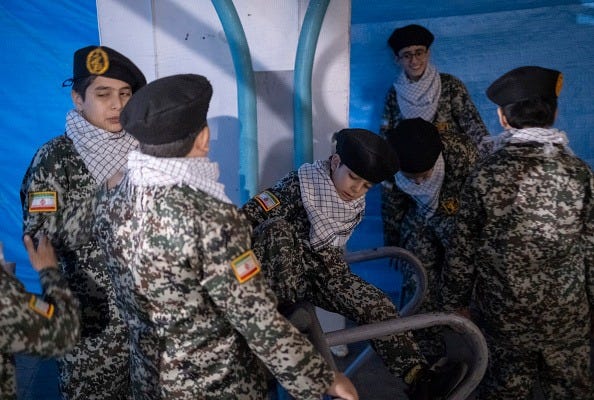
Currently, all male Iranian citizens over the age of 18 must serve for at least 14 months, which was reduced from 2 years in 2024. There are some exemptions, including men with two children over 35.
However, since recruitment efforts inside Iran have intensified, Iranians like Kourosh are finding it harder to evade the military draft.
“Nowadays, If you cause any trouble with the government or oppose the regime in any way, they will send you to the military for service again — that’s what I am hearing,” Kourosh said.
When Kourosh was 23 and in his last year of his bachelor’s degree in mechanical engineering – he started thinking about his future more seriously, but he felt unsure about what to do next. But when protests broke out in Iran, he started talking to an immigration lawyer about the possibility of moving abroad.
“I was very unsatisfied with the situation, I thought Iran wasn’t doing well, I was really disappointed in the Iranian government,” Kourosh explained.
But he quickly realized if he didn’t leave soon, he would be drafted, which could ruin his chances of ever leaving Iran.
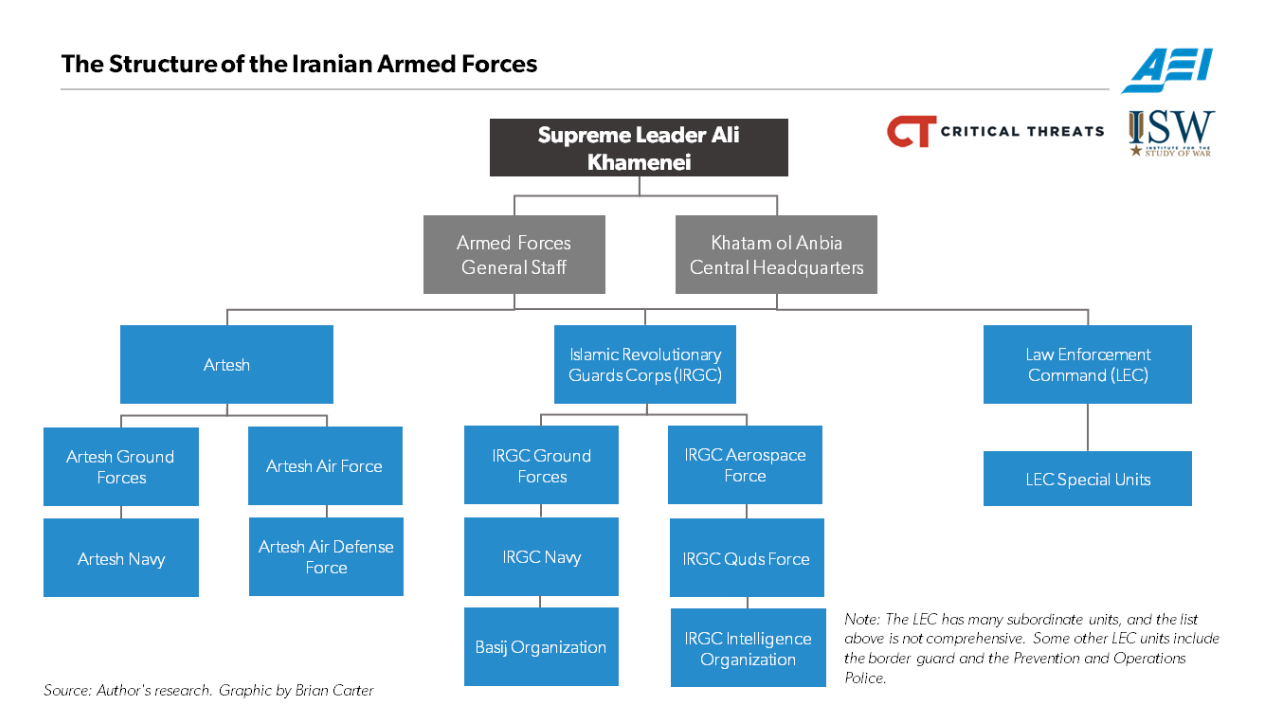
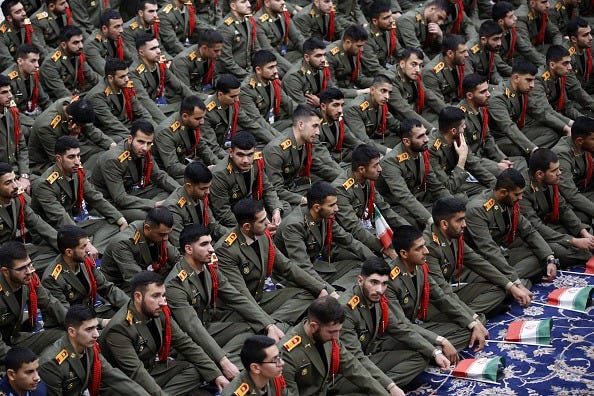
After an Iranian citizen is conscripted, he is required to serve in either Artesh or the Islamic Revolutionary Guard Corps (IRGC). Artesh is Iran’s conventional, national military, established during the Shah’s rule before the 1979 Islamic Revolution, while the IRGC was born out of a fear that the Artesh would not be loyal to the Islamic Republic.
The IRGC was created to serve the Islamic Republic, rather than the elected government, and is far more ideologically driven, often involved in Iran’s violent protest crackdowns.
In 2019, the U.S. blacklisted the IRGC as a terrorist organization, meaning that any Iranian who served in the IRGC, even before 2019, was now ineligible for a U.S. visa.
Kourosh wanted to join his younger brother who was living in America. But if Kourosh was drafted into the IRGC, he would never be able to travel to the U.S.
He had seen this happen to his own family members already. His uncle had been one of the 55,000 winners in the U.S. Green Card Lottery about 15 years ago, but was then rejected because he had previously been drafted into the IRGC, Kourosh said.
Evading the draft is, of course, illegal. In Iran it prevents you from being able to get government or official jobs, obtaining a driving license or a passport.
“If you evade the draft you have to live very, very quietly… If you run into trouble and get the police involved, they will arrest you and you will be sent to military service,” he said.
After talking to his lawyer, Kourosh devised a plan: he would leave university before his temporary exemption was over.
But leaving meant that Kourosh couldn’t return to Iran, as long as the current government was in power.
“If I return to Iran now, I will be arrested, then fined and sent to do military service. Then I won’t be allowed to leave Iran again until my military service is over,” Kourosh explained.
During his three years in Armenia, he converted to Christianity and even worked at one of the local churches. “I am just waiting for the time to get back to Iran freely,” he said.
The decision to leave home, his family, and his life in Iran was difficult, but the idea of serving in a military he couldn’t agree with was something he couldn’t stomach.
However, avoiding the military draft also comes at a cost.
“The military service is two years…you are giving two years of your life for nothing,” Kourosh said.
Saiid*, 27, moved to Armenia 8 months ago to avoid the draft in Iran and is now waiting to hear about his Canadian visa. His life, too, has been paused indefinitely: “Even if the war ends tomorrow and Iran becomes a safe place to live, I will still be 27 – all those years of waiting will be wasted, I can’t get them back.”
Kourosh knew what the cost of getting drawn into a war could be — he saw how it changed his father.
Kourosh had a difficult childhood, between being bullied in school and his family’s financial struggles. His relationship with his father was also difficult.
Kourosh’s father was drafted when he was 18 and fought as a ground soldier in the Iran-Iraq war. “He experienced a lot of horrible stuff. It really got into his head, and so when I was a child he used to beat me a lot,” Kourosh explained.
Kourosh grew up listening to stories about his father’s service.
One day during his military service, Kourosh’s father was driving with his unit in Iran’s Southwestern Khuzestan Province, near the Iran-Iraq border. Overhead, Kourosh’s father saw an enemy aircraft, but when tried to warn the rest of the group, nobody listened. It was then that the aircraft started diving down towards their vehicle.
Having seen the aircraft in advance gave Kourosh’s father enough time to jump into a ditch by the side of the road, where he landed on a bush full of thorns. The noise of the explosion was ringing in his head for hours after it happened, Kourosh explained.
It was incredibly painful but when he got up out of the ditch, he just saw a sea of bodies and realized he had been one of the lucky ones.
“He was one of the few people from his unit that had survived the attack…I think that experience in particular really messed him up,” Kourosh explained.
Despite everything Kourosh and his family have experienced, he is on a course to start anew in Germany.
“My first choice would still be the U.S., I have done so much to be able to go to the U.S., but it seems so out of reach now,” Kourosh said.
Despite the fact that Kourosh has risked never returning home to Iran and has learned English fluently in the hopes of getting a U.S. visa, the prospect of this happening looks even less promising than when he left Iran.
In 2017, Trump introduced a travel ban on several countries including Iran. Although Biden rolled back these restrictions in 2021, Trump reintroduced them in 2025, preventing Iranians like Kourosh from going to the U.S.
Kourosh is currently living in Yerevan, where he is studying German so that he can prepare himself for the German language exam needed to obtain a German visa.
He plans to finally finish his studies in Germany – the studies he fled to escape Iran’s military draft. But for now Kourosh feels his life is waiting to start again.
“While I’ve been in Yerevan, my life has been put on pause for now, I can’t start the next stage of my life,” Kourosh explained.
But for now, the only way is forward. Kourosh has passed the point of no return: he knows if he returns to Iran, his home won’t be the way he remembers it.
“I miss everything…but with this regime, everything is gonna get destroyed,” Kourosh said.
*Saiid and Kourosh’s names have been changed for security reasons.
Featured subscriber comment:
“Thank you for this reporting. With the lack of internet in Iran the outside world doesn’t get to know much from the people.”
That’s what we’re here for, bridging the gap between people living through the conflict and readers like you who want to go beyond headlines to see the full picture.
Subscribe to support us in this mission!
THE LATEST NEWS AT THIS HOUR:
By: Kateryna Antonenko
IRAN WAR PUSHES U.S. INFLATION TO THREE YEAR HIGH: As the Iran war has sent the global energy market into chaos, the skyrocketing price of gasoline has shocked the American economy: gas prices increased 5.4 percent in April, which is a 30 percent increase from 2025.
Overall, the increase is the largest rise in 12 months in the last three years.
TRUMP LOOKS TO RESUME IRAN WAR: President Trump is considering resuming combat operations against Iran more seriously than in recent weeks, CNN reported. Sources say the shift is driven by Trump’s anger over Iran’s handling of talks, including the continued closure of the Strait of Hormuz and what he views as a lack of genuine engagement from Tehran.
With diplomacy stalling, Trump said Monday that the ceasefire is on “massive life support.” Two images posted on Trump’s Truth Social on Tuesday appeared to show strikes on Iranian military assets, including an aircraft with an Iranian flag exploding and fast boats coming under attack at sea.
Meanwhile, the Iranian army spokesperson wrote on X that “no one in Iran is making plans to please Trump.”
There are differing views within Trump’s administration on the matter, according to CNN. Some officials, including within the Pentagon, are advocating a more aggressive strategy that could involve targeted strikes to pressure Tehran back to the negotiating table, while others continue to favor keeping diplomatic channels open.
UAE HAS BEEN SECRETLY ATTACKING IRAN: The United Arab Emirates has begun covertly striking Iranian targets, the Wall Street Journal reported, citing sources familiar with the matter.
The UAE has not publicly confirmed the strikes, but people familiar with the matter say one of them hit a refinery on Iran’s Lavan Island in the Persian Gulf. The attack is said to have taken place in early April, coinciding with President Trump’s announcement of a ceasefire after a five-week air campaign.
IRAN LAWMAKER THREATENS POSSIBLE HIGH-LEVEL URANIUM ENRICHMENT: A senior Iranian MP, Ebrahim Rezaei, said Tuesday that Iran could consider enriching uranium up to 90% purity, levels widely seen as weapons-grade, if it is attacked again.
In a post on X, Rezaei, who serves on the Iranian parliament’s National Security and Foreign Policy Commission, said such a step would be among the options under review by lawmakers in the event of further escalation.
MASS STARVATION AHEAD IF HORMUZ STRAIT REMAINS CLOSED: Disruptions in the Strait of Hormuz could lead to a large-scale humanitarian crisis due to their potential impact on global fertilizer supply chains, through which roughly one-third of global flows pass, The Guardian reported, citing a United Nations official.
Jorge Moreira da Silva, Executive Director of the UN Office for Project Services (UNOPS) and head of the task force, stated that there are only a few weeks to prevent mass famine and the starvation deaths of approximately 45 million people. Back in April of this year, the UN had already warned that the blockade of shipping in the Strait of Hormuz poses a severe threat to global food security.
Stay safe out there!
Best,
Alessandra