

At the bottom of this page: Latest news at this hour.
Israel claimed it killed Iran security chief and Basij commander… U.S. general leaves classified material on train… Iraq warns Kurdistan over oil dispute… Greece says Europe will not join military action… projectile near U.S. Embassy intercepted in Baghdad… UK petrol prices hit 18-month high… civilians in Iran suffer during Nowruz… Iran negotiates with FIFA to move world cup games to Mexico.

Editor’s note:
Our human-interest stories aim to tell you how this war, however far away from where you’re sitting, impacts you.
Appreciate our work? Subscribe now. There’s nothing stopping you!
OUR LEAD STORY:
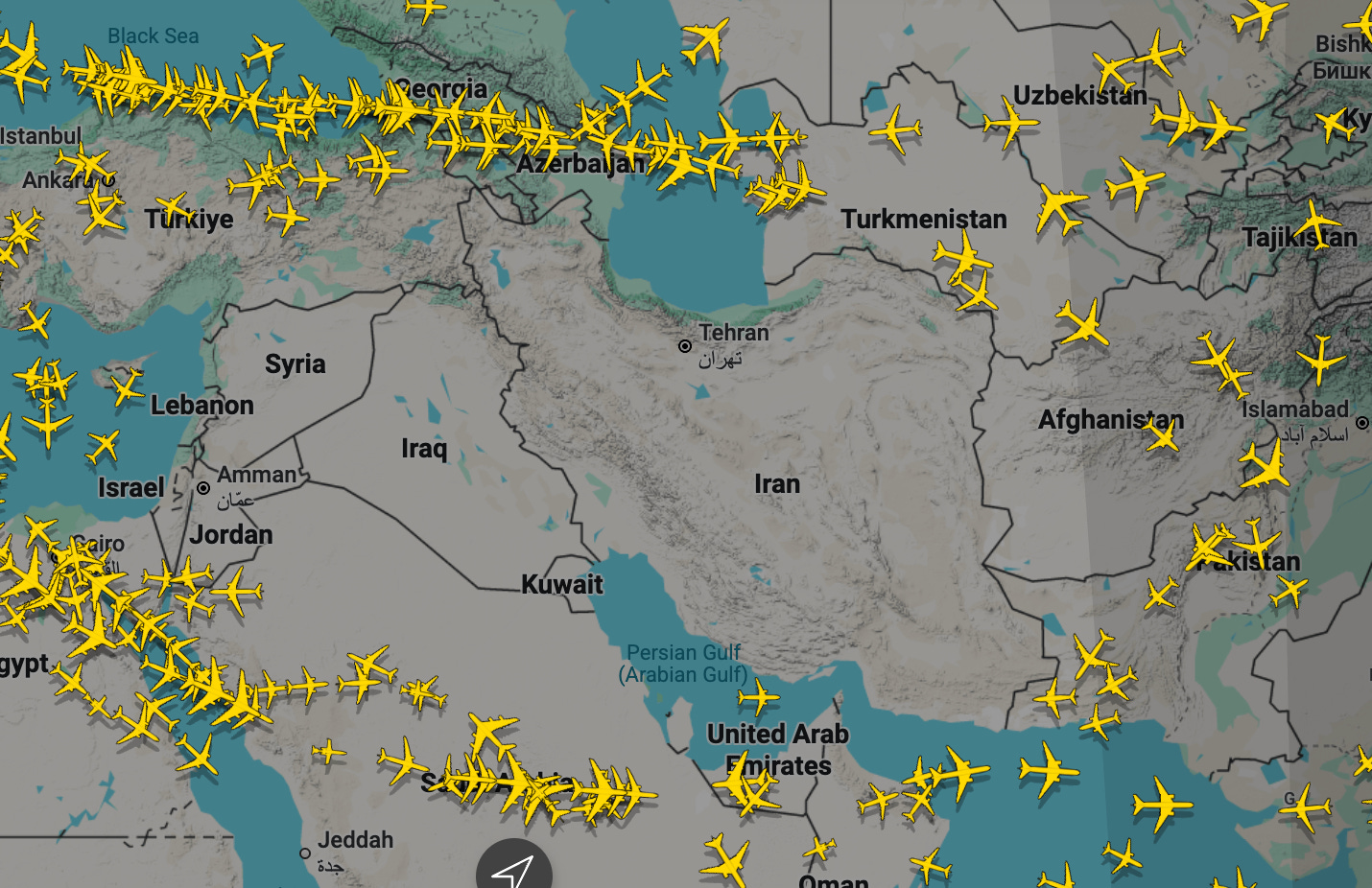
Through flight tracking, you can see a scar in the sky – a zone where civilian aircraft dare not venture.
On tracking websites like Flightradar24, the entire map of the second-largest country in the Middle East is barren of the usual little yellow plane icons. Iraq is mostly blank too, as is Syria, Lebanon, Israel, Jordan, and Kuwait. The UAE depends on the day.
If you zoom in on an individual flight, you might also see something stranger — jagged squiggly flight paths that look more like an EKG monitor than an airplane route. That’s GPS spoofing, and it’s one massive part of this war that will affect all of us.
The night the United States and Israel launched their first strikes on Iran, visitors to Flightradar24’s site doubled said Ian Petchenik, their director of communications and long-time aviation expert.
On March 16, a drone attack near Dubai International Airport forced flight disruptions for the third time since the war began, not to mention the wave of strikes across the Middle East that has shut down airspace from Iran to the Gulf.
As millions of people watch the Iran war unfold on flight-tracking maps, they are seeing something unusual: aircraft positions jumping, zigzagging, and disappearing.
These distortions are largely caused by GPS spoofing, the deliberate transmission of fake GPS signals designed to make devices think they are somewhere else.
This technology, which is used to confuse drones and missiles, is now inadvertently disrupting the GPS trackers that we use every day — from civilian planes to tracking a shipment to Google Maps.
“The amount of GPS spoofing has taken on a life of its own,” said Ian.

For Ian, major world events are visible first in the sky. He grew up in a house about two miles from the tarmac at Chicago O’Hare International Airport, where planes were constantly flying overhead. As a kid, he always wondered where each one was coming from or flying to, and before flight-tracking sites existed, that meant digging through printed airline timetables and studying in-flight magazines.
Ian later worked in academia before dabbling in aviation journalism, and when the opportunity to work at Flightradar24 came up, he jumped at it.
It’s not just people like Ian who follow flight paths online. When Queen Elizabeth II’s coffin was flown from Edinburgh to London, 6 million people logged on to follow it.
“It’s been really interesting to see not just Flightradar24, but flight tracking geekdome become much more mainstream,” Ian said.
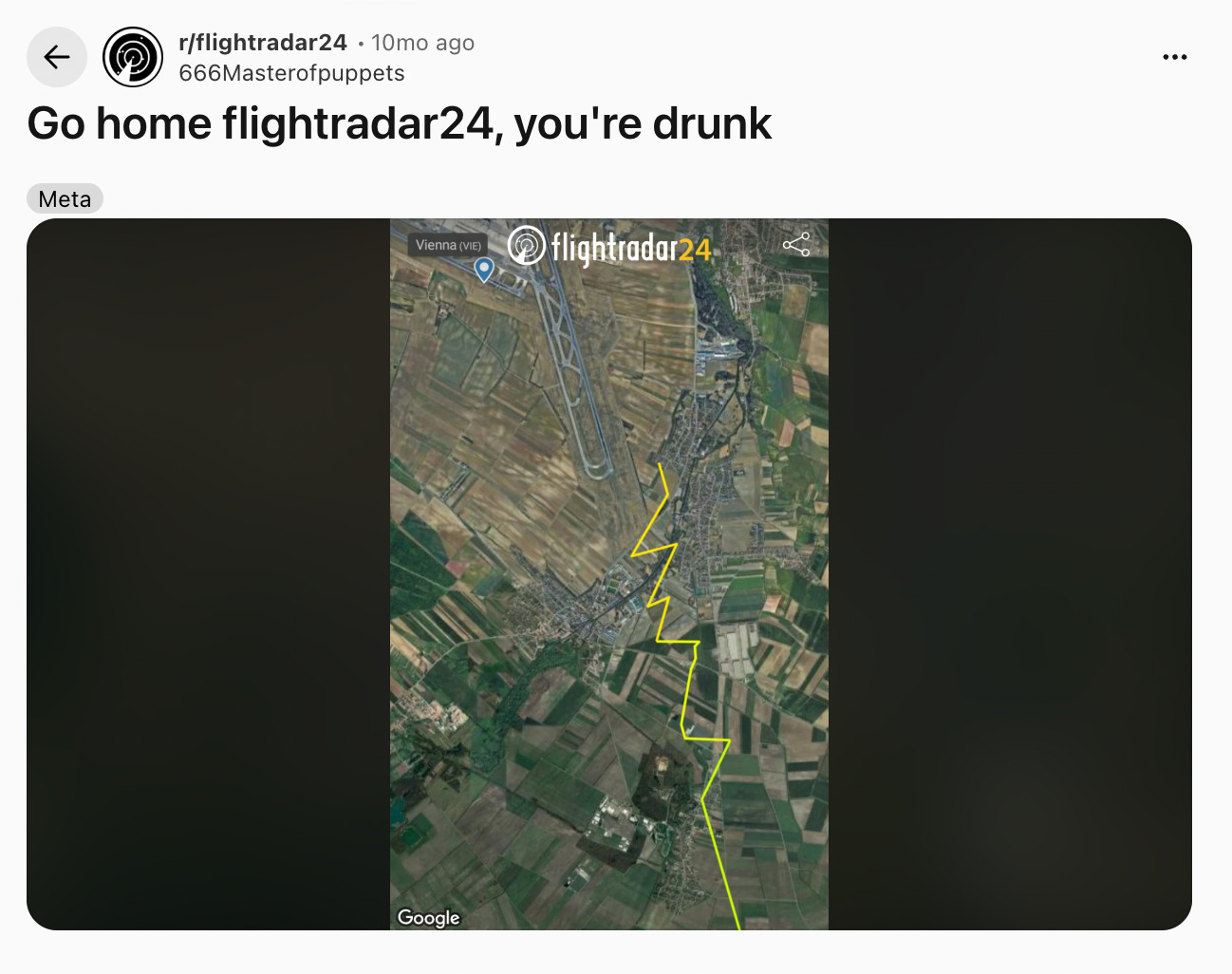
That wider audience has also turned strange flightpaths into a viral joke online. A popular meme shows a chaotic, zigzagging flight path with the caption, “Go home Flightradar24, you’re drunk.” But those strange lines are often the result of GPS spoofing, and it might be less funny than the meme implies.
One weapon that relies on GPS technology to hit targets is the Iranian-designed Shahed drone. These one-way ‘kamikaze’ drones, which Russia uses often in Ukraine, are playing a large part in Iran’s retaliation against American strikes.
Shahed drones use cheap, off-the-shelf technology to know a target’s position and fly there, Ian said. Spoofing tries to mitigate accuracy by giving bad information to those weapons.
“If the weapon doesn’t know where it is or where the thing it wants to hit is, it’s more difficult,” he said.
GPS interference is not brand new — Ian has seen tons of it in Russia and Ukraine, and it has been creeping into modern warfare for years. “It was hugely influential over the Mediterranean during the war in Gaza, and now we’re seeing some really funky stuff as governments try to mitigate the use of GPS-enabled weaponry,” he said.
That “funky stuff” refers to completely unrealistic flight paths — like a plane flying in impossibly small circles at an impossibly low speed at an impossibly high altitude, Ian explained.
As this war in Iran is being fought through signals, everyone gets impacted, because everyone relies on those signals.
GPS interference is scrambling ship tracking in the Persian Gulf, delivery apps in big cities, and even everyday navigation. Ian heard from one man in Dubai who watched his food delivery driver appear to drift into the ocean on his map.
Passengers sometimes notice spoofing mid-flight, when the little seat-back tracker suddenly shows the plane jump across the screen. In the cockpit, pilots may have to switch to backup navigation methods to confirm their position, but it has not posed a safety risk, according to Ian.
“The flight’s perfectly safe. It’s just a really, really big annoying thing to have to deal with.”
Flight trackers can work around GPS problems by relying less on GPS and instead calculating an aircraft’s position based on how long it takes its signal to reach different ground receivers.
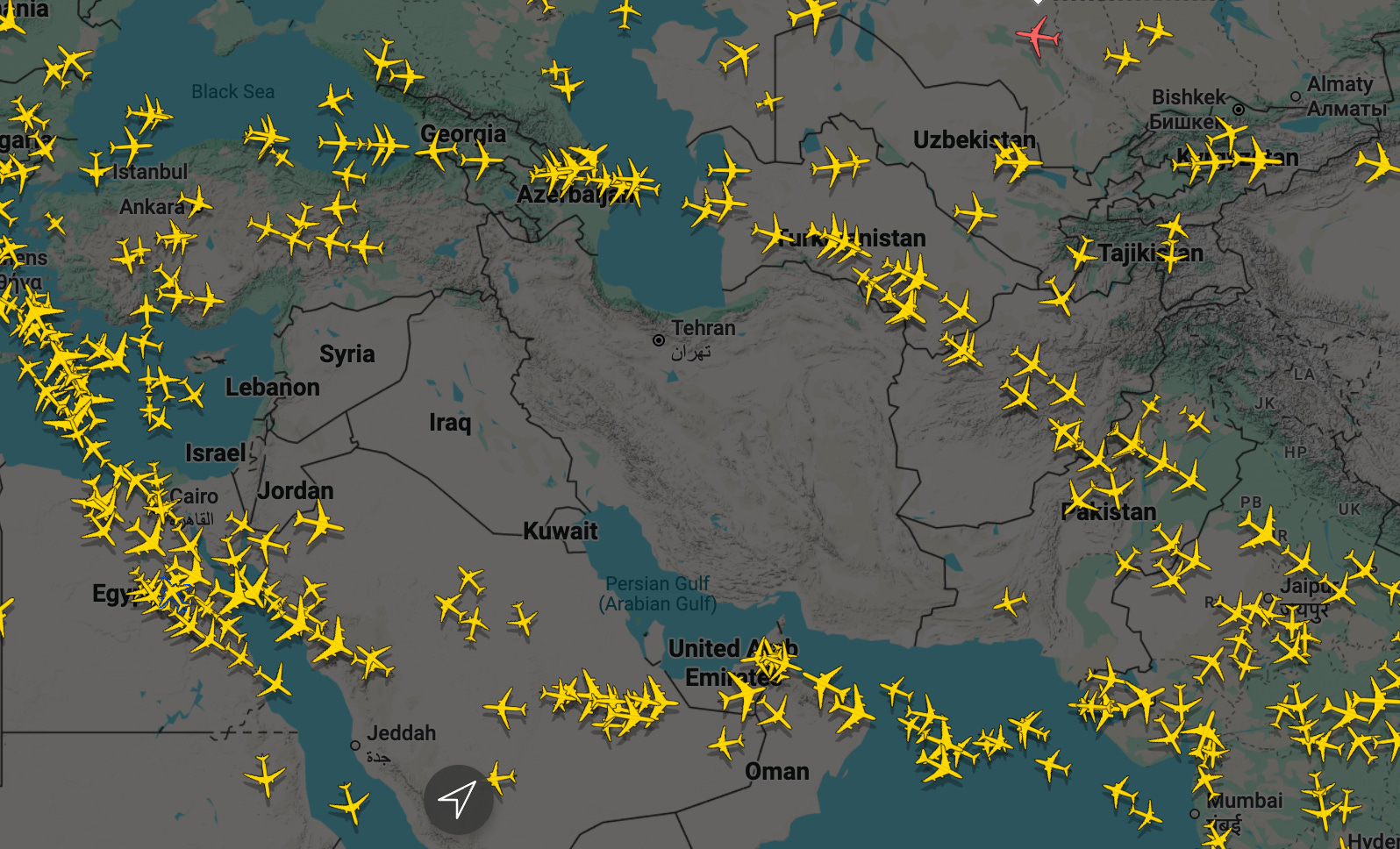
Workarounds mean flights can keep operating even as the signals around them turn noisy, but usable airspace in the Middle East is still shrinking, forcing planes into narrower and narrower corridors along the edge of the conflict zones.
One recent strike near an airport in Azerbaijan briefly shut down part of the country’s airspace, tightening an already-limited pathway that runs through the Caucasus.
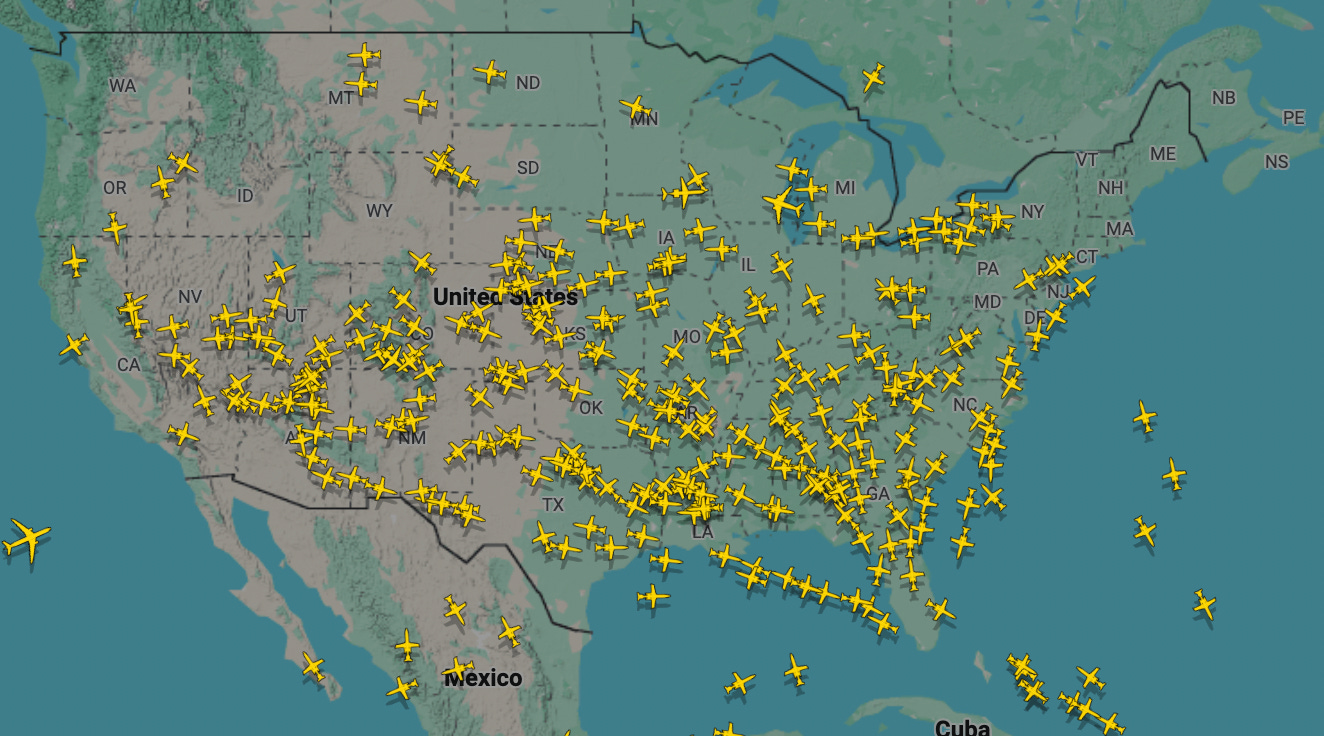
Nowadays, those little yellow plane icons over the Middle East look like ants chasing a common breadcrumb — all in a line, pointing the same direction. The map looks less like the scattered chaos you see over North America and more like a handful of lines squeezed between large empty spaces.
Though airspace closures feel endlessly chaotic, people at Ian’s company know this game all too well. “We’ve unfortunately become adept at managing a situation like this from previous experience. When there are strikes in the Middle East, we know what to look for now,” he said.
But the more interference there is, the stranger the sky looks, which is actually good for Ian’s business.
“Any time something looks weird, that’s gonna be more interesting to people,” Ian said.
And in the past two weeks, things have looked awfully weird.
Interest in flight tracking tends to spike during major world events — like that Queen Elizebeth II flight, or when Russian opposition leader Alexei Navalny flew back to Moscow after recovering from poisoning.
For someone like Ian, he remembers these major world events through aviation. He can picture himself standing at his kitchen island when he found out the U.S. would be closing off to international airtraffic during the pandemic.
“I knew something major was happening, and began to formulate how we could best understand what was happening and convey that information to our users and to the public,” he said.
He says the pandemic was a big moment in public interest in flight tracking, too. With so many stuck inside, the idea of a plane going somewhere triggered curiosity, envy, or even judgement .
“People were discovering the wonder that is the sky above them, and how busy it is, and how much stuff is up there,” Ian said.
That’s especially true during wars, and part of his job is converting misinformation about flight data that is interrupted by GPS spoofing into lessons on aviation.
Part of the appeal, he thinks, is that the map is visual and immediate. Instead of reading about disruptions, users can watch them happen in real time.
“The broadening of the aviation community has been super interesting to me, and how folks have embraced flight tracking specifically, but just aviation more generally, because it’s playing a larger role in how they understand the world.”
You don’t have to be near the front line to see this war in Iran unfold – you just have to open a flight map.
*Correction: The date of the recent attack on Dubai’s airport has been changed to March 16. We apologize for the error.
Editor’s note:
Our human-interest stories aim to tell you how this war, however far away from where you’re sitting, impacts you.
Appreciate our work? Subscribe now. There’s nothing stopping you!
THE LATEST NEWS AT THIS HOUR:
By: Anastasiia Lutsenko
ISRAEL CLAIMED IT KILLED IRAN SECURITY CHIEF AND BASIJ COMMANDER: Israel said it killed senior Iranian official Ali Larijani and Basij commander Gholamreza Soleimani in strikes. Iran has not confirmed this.
If true, Larijani would be one of the highest-level figures killed in the war so far. Israel says it is continuing attacks on Iran’s military and infrastructure.
U.S. GENERAL LEAVES CLASSIFIED MATERIAL ON TRAIN: Maj. Gen. Antonio Aguto, overseeing U.S. support for Ukraine, left classified maps on a train to Poland and suffered a concussion after heavy drinking in Kyiv, a Pentagon report said. The maps were recovered by the U.S. Embassy the next day. Aguto accepted responsibility, and medical exams confirmed his injuries.
IRAQ WARNS KURDISTAN OVER OIL DISPUTE: Iraq warned the Kurdistan region it may face legal action for blocking oil exports through a pipeline to Turkey, as regional tensions grow during the Iran war.
Baghdad said this breaks the constitution, while Kurdish authorities refuse to resume exports until new customs rules are removed.
GREECE SAYS EUROPE WILL NOT JOIN MILITARY ACTION: Greek Prime Minister Kyriakos Mitsotakis said Greece and other European countries will take part in military operations near Iran, despite US requests for allies to send ships to reopen the Strait of Hormuz.
Mitsotakis emphasized that Europe should focus on the economic impact of the Iran conflict, such as rising oil prices and trade disruptions, rather than military engagement. He also noted that existing EU missions, like Aspides in the Red Sea, will not be redirected to the Strait of Hormuz.
PROJECTILE NEAR US EMBASSY INTERCEPTED IN BAGHDAD: Air defenses engaged a projectile near the US Embassy in Baghdad early Tuesday. Videos geolocated by CNN show anti-air rounds, likely from US C-RAM systems, intercepting what appeared to be a drone.
Embassy officials confirmed prior drone attacks over the weekend. Iraqi authorities noted the area includes the embassy, Majnoon oil field, and Al-Rasheed International Hotel.
UK PETROL PRICES HIT 18-MONTH HIGH: Fuel prices in the UK reached their highest level in over 18 months, with unleaded petrol at 140.28 pence per liter and diesel at 158.78 pence. The surge comes as the US-Israel war with Iran disrupts oil trade through the Strait of Hormuz, pushing Brent crude above $100 a barrel.
The government is pressuring petrol retailers and energy suppliers to limit price rises, while support measures are in place for low-income households. Domestic energy bills remain capped until July.
CIVILIANS IN IRAN SUFFER DURING NOWRUZ: The International Committee of the Red Cross (ICRC) said civilians in Iran are facing a heavy toll amid ongoing attacks. Homes and essential infrastructure have been damaged, schools are closed, and many businesses have temporarily shut down.
Normally a time for Nowruz celebrations, families are now attending funerals. ICRC teams and the Iranian Red Crescent are on the ground providing aid, but staff have also been affected.
IRAN NEGOTIATES WITH FIFA TO MOVE WORLD CUP GAMES TO MEXICO: Iran’s football federation is discussing with FIFA the possibility of moving its first-round World Cup matches from the United States to Mexico. The decision follows President Trump’s warning that the Iranian team should not travel to the tournament “for their own life and safety” amid the ongoing Middle East conflict.
Iran is scheduled to play New Zealand, Belgium, and Egypt in the US, with its team base in Tucson, Arizona. The Iranian embassy in Mexico said the move would ensure the team’s safety and criticized the US government for lack of visa and logistical support. FIFA has not yet commented.
Stay safe out there!
Best,
Jacqueline
“Greece and other European countries will NOT take part”
A no brainer that FIFA should move games from the US. It was a dumb move to have them there in the first place. I read about the Ig Science contest leaving the US for Europe for the safety of participants and journalists.
I am in the EU and I am hoping the EU stays out of the war.