

At the bottom of this page: Latest news at this hour.
Trump halts strikes on Iran... Ukraine strikes Iranian vessels... Global protests against U.S. strikes on Iran.

Editor’s note:
Each week we talk to real people who help us understand the answers to existential wartime questions. Original, independent reporting is hard to come by these days. Subscribe for free to get it delivered in your inbox.
We need your help to keep reporting these hard-to-get stories. Will you upgrade today?
OUR LEAD STORY:
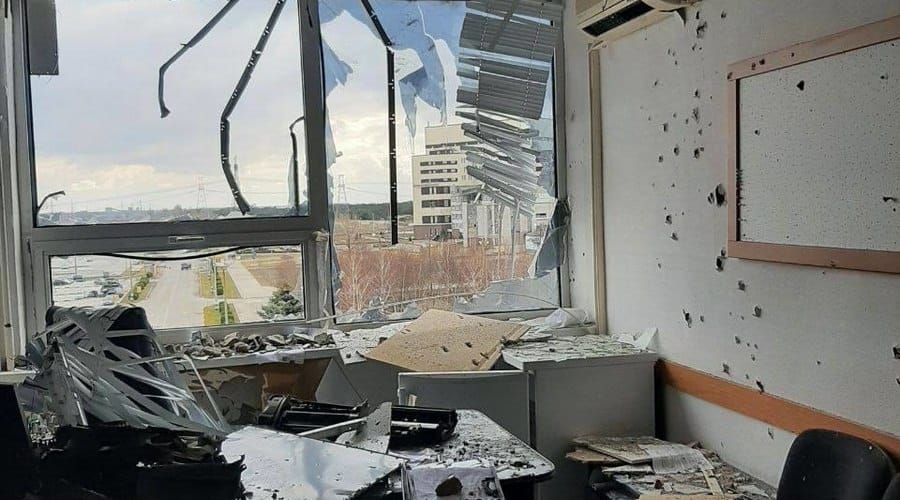
KYIV, Ukraine – Oleksandr was a nuclear engineer at the power plant in Zaporizhzhia when Russian troops encircled it in early March 2022. The plant sat just a few hundred kilometers north of Russian-occupied Crimea, which meant that Russian forces were able to move to capture it within days of the full-scale invasion.
Before 2022, the engineers at Zaporizhzhia Nuclear Power Plant (ZPNN) — the largest in Europe — weren’t revving up for an invasion. They knew what to do without electricity and were prepped for natural disasters, but a full-on occupation of their plant? Not something they’d prepared for.
Then, Oleksandr said, normal life became full-scale war in just seconds. “Imagine being in Washington, DC, and getting dropped in the middle of Donbas.”
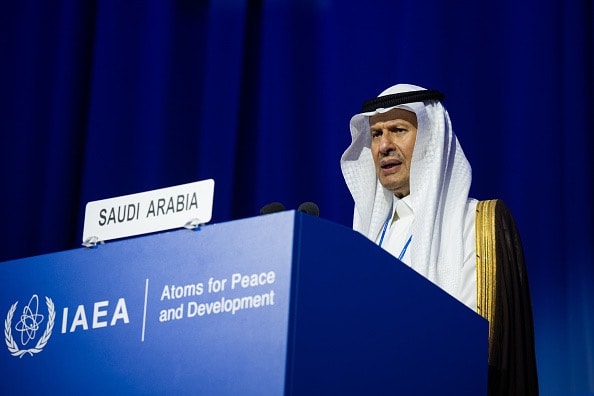
Spreading nuclear infrastructure around the world is both a promise and a gamble. The U.S. president just signed a 30-year agreement that allows Saudi Arabia to use American technology to establish a civilian nuclear program. The next day, Trump globbed on the condition that Saudi Arabia must recognize an Israeli state.
A likely knee-jerk concern is to wonder if what starts as a civilian nuclear program could pave a smooth path toward further enrichment and, down the line, a bomb. After all, enriching the same batch of uranium from 3 percent to 90 percent can bring it from civilian to military-ready.
But there is another fear, which Oleksandr knows well. Developing a civilian nuclear program is no simple task, and to do it in a country under fire is a different order of risk. Since the U.S. and Israel struck Iran in February, Saudi Arabia has been absorbing Iranian strikes. Last week, the Iran-backed Houthis in Yemen declared a naval blockade of Saudi ports, and this weekend, Houthis claimed an attack on an oil refinery in Saudi Arabia in response to Riyadh’s strikes on Houthi targets in Yemen. Tensions are cresting, though U.S.-allied Saudi and Iran-backed Houthis have been in conflict for decades.
As countries around the world turn to nuclear power for energy security and lower emissions, Oleksandr’s experience raises a question that extends far beyond Saudi Arabia: can a country safely build nuclear power in a place where peace can’t be assumed?
Oleksandr followed his family into the nuclear energy business — a natural step for someone from Enerhodar, a city in Zaporizhzhia whose name combines the Ukrainian words for ‘energy’ and ‘gift.’ From 2003 to 2008, he studied to be a nuclear engineer in Crimea at a specialized university.
After graduating, he went to work at the Zaporizhzhia Nuclear Power Plant, home to six nuclear reactors: the largest plant in Europe.
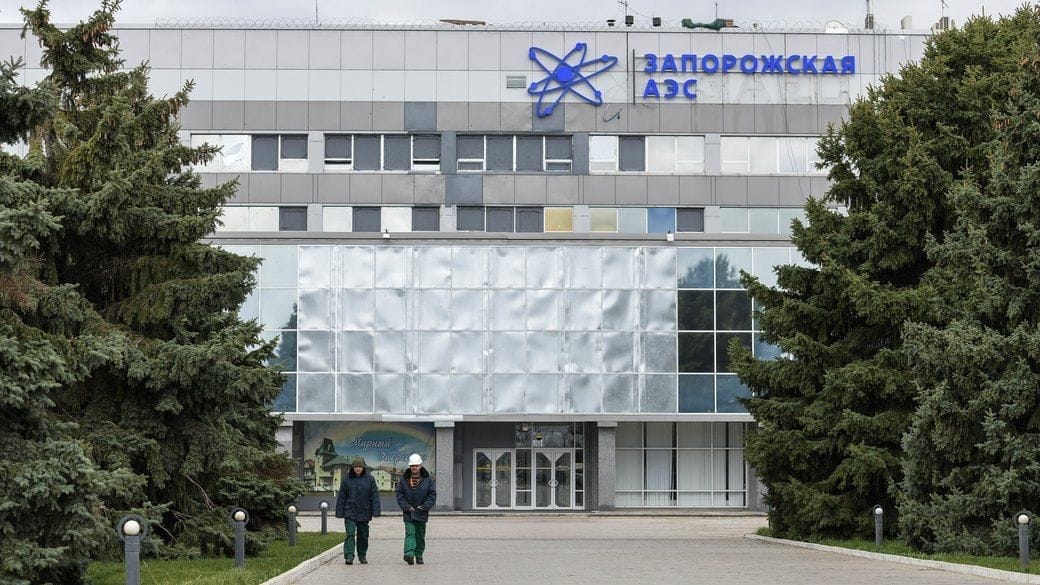
When Russia launched its full-scale invasion into Ukraine on February 24, 2022, Oleksandr’s instinct was to stick around, despite personal risk, for the sake of the power plant. “We were needed there,” he said. “We understood that. Most of my colleagues left, but I stayed because I knew there could be a future.”
Days later, he was on rotation, driving in to swap shifts with a crew that had been working 28 hours straight, he said.
“We started to drive up. First, a bunch of military equipment. Then, smoke and fires,” he said.
The Russians were showing a peculiar restraint.
“First they encircled it, and they were waiting as if they were waiting for a command,” Oleksandr said.
When Russian troops did eventually take the plant, they took the workforce with it. The Russian military marked them all up in a database — where everyone lived, where everyone worked.
“The workers felt panicked and lost, as did the management,” Oleksandr recalled. “No one knew what would happen.”
The plant kept running under occupation for months, during which Kyiv and Moscow accused each other of risking nuclear disaster as the plant continuously came under fire. Oleksandr remained a member of an operating control unit.
But in early September 2022, Russian shelling cut the plant’s connection to Ukraine’s grid, shutting down the last working reactor.
Oleksandr said he got word from the capital that workers at the plant should flee the occupation if they could.
And so, he tried. Five times.
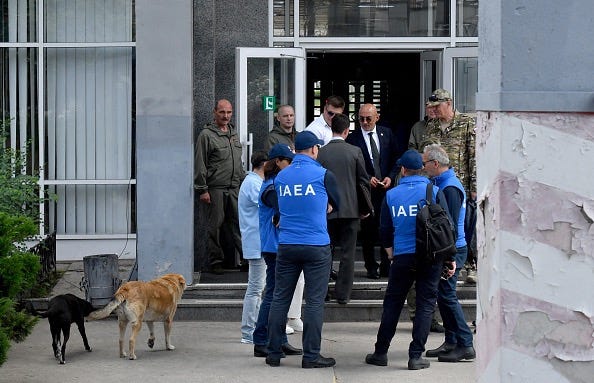
On his birthday on December 7, the fifth attempt, he finally made it out to the city of Zaporizhzhia, which he said was pure luck. He had to pass fifteen Russian checkpoints, only managing to escape because, on that day, the International Atomic Energy Agency (IAEA) was visiting the power plant.
He spent a night with a friend in Zaporizhia, celebrated his birthday at a small cafe, and headed straight to Kyiv the next morning.
The Russian-occupied ZNPP still struggles to function — on July 24, 2026, its water supply, necessary to cool reactors, was partially cut off due to nearby Russian attacks. In May 2026, the plant was without internet access for about 12 hours, likely correlated to attacks near Enerhodar. The IAEA can’t properly rotate its staff in and out due to obvious security threats.
What ZNPP makes clear is that wartime conditions threaten a nuclear program far beyond the risk of a missile hitting it. In March 2022, the IAEA laid out ‘seven indispensable pillars’ for keeping a nuclear facility safe during armed conflict. Only one of them is about the building. The rest concern staff safety, communication, off-site power supplies, and radiation monitoring.
Beyond what’s in the IAEA’s control, the emotional tax of war, or even the threat of violence, raises concerns over increased human error — a danger Ukraine faced in the harshest way during the 1986 Chernobyl disaster.
Zaporizhzhia has six reactors. Chernobyl had four. Oleksnadr thinks a nuclear catastrophe at ZNPP would cause a disaster of 100 times the scale.
To this day, Oleksandr worries about people incorrectly turning reactors on or misunderstanding the technology he helped build.
The idea of a nuclear disaster haunts him. Come springtime, he grows paranoid—superstitious because three of the world’s worst nuclear accidents happened in early spring. The Three Mile Island Accident in March 1979. Chernobyl in April 1986. Fukushima Daiichi in March 2011.
“It’s some kind of numerology. It scares me,” he said, though he doesn’t believe there’s any real seasonal correlation.
Oleksandr is now the lead engineer at the South Ukrainian Power Plant, where he’s been working since September 2025.
There are now procedures for air alerts and for losing power that were written during the war, he said. War should not mean complete nuclear avoidance — there is a way to build nuclear infrastructure with caution.
In Saudi Arabia, as in Ukraine, taking a step toward nuclear energy could be hugely advantageous. Though the word ‘nuclear’ will always carry the disturbing weight of the atom bomb, using nuclear fission to provide energy alternatives brings a low-emission option to generating mass amounts of energy, which Saudi Arabia, an oil-dependent economy, could really benefit from.
The U.S. is weighing the very real risk of proliferation down the line against the also very real risk that if it doesn’t move fast, an adversary — China or Russia — will. Put simply, it’s the same logic parents use to let their child drink under their own roof: better to set the rules than to pretend it won’t happen somewhere worse.
“If for Saudi Arabia the Russians were building that power plant, I would be concerned,” Oleksandr said, adding that he trusts the Americans to provide safe infrastructure. For Saudi Arabia, that project means a cheaper energy source and more exposure to the proper, up-to-par, latest in nuclear technology.
At this point, Saudi Arabia and the Houthis have been in conflict for more than a decade, and nothing about a deal like this moves quickly: when the UAE signed its own 123 agreement with Washington in 2009, its first reactor didn’t reach the grid until 2020. Whatever Saudi Arabia builds, it will be building through the 2030s, but in a region more often at war than not.
Which is why Oleksandr’s answer is not the one you’d expect. The rockets and the drones, he says, are a solved problem, solvable at the design stage, depending on the type of reactor.
“If the building is done properly, if that power plant will also include air defense, or if those reactors are underground, there are no concerns,” he said.
Editor’s note:
Each week we talk to real people who help us understand the answers to existential wartime questions. Original, independent reporting is hard to come by these days. Subscribe for free to get it delivered in your inbox.
We need your help to keep reporting these hard-to-get stories. Will you upgrade today?
THE LATEST NEWS AT THIS HOUR:
By: Oleksandra Poda
TRUMP HALTS STRIKES ON IRAN: On July 25, for the first time in almost two weeks, the U.S. did not strike Iran. According to Axios, after thirteen consecutive days of approving strikes on Iran, Trump rejected plans to attack the country, following a meeting between Trump and his top advisers and cabinet members on Friday.
Iran, in response, halted its strikes on Gulf states and U.S. interests in the region in response to a two-day pause in American strikes on Iran.
The New York Times had previously reported that the U.S. is concerned about the pace at which its already depleted stockpile of Patriot interceptors and other air defense systems in the Middle East is being exhausted.
UKRAINE STRIKES IRANIAN VESSELS: On July 25, Zelenskyy announced that Ukrainian forces achieved “very strong results” during long-range strikes in the Caspian Sea, including “military cargo shipments involving Iran.”
Iran said that a commercial vessel was among those hit, and that a crew member was killed as a result of the strike. Iran’s Foreign Ministry described the strike as a violation of the UN Charter and summoned Ukraine’s charge d’affaires in Tehran.
Iran has been supplying Russia with Shahed drone components and related technology via the Caspian Sea. Iran has denied involvement in supplying weapons to Russia.
GLOBAL PROTESTS AGAINST U.S. STRIKES ON IRAN: On July 26, anti-war demonstrators gathered in several countries. In the UK, protesters held a rally outside the gates of RAF Fairford — a base hosting U.S. Air Force personnel. In South Korea, rallies took place in Seoul, where protesters displayed Iranian flags and placards that said “Shame on You”, opposing the South Korean government’s involvement in the conflict.
The protests in the UK and South Korea are part of a broader wave of anti-war demonstrations that have swept France, the Netherlands, Australia, and the United States, where opposition to the conflict has grown significantly following the first reports of American casualties in Jordan on July 17.
Stay safe out there!
Best,
Jacqueline